Understanding India’s neutrality on Russia and Ukraine

Russia’s Putin meets with India’s Modi in 2018 – Russia has consistently supported India over Pakistan and China

India has taken a lot of criticism for not joining in global criticism of Russia over the invasion of Ukraine.

In the drama of conflict, few take time to think – but India perhaps deserves you taking a moment to reflect on why it has taken a neutral stance.

At the very centre of India’s position is that in face of border challenges with China, it needs its defence partnership with Russia to continue.

Interesting that almost all western leaders recognise this strategic dilemma.

India is an important part of the move to balance China in the Indo-Pacific, so it is vital to understand their position.

Few are aware that for all of its democratic and independent life, India has been very close to Russia. It is a long standing relationship.

India is now the only Quad country to have not called Russia out by its name let alone by imposing economic sanctions.

But the other three nations in the Quad know that India’s defence relationship with Russia could be described as its “most valued partnership”, as a recent Lowy Institute paper put it.

How important is Russia to India?  A whopping 86% of Indian military hardware is of Russian origin – and this hardware is central to India’s ability to stand up to China over longstanding territorial disputes.

In 2018, India signed a US$5 billion deal with Russia to buy the S-400 missile defence system. Trump warned India that it might impose sanctions – so far, no sanctions have arisen.

And don’t forget Russia has been the only country to support India over decades of problems with Pakistan. In 1971 when India and Pakistan fought for 13 days, Russia was the only country to help India – no western country provided support. The USA ignored Delhi’s please for help over East Pakistan as it then was.

You could see this as an “over reliance” on Russia, but don’t forget it has been close to Russia since the first Prime Minister Nehru took office – and it is only recently that it has become involved closely with countries like the USA, Japan and Australia.

India’s position on Russia and problems with China were somewhat challenged by the recent Russia-China joint statement, pledging that “there are no ‘forbidden’ areas of cooperation”. India is no doubt seeking to understand what this means – and in such a fast changing environment, is even more unlikely to call our Russia over Ukraine.

With the brutality and horror of the war on Ukraine now clearly visible, whether India will change its neutrality stance remains to be seen.

But hopefully the above information has helped you understand India’s position.

Can Indian Ocean nations move towards OPTIMISM and away from fear and negativity?

Could the nations of the Indian Ocean region combine to put their focus on OPTIMISM as a replacement for rampant negativity, fear politics and division?

What a contrast this would be to the so-called “Indo-Pacific Region” which seems to have one negative driver – containment of China.

Debate has started in Australia which “needs a new narrative and new thinking from the top,” according to the Centre for Optimism which has released a six-point plan for government and industry to adopt to boost their capabilities with a positive, uplifting mindset and optimistic leadership focused on collaboration, participation, and transparency.

What is wrong with the current narrative?

The Centre’s founder Victor Perton said the current national narrative is framed in old behaviours – state-federal squabbling over policy and service responsibility, hand-outs addressing market failures, institutional inertia, and short-run responses to crises.

I would add that our politicians are disconnected, use fear and manipulate the electorate through division and hostility.

The World Economic Forum recently warned its members, including Australia, that the contemporary “lack of optimism could create a vicious cycle of disillusionment and social unrest.”

Mr. Perton said that with Australia coming out of COVID lockdowns, people’s lives have changed, and people expect their governments to learn the lessons too. “They want positivity, not an aggressive fear-driven narrative,” he said.

Victor Perton was a Victorian MP for 18 years, a former Victorian Government’s Commissioner to the Americas, and the Federal Government’s Senior Engagement Adviser for the Brisbane G20 Leaders’ Summit of Finance Ministers & Central Bank Governors.

The six (6) point-plan proposed to government and political leaders is:

Collaboration – as a primary goal – Federal Cabinet should create a National Collaboration Commission to exist alongside the ACCC and National Competition Council.

Vision focus – Government Agencies should establish teams in each Department whose core purpose is to develop a vision, a long-run view of the future.

Active community engagement – through the establishment of citizen juries, in which citizens can assess policies, or plans that are either prospective, or already in place.

Reframe measurement (evaluation) – Replace the preoccupation with GDP and introduce a new Optimism indicator…increasing attention on (a) volunteerism, (b) community engagement, (c) non-market work, (d) care for disadvantaged segments, (e) satisfaction with life, and (f) confident and optimistic outlooks.

Reframe economic development – Move from a focus on size of Government to broader based policies. This to include policies on care and health sectors, innovation, education, green capabilities, and supporting them through “needs clusters”. This would involve the establishment of more public-private partnerships and socially responsible funds, including social impact funding.

Broader institutional change – The inclusion of Opposition party members in the National Cabinet to promote bipartisanship and a collective long-term view on national issues which have been clearly delineated, such as those covering climate change and immigration. The Cabinet would have pre-determined flexibility to add issues or remove them from the agenda.

Is this the optimism lens we need?

I think so, and am keen to hear your views and ideas.

https://www.centreforoptimism.com/AustraliaPositiveNarrative/

Are QUAD cracks showing? My article in India’s News18

India at the QUAD was being squeezed more than a little by the USA wanting the QUAD to condemn Russia over Ukraine. Russia is a long-standing friend of India (since 1947 independence).

And behind the scenes there are questions about the commitment of the USA to the region and specifically to South East Asia and the Indian Ocean.

The four QUAD countries (India, Australia, Japan and USA) are closer than ever before and doing positive things in supply chains, emergency relief and vaccines for poor countries.

But, are the cracks beginning to show?

My article in India’s biggest media group, Network 18 News:

https://www.news18.com/news/opinion/cracks-in-quad-are-showing-from-doubts-over-us-pledge-to-indo-pacific-to-differences-over-ukraine-4763273.html

More good news! Consider Bangladesh – which for many symbolises everything wrong with the world – take another look

Literacy in Bangladesh jumped from 35% to 74%

Bangladesh, home to 160 million people, for many people in the west is a symbol of everything wrong with the unequal world.

But take another look.

It celebrated a ‘development miracle’ in 2021, its 50th year of independence. In the last three decades, GDP per capita has increased seven fold, 24 million people have been lifted out of poverty, life expectancy has risen to 73 years, infant and maternal mortality rates have fallen by a factor of five, the literacy rate has increased from 35% to 74%, and more than 97% of the population now has access to electricity, up from 62% in 2014.

Worth going over that again – it is genuine good news.

Use “smart power” advises leading Australian diplomat

With great clarity and logic, John McCarthy AO, former Australian diplomat, has outlined the three choices for Australian diplomacy – hard, soft or smart power.

McCarthy is concerned that Australia in recent times has used “hard” power and this can bring reputational damage.

https://asialink.unimelb.edu.au/insights/its-time-for-australia-to-be-a-smart-power-country

He describes how “soft” power is often mistakenly seen as just culture or cricket.

And he concludes by describing the “smart power” option.

Brilliant article.

I am sure most of our diplomats and think tanks would agree – but can the politicians wake up to the harm they are doing to Australia’s international reputation?

Will India and Australia achieve “early harvest” trade deals and lay groundwork for a CECA?

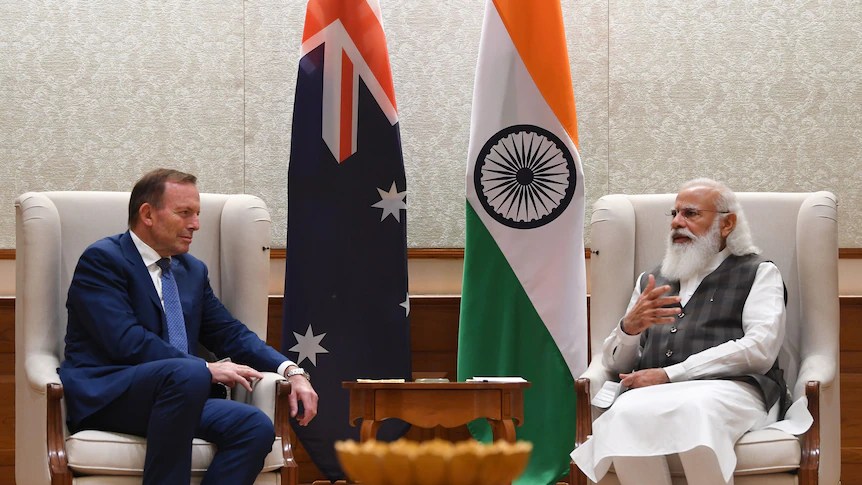
Former PM Tony Abbott was instrumental in getting trade talks going again

INTO INDIA believes the two big issues facing Australia are allowing greater people movement from India to Australia, and directing more of our massive A$ 2.3 trillion pension fund sector that could be a regular source of investments in the Indian infrastructure and disinvestment story.

The key for Australia is to see India as more than a “quick sale” – Indian negotiators will be looking to push the two countries to become partners, adopting policies that streamline physical movement, including, on-arrival visas, multiple entry long term business visas, etc.

From India’s perspective, it will want to ensure that trade deficits in the post agreement period do not widen. And two, non-tariff barriers and differences in standards or recognition of qualifications do not offset higher access through the trade deal. As an Indian report recently wrote: “This is the crux of the matter.”

In the larger CECA agreement, investments from Australia will play a big role in the growth of bilateral trade between the two countries, because the growth trajectory of India will create new opportunities for Australian companies, including in areas like water management and up in future, for which Australia can be a long term reliable supplier.

In the early harvest agreement, Australia wants services included with goods – an area where India has not performed well in earlier trade deals such as with ASEAN.

Australia however just needs to accept the sensitivity of the agribusiness sector in India – the deal will fall over if Australia demands substantially lower tariffs across the board for fruits, dairy, agriculture and processed food items.

INTO INDIA RECOMMENDS Australia narrow its ambitions down to selected niche items in the agriculture sector. Finding ways that Australian expertise, technology innovation and scale can actually transform Indian agriculture sector towards value addition would give Australia a big advantage.

Finally, you can expect India could show flexibility in tariff lines related to commodities and minerals, which are needed for its growing economy and the e-mobility program. In turn, Australia could be accommodative in tariff lines related to refined petroleum, medicaments, railway vehicles, gems and jewellery, auto components and made up textile items, which it imports in any case from countries around the world, in addition to India.

Thanks to Confederation of Indian Industry (CII), in collaboration with KPMG and led by Amb Anil Wadhwa, who is Former Secretary (East), Ministry of External Affairs, Government of India.

Launching your startup into India – my 5 key tips

The team that have taken Australian startup CANVA global – India is a market for almost every startup

Launching your startup into India – 5 key tips

Here’s a big generalisation – almost every startup can find an eager market in India.

I say that with confidence, because the Indian economic growth story means demand for everything cannot be met – demand is huge, so that means opportunity for your startup.

But how to approach India?

First – think longer term than you normally do, but keep in mind modern India can be either fast or slow and there is no way of predicting.

Second – leave your ego behind. Pretty much every western company that has succeeded in India has done so on the support of a strong local Indian team across all levels. To do this, they have effectively left their ego behind.

Third – India wants your startup, NOT your culture. Those who struggle typically want to transfer their “culture” to India, so they put their expat team in charge of the local team.

Being preoccupied with transferring “the way we do things in our company” to India makes them blind to “the way Indians do things there” which is the most important insight for future success.

Fourth – use your expat team wisely. Expats can come and go as needed – but your business needs longevity in India and that is what an Indian management team can provide.

Fifth – Smart companies that go into Asia also ensure they hire Asians into the Head Office team, so you have Asians running your enterprise on the ground in Asia and Asians at the right level in HO guiding and advising the HO team.

The future of startups and innovation is looking good for India.


Australia told to be partners, not adversaries, with China

Prime Minister Lee Hsien Loong of Singapore and PM Scott Morrison of Australia

Prime Minister Lee Hsien Loong of Singapore gives advice to Australia on China

“China is one of the biggest policy questions for every major power in the world. You need to work with the country. It is going to be there, it is going to be a substantial presence. You don’t have to become like them, neither can you hope to make them become like you. You have to be able to work on that basis, that this is a big world in which there are different countries, and work with others who are not completely like minded but with whom you have many issues, where your interests do align. There will be rough spots … and you have to deal with that. But deal with them as issues in a partnership which you want to keep going and not issues, which add up to an adversary which you are trying to suppress. That is speaking in very general terms, but I think that’s from Singapore’s point of view how you have the best chance of developing a constructive relationship and avoiding very bad outcomes.”

INTO INDIA has long campaigned for Australia to just calm down and deal with the massive regional opportunity (and challenge) that we face.

Such common sense. Calm, rational and accepting of reality.

Can Australia follow this advice?

Emerging Markets Guru Mark Mobius – India a 50-year rally

Emerging Markets guru Mark Mobius is bullish on India

Thanks to my friend Mugunthan Siva, Managing Director, India Avenue Investment Management for spotting this one!

“India is on a 50-year rally,” even when there are quick bouts of bear markets, veteran Emerging Markets investor Mark Mobius mentioned in an interview on Bloomberg Tv. “India is possibly the place China was once 10 years in the past,” he said.

A man of his word, Mark Mobius has allotted nearly half of his emerging-markets fund to India and Taiwan to assist offset a slide in China shares that has dragged down returns from creating nations as an entire.

Mobius’ bullish view on India clashes with these of analysts at Morgan Stanley and Nomura Holdings Inc, who’ve downgraded the inventory market after the benchmark S&P BSE Sensex Index greater than doubled from a March 2020 low.

“Individuals say emerging-markets look unhealthy as a result of China is dragging down the index, however they’ve got to have a look at different areas similar to India which can be going up,” mentioned Mobius, who created Mobius Capital Companions LLP after a profession at Franklin Templeton Investments.

The Mobius Rising Markets Fund has a mixed 45% of its portfolio allotted to India and Taiwan, with tech {hardware} and software program the largest holdings in these markets. Indian software program companies supplier Persistent Techniques Ltd. and eMemory Know-how Inc, a Taiwanese chip know-how supplier, have been amongst its largest stakes as of end-September. The shares have each greater than doubled this year.

8 things we need to know about India

Confident young Indians like these are driving new entrepreneurial spirit

CAUTION – generalisations are just that, and you will almost always encounter those who do not fit in this list. This is offered to assist those visiting India for business, education or tourism.

1. Successful and confident

Economic success has restored Indian confidence. Indian entrepreneurs are now recognized around the world and there is a national expectation that the next Bill Gates will be an Indian. This entrepreneurial spirit permeates the nation (most dream of becoming entrepreneurs) which is now confident.

2. Never forget rural people

Indian business and political leaders may live the urban lifestyles, but they do not forget the small towns and villages at the centre of rural life – and it’s not just the politicians with an eye for votes, with major corporates such as Infosys pouring resources and funding into village developments.

3. Avoid pointing the finger

Indians become instantly passionate when challenged on subjects like their high tariffs, especially if the challenge comes from the west. The message is, point the finger at India and you can expect a robust response.

4. Oceans of patience

Indians have oceans of patience which can drive westerners crazy, but it gives them a special strength in negotiations. This patience is derived from deeply held spiritual views such as impermanence – Indians are constantly reminded of the impermanence of this life, everything changes, and they can wait when often we cannot. Who has the advantage in this situation?

5. Not just an IT miracle

Do not be fooled with the view that the Indian economic miracle is just driven by call centres and IT. Important as these are, look also at insurance, energy, retail, clean technology, manufacturing, pharmaceuticals and even agriculture as areas where efficiency is producing startling results.

6. Not especially “Asian”

While India feels great about the success of “Asia”, in many ways it does not feel particularly “Asian”. First and foremost, Indians feel Indian, and to them that is vastly more relevant than being geographically part of Asia.

7. Remember the “Father of the Nation”

Whether dealing with the young or the old, in India never forget the “Father of the Nation”, Mahatma Gandhi.

8. Equity up there with democracy

Partly because of Gandhi, Indian leaders are more concerned with equity than with spreading democracy around the world – and cannot understand the enthusiasm of the USA and its allies to champion democracy in unlikely locations.