Australian critical minerals, infrastructure, energy, technology, agribusiness, education and space – step up to the table for FTA talks with India

The Australian Trade Minister, The Hon Dan Tehan MP, last week pointed to Indian FTA priority areas such as critical minerals, infrastructure, energy, technology, agribusiness, education and space.

He announced a speeding up of talks with India last week and chose the launch of the Canberra chapter of the Australia India Chamber of Commerce to also announce an update of the India Economic Strategy.

This is a great time for business to step forward. You can have a say. You can be at the FTA discussion table.

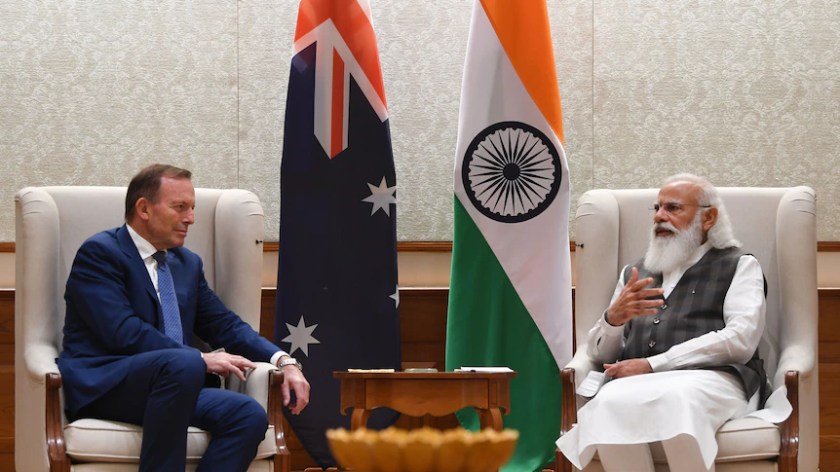
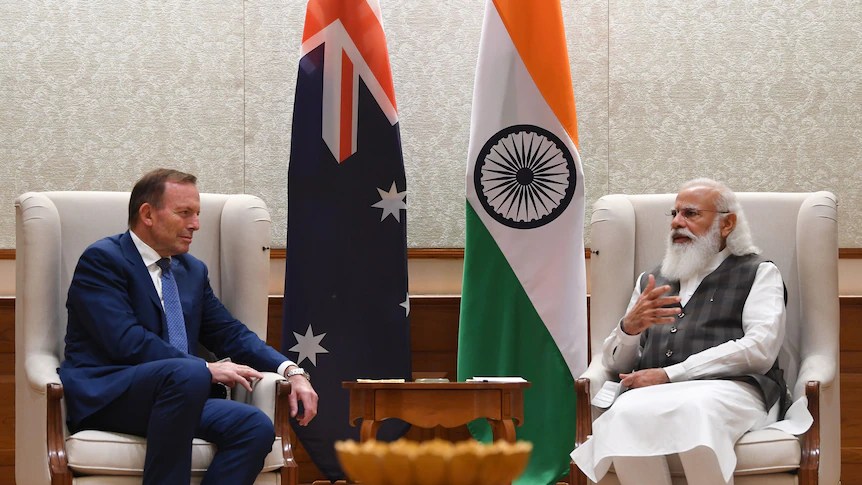
The Minister said he had asked former Prime Minister, Tony Abbott, to visit India for meetings around the Comprehensive Economic Cooperation Agreement (which is an FTA).

He announced to the AICC that both countries were hopeful of concluding negotiations this year – a dramatic ramping up of the pace.

The AICC has the Hon. Ted Baillieu AO as its Founding Patron.
Australian Trade Minister announces boost to India FTA talks at launch of Australia India Chamber of Commerce chapter in Canberra

Major announcements made at launch of Canberra chapter of Australia India Chamber of Commerce.

The Australian Trade Minister, The Hon Dan Tehan MP, chose the launch of the Canberra chapter of the Australia India Chamber of Commerce to announce both a speed up to negotiations on a Free Trade Agreement and an update of the India Economic Strategy.

The Minister said he had asked former Prime Minister, Tony Abbott, to visit India for meetings around the Comprehensive Economic Cooperation Agreement (which is an FTA).

He announced to the AICC that both countries were hopeful of concluding negotiations this year – a dramatic ramping up of the pace.

The Minister pointed to trade and investment in areas such as critical minerals, infrastructure, energy, technology, agribusiness, education and space.

AICC in Canberra is led by Tony Huber, a Director within DFAT and former Consul in Mumbai, and Deepak Raj Gupta, former Member of the ACT Legislative Assembly.

If India’s tier 1, 2 and 3 cities attract Mercedes, maybe they should attract you?

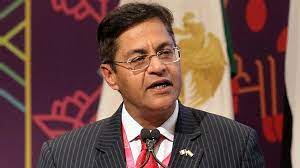
India’s High Commissioner to Australia, HE Mr Manpreet Vohra, spoke at a recent Australia India Chamber of Commerce function

Really interesting comments made recently by the outstanding Indian High Commissioner in Canberra – His Excellency Mr Manpreet Vohra:

We all know the mega cities of India such as Mumbai, and everyone wants to be there, but what about the tier 1, 2 and 3 cities which account for:

50% of all Mercedes Benz sales in India

60% of Amazon sales

50% of the entire digital economy

You can see why India is set to be the world’s fastest growing large economy in the years 2021 and 2022.

Well done to the Australia India Chamber of Commerce for this event.

Indian Independence Day is joyful and optimistic

Have you been in India on Independence Day, 15 August? It is a most joyful and optimistic day, in a country which has many joyful and optimistic celebrations.

India proudly celebrates Independence Day to cherish the idea of oneness and remember the sacrifices that freedom fighters made during their struggle against the British empire.

What really hits me about this day is the feeling people have about the glory of India’s struggle. It is a kind of mindset that “if we can do this, then anything is possible”.

Well done India – have a great celebration.

Tech innovation is not just about tech – it needs a basis of deep understanding of your business

Sundaram Business Services has a deep understanding of Australian business.

Indian firms like Sundaram Business Services in Chennai and Australia should be on your radar for tech innovation – in addition to their tech innovation capabilities, SBS has been active in Australian business for many years and knows the business environment very well.

A KPMG survey ranks India third among countries that show the most promise for tech innovation.

Tech innovation is most successful when the supplier has a deep understanding of your business. This is like a mantra for the SBS group – building innovation on the sound basis of business understanding.

There has to be cross cultural understanding and good communication.

Whether it is Artificial Intelligence, Machine Learning or other innovation, success is gained when the supplier has the capacity to how your business works and what your needs are in the market.

More than 800 industry leaders were surveyed for the report which said 39 per cent believe global ‘hub’ cities such as London, Singapore, and Tel Aviv will continue to play a vital role, enabling talent to coalesce and collaborate in communities with a solid digital infrastructure.

There are so many great Indian startup stories – and much more to come

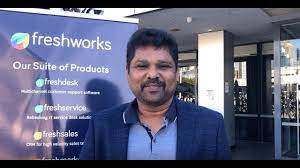
Mr. Girish Mathrubootham started Freshworks without any special help, nor did he come from wealth.

There are so many startup and unicorn stories in India today – and we know there will be more tomorrow.

Consider Freshworks which began eleven years ago and is now a huge firm with more than 3,800 team members and offices all over the world.

Mr. Girish Mathrubootham started Freshworks without any special help, nor did he come from wealth.

“We were only a six-person company operating out of a tiny garage in Chennai over eleven years ago. I didn’t have a gilded CV or come from a wealthy household, but that didn’t stop me from dreaming big.”

“I recognise that not every creator is as lucky, which is why as an angel investor, I have funded more than sixty startups,” he continued.

Now Girish Mathrubootham of Freshworks, Mr. Manav Garg of Eka Software, Mr. Shubham Gupta ex-Matrix, and Mr. Avinash Raghava ex-Accel have teamed together to establish a founders-first company called Together Fund in an effort to boost entrepreneurial enthusiasm in India.

The fund, which has a US$ 85 million initial capital, aims to assist India’s finest SaaS entrepreneurs in building, scaling, and winning together, therefore creating India as a true product country. Together Fund is India’s first and only venture capital fund run by founders. They operate some of India’s most well-known SaaS businesses in addition to being founding partners of Together.

The future of startups and innovation is looking good for India.

India’s EdTech has a huge boost due to covid and home learning

Harsh Rajan and Nirmla Sankaran founders of HeyMath – an E-Learning, online Maths coaching institute in Chennai.

India’s online education sector has really taken off as the pandemic led to school closures and a big part of the 250 million school children switched to online learning.

Investors are attracted to the large number of startups and unicorns in EdTech.

It’s an industry that will be worth nearly $2 billion by next year and is producing unicorns such as Byjus and Skillmatics.

Even with this dramatic growth, online education is touching only a small fraction of the Indian education market, so the future is strong.

A further boost for EdTech is the new National Education Policy (NEP), which looked at addressing the challenges and extending the scope of right to education (RTE) to students aged 3-18 years, with a key recommendation to harness edtech through app-based learning, online student communities, and lesson delivery beyond ‘chalk and talk’.

According to estimates by DataLabs, there are a total of 4,450 edtech startups operating in India, spread across various segments such as test preparation, e-tutoring, online certification, skill development, online discovery, and STEAM kit and enterprise solutions.

Educational delivery will no longer be either fully online or offline but a hybrid blend of both worlds.

For countries like Australia, India has an appetite for almost all of the EdTech innovations coming through.

India ranks high for tech innovation as “the internet and digital become the superhighways of global trade”

Pictured – Sundaram Business Services Chennai has a long relationship with Australia.

Indian firms like Sundaram Business Services in Chennai and Australia should be on your radar for tech innovation – A KPMG survey ranks India third among countries that show the most promise for tech innovation. India Global Business has reported on the results:

The Indian tech industry has always stood as a byword for resilience, agility and innovation – and a latest survey from KPMG has just confirmed that, ranking the country third among jurisdictions that show the most promise for developing disruptive global technologies.

In its annual Global Technology Industry Innovation Survey, KPMG ranked Bengaluru at eighth position among the top 10 cities.

More than 800 industry leaders were surveyed for the report which said 39 per cent believe global ‘hub’ cities such as London, Singapore, and Tel Aviv will continue to play a vital role, enabling talent to coalesce and collaborate in communities with a solid digital infrastructure.

Federica Saliola, joint director of the World Development Report, said: “The internet and digital technology are the new superhighways of trade. India, where most workers are employed in the informal sector and the participation of women in the labour force is low, has an opportunity to seize the opportunities that digital technology provides,” said. “Innovation is also a friend to entrepreneurs and India’s entrepreneurial spirit makes it an ideal incubator for start-ups to thrive,” he said.

India speeding up solar power across Africa

Indian PM Narendra Modi meets with African leaders during the International Solar Alliance meeting – an initiative created by India.

India is taking a leading role in supporting the spread of solar power across Africa – where nearly 600 million Africans still do not have access to modern sources of electricity.

India created and leads the International Solar Alliance, which has 86 member countries including Australia – and is now attracting strong participation from Africa.

With drastically falling technology costs, renewable energy has become a cost-effective option of generating clean power all over the world.

The International Solar Alliance (ISA) was conceived as a coalition of solar-resource-rich countries (which lie either completely or partly between the Tropic of Cancer and the Tropic of Capricorn) to address their special energy needs.

The ISA will provide a dedicated platform for cooperation among solar-resource-rich countries, through which the global community, including governments, bilateral and multilateral organizations, corporates, industry, and other stakeholders, can contribute to help achieve the common goal of increasing the use and quality of solar energy in meeting energy needs of prospective ISA member countries in a safe, convenient, affordable, equitable and sustainable manner.

ISA has been conceived as be an action-oriented, member-driven, collaborative platform for increased deployment of solar energy technologies to enhance energy security and sustainable development, and to improve access to energy in developing member countries. The ISA has 122 sun-belt countries that lie between the two tropics as its prospective member countries and currently boasts a membership of 86 countries globally.

Bengaluru is India’s “must visit” city for all kinds of tech

New research based on data by Dealroom.co data and analysis by London & Partners – the Mayor of London’s international trade and investment agency – found Bengaluru as the world’s fastest growing tech ecosytem.

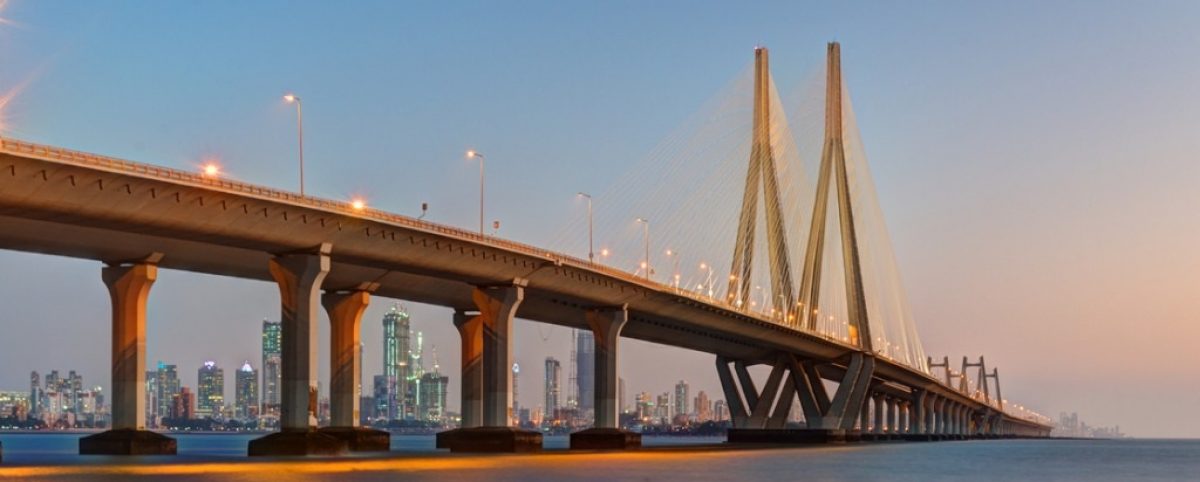
Bengaluru, often dubbed the Silicon Valley of India, has firmly cemented its tech credentials. The second Indian city was Mumbai, which made it into the top 10 fast-growing ranking at sixth place.

While Bengaluru, the capital city of the southern Indian state of Karnataka, grew 5.4 times from $1.3 billion in 2016 to $7.2 billion in 2020, the Maharashtra capital of Mumbai grew 1.7 times from $0.7 billion to $1.2 billion in the same period.

Bengaluru is also ranked sixth for the world’s tech venture capitalist (VC) investments, on a global list topped by Beijing and San Francisco, New York, Shanghai and London making up the top five. Mumbai comes in at No. 21 in the worldwide ranking, with Boston and Singapore among the other high-ranking cities.

Bengaluru is dynamic and global in feel, with sleek offices and countless quality bars and restaurants.

It used to be India’s “garden city” but has become a global “tech city”.

For EdTech, MedTech, AgriTech and in fact “any Tech”, Bengaluru is your India starting point.

It is also home to the dynamic Victorian Government Business Office led by Michelle Wade – essential to talk with them about your India entry plans.