India a prime target for Aussie exports and investment – Austrade

Austrade’s Ashley Brosnan puts the case for Australian businesses to quickly get into India:

Australian businesses continue to see opportunities across a range of sectors including education, mining and resources, infrastructure, agri-food, and digital services. Thanks to the steady success of some great Australian brands, Australia is already a trusted supplier and investor.

However, India remains a challenging place do business. Expansion requires a high degree of market literacy and on-the-ground experience. Local partners help exporters and investors to navigate markets and regulation – and these partners can prove invaluable.

Despite this, the Government of India has signalled that India is ‘open for business’. It is emphasising investment and competitiveness as factors that will support the economy and encourage a return to growth.

The effects can be observed already in global rankings. India has moved up 63 places in the World Bank ‘ease of doing business’ rankings in recent years.

Austrade is helping Australian companies to explore India

The Australian Government is investing heavily in developing commercial links between Australia and India. The Australia-India Comprehensive Strategic Partnership agreed by Prime Ministers in June 2020 creates further opportunities for Australian business.

The Partnership seeks to build supply chain resilience between the two countries. It strengthens and diversifies trade and investment links with a focus on education, critical minerals and technology cooperation.

Today, Austrade posts across India are working intensively with Australian businesses to understand market, identify opportunities, make connections and help companies negotiate contracts.

India consumer spending skyrockets

India’s consumer spending a “revolution”

Austrade’s Ashley Brosnan on India’s consumer spending “revolution”:

The biggest revolution taking place is the rapid rise of a huge, diverse and wealthy consumer market. Despite the impacts of the pandemic, domestic demand is likely to be a major driver of recovery and growth over the next decade, making up 60% of the overall economy.

E-commerce is taking off as smartphone usage multiplies. India already has over 1 billion internet users and the digital economy’s contribution to GDP is projected to grow 15–20% by 2024.

Incomes are also rising strongly. India’s median income per household is expected to reach A$13,867 by 2025. The World Economic Forum considers that consumer expenditure in India will grow by a factor of four up to 2030.

This means over 80% of Indian households will be middle-income in 2030 – an increase of 140 million. Another 20 million will be considered high income.

India’s emerging and aspirational middle class is seeking premium food and beverage, healthy lifestyle products, technical infrastructure, quality healthcare and education, entertainment and consumer goods.

Trends in consumer demand are encouraged by a substantial, highly-skilled Indian diaspora in Australia, which is set to number 1.4 million in 2031.

India now a top FDI destination – assuring economic growth

FDI fuels double-digit growth

Austrade’s Ashley Brosnan sets out the FDI picture:

Despite the COVID-19 crisis, foreign direct investment (FDI) inflows into India grew 13% in 2020. This is an extraordinary achievement – and a landmark development in a country that has historically proved challenging to foreign investors.

The rapid inflow of investment makes India one of the few countries to experience double digit growth in FDI during 2020. It means India is now a top 10 destination for FDI, and it heralds a sea change in global investment sentiment.

Multinationals are seeking to move their supply chains into the subcontinent. The push factor is a desire to diversify from an over-dependence on China. The principal pull factor is a young, competitive workforce, particularly in the information technology and construction sectors.

FDI flows into India contrast sharply with the global picture. For example, FDI flows into China grew by 4% last year, while FDI flows globally fell 42%. FDI flows into developed economies fell 69%.

Investment in India is likely to grow significantly over the next decade.

India growth 2021 12.6% – the only world economy to be over 10%

Prime Ministers Modi and Morrison are close – and should talk more about trade.

Rapid recovery in 2021

Austrade’s Ashley Brosnan points to India’s post-coved economic recovery based on fast rollout of the vaccine, falling caseloads, economic stimulus and Foreign Direct Investment – it has every angle covered:

The OECD projects that India’s economy will grow 12.6% in 2021. This will make India the only major country to achieve double digit growth in 2021.

It should be acknowledged that the Indian economy is among the worst affected by the pandemic, which has resulted in strict, multi-month lockdown restrictions. GDP fell 10.3% in 2020 damaging household income and business confidence.

But rapid economic growth in 2021 will be driven by an expansive vaccine rollout, falling COVID-19 caseloads, and extensive economic stimulus.

Not forgetting that India is now a top 10 destination for Foreign Direct Investment.

India to lead growth in post pandemic global economies

Austrade’s Ashley Brosnan has the stats and facts at his fingertips and he is certainly bullish on the future of India:

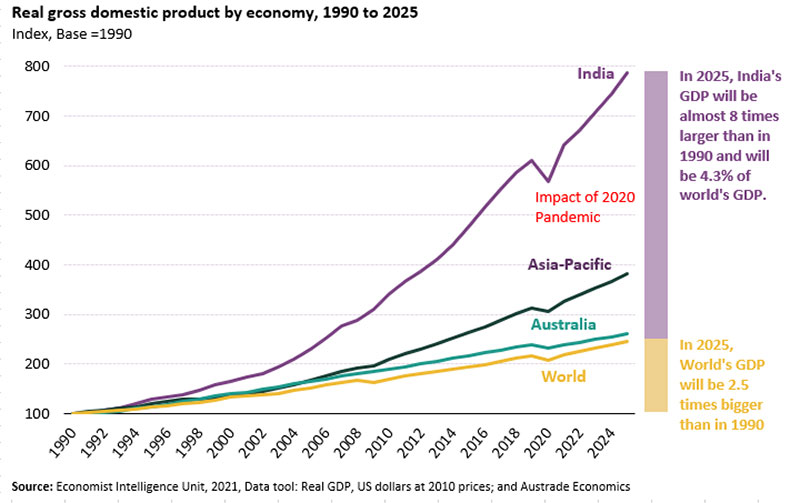
No longer just ‘rising’, India is now a significant and influential global player. India has recorded strong economic growth over the past 4 decades to become world’s third largest economy in terms of purchasing power parity (PPP).

Following the pandemic, rapid growth is set to resume. The Indian economy is projected to expand by an average annual real rate of 5.8% from 2021–2040, which is faster than the global average and the average for the Asia-Pacific region.

Take a look at this chart!

India great agritech market but an insider advises “find local partners”

Agritech booming in India but be careful about market entry

A recent story in EVOKE, an agritech site, really caught my eye with a piece of sound advice.

It was so good to read the Managing Partner of Omnivore, Mark Kahn, with his greatest piece of advice to those not already there: do not to move to India immediately. Omnivore is the largest and oldest player in the Indian agritech venture scene

“I’ve never seen a foreign startup succeed in India that was selling directly. Sometimes we have very well-meaning people that relocate their lives here and think they’re going to be able to build an organisation from the ground up and the reality is it’s just very difficult.

“The best thing you could do is get some Indian members on your team, co-create solutions that bridge the gap between whatever you’ve developed earlier and whatever our local farmers actually need and find local partners.

“You should be manufacturing in Australia or maybe India, but you don’t want to build a distribution system yourself and even if you try, you’re not very likely to succeed.”

He pointed to agritech related to water and drought resistance as two high priority opportunity areas.

The agritech opportunities are huge, but INTO INDIA has been advising for a long time that you need partners and a collaborative mindset to really succeed in India.

Can trade steer the Indo-Pacific towards recovery?

Trade presents as a very mixed story for countries in the Indo-Pacific region – there appears to be both peril and opportunity ahead.

On the peril side – lockdowns, disrupted supply chains, security tension and travel restrictions.

What’s on the opportunity side?

Not much, but we should be optimistic.

The plunge in world trade could be bottoming out. Weak global growth could turn into moderate growth. Closed borders might soon open. And tensions around key areas of trade, technology and security (ie around China) could stop festering.

Or maybe pigs might fly?

What do you think is ahead?

Let’s build a secure Indo-Pacific but talk of war is not helping

First mission of the UK’s new mega aircraft carrier The Queen Elizabeth, was into the Indo-Pacific which is the world’s hottest region right now.

Globally the key strategic location of the world is moving this way – to the Indo Pacific region – and it is happening with some urgency.

Why?

Because of the economic success, military preparedness, activity in the region and the general rise of China.

Urgent discussions are happening among democracies and those in the region – such as India – are seeking defence support to balance things with China.

It is all happening in a rush.

India is fast tracking strategic discussions and arrangements and just completed some ground-breaking strategic deals with the UK and the European Union.

Of symbolic importance, the first mission of the UK’s new mega aircraft carrier (The Queen Elizabeth) was into the Indian Ocean.

The language of all these deals is about China – without mentioning the name. For example, most seek “an open, free, inclusive and rules-based Indo-Pacific region, underpinned by respect for territorial integrity and sovereignty, rule of law, transparency, freedom of navigation and overflight in the international seas, unimpeded lawful commerce, and peaceful resolution of disputes”.

That’s a lot of words but it adds up to one word – China.

A secure region is good for us all. A region too keen to go to war is not good for us.

On the extremes of the discussions are those who eagerly await the “drums of war” – let’s just remember that these are either the same people or in the same lineage as those who took the west into disasters such as Afghanistan, Iraq and many more right back to and including the Vietnam War.

They have been wrong every time.

Can the Indo-Pacific region achieve peace without repeating these mistakes?

Deakin University again leads the way with India

When organisations ask how to engage with India, the answer can be found in how Deakin University has built the India relationship.

Deakin has demonstrated patience, long term commitment, adaptability and real community engagement with India.

Their latest announcement takes it to another level:

“Deakin University’s relationship with India has been a key part of who we are for more than 27 years. Our Indian students and staff are an integral part of the Deakin community and we have been shocked and saddened seeing the COVID-19 crisis unfold. 

“After careful consideration about what we can do to help make a difference to the Indian community, we’ve decided to join forces with our long-time partners, Tata Trusts, through their initiative ‘One Against COVID-19’ to lend financial support and encourage our community and partners to do the same.

“Funds will go to the areas most in need, specifically to aid with:

  • Repairing/upgrading facilities
  • Staff training, and
  • Expert project management to improve the efficacy and efficiency of the health response

“These funds would be in addition to the existing Student Emergency Assistance Fund which supports Deakin students experiencing financial distress and would go directly to the individuals and public services in need in India.”

To Vice Chancellor Iain Martin and Ravneet Pawha, Deputy Vice President Global – well done for shining a light in the relationship with India.

India could be world’s third largest economy as soon as 2030

Two facts demonstrate India’s amazing economic growth:

First, today India is the world’s 6th largest economy.

Second, as soon as 2030, it is likely to be the 3rd largest.

Mugunthan Siva, CEO of India Avenue Investment Management (Sydney and Mumbai) makes a compelling case for India focused, actively managed high conviction funds and the investment themes he likes include technology, manufacturing, construction, rural, real estate, B2B and market share leaders.

You can read more here:

https://www.livewiremarkets.com/wires/why-india-could-be-third-placed-by-2030

India Avenue website: