How India is different from China – insights from Asialink Business

Asialink Business has a wonderful Asian Market Update Series and a recent one focused on India.

One of the speakers was Mary Manning – Portfolio Manager at Ellerston Capital.

Dr Manning manages the Ellerston India Fund among other Asian investments.

She detailed why India is unique and not the next China. For example, the structures of the two economies are very different and beyond coal, exporting bulk commodities is not going to be the bedrock of Australia’s relationship with India.

India is also at a very different stage of economic development to China, with different consumer preferences, price points and distribution channels. These factors give rise to a completely different set of sectoral opportunities, that will most likely require capital investment on the ground – but one size does not fit all when it comes allocating capital in India.

podcast

Dr Manning cited several examples of successful investment in India by multi-national corporations that cut across geographies, sectors, time frames and business models, such as majority stakes in listed companies, through to unlisted joint ventures and distribution agreements. These companies include household names in Unilever, Suzuki, Prudential, Macquarie, Facebook, Alibaba, McDonalds, Walmart, and QBE.

Dr Manning said the higher returns on equity that could be achieved in India were a major reason why Australian companies should be considering investment opportunities there.

She said there was currently an investor scramble for ‘new economy’ assets in India in key areas such as healthcare and infrastructure and while good buying opportunities could present over the next six to 12 months for equity investors – with the Indian economy weakened by COVID-19 – a long-term view was needed.

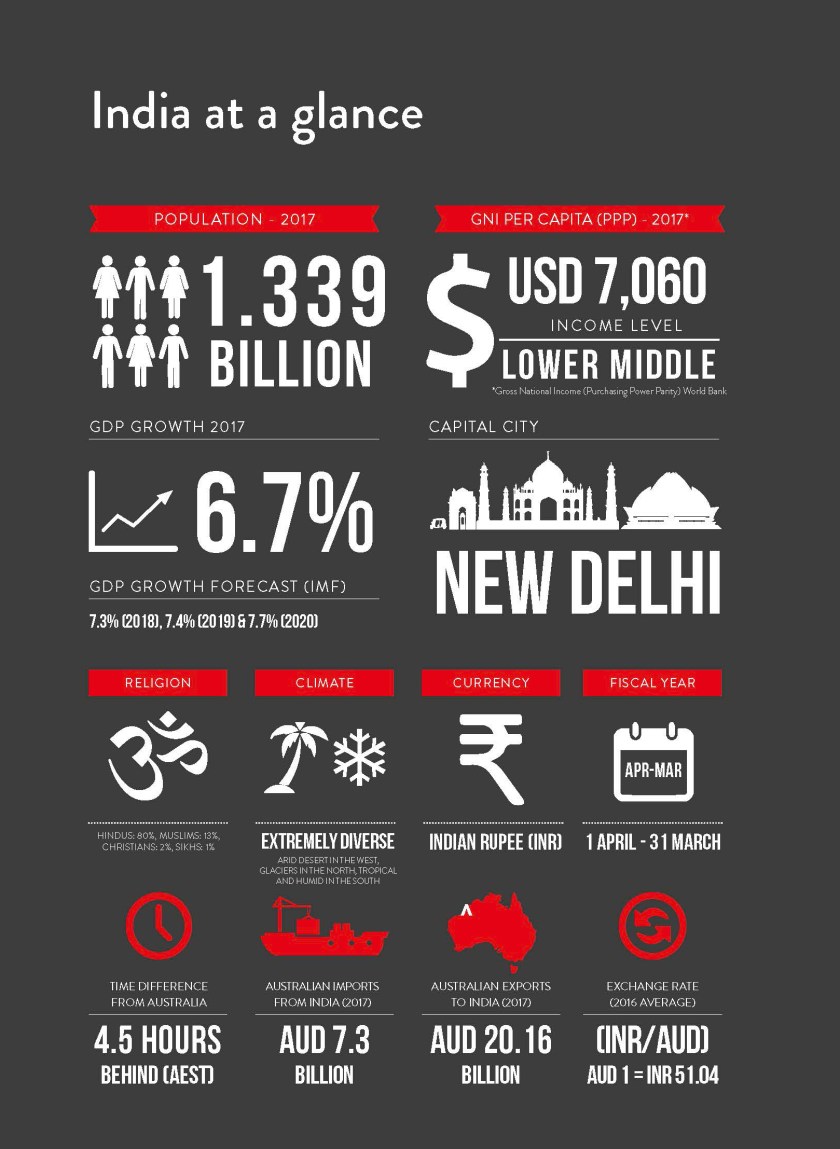
India_At_a_Glance_Country_Starter_Pack

7 ways to succeed in wonderful India

This short list can be your guide to success in wonderful India:

  1. Bring a culturally aware and adaptable mind to India – you will need both. By “culturally aware” I mean more than how to greet and exchange cards. Cultural awareness is understanding how the other thinks and requires some study and effort.
  2. Develop some flexible plans for India – they will need to change!
  3. Commit to India for the long term. One or two years is not enough. I have been going to India since around 2005 and still learning new things and making new connections – to find a way through the maze that is India.
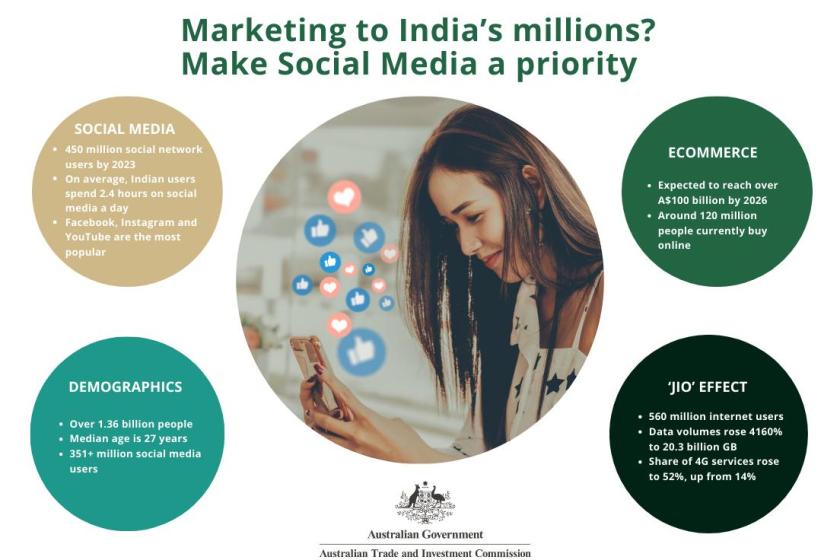
  4. Make social media a part of your program to build your brand and product awareness in India – the shift to social media/digital marketing there is huge.IndiaDigitalEco
  5. Adapt planning and approaches for the need of your business and sector. You might need a quick market study – or you might need studies over several years. Each is different.
  6. Learn as much as you can about your potential market – connect with your potential customers and see how they operate and what is happening in their sector.
  7. Let the market build a relationship with you and learn about your business. Again, like all the other points, this takes time.

CONCLUSION

It is going to take time to succeed in India. But for one of the biggest most dynamic markets with the youngest population on the planet, investing your time will pay off.

Why get closer to India? About 600 million people, more than half India’s population, are under 25 years old; no country has more young people. Remember the economic impact of the western “baby boom”? It is time the west moved closer to India in trade, culture and tourism. What do you think? As the great Indian philosopher Rabindranath Tagore said: “You can’t cross the sea merely by standing and staring at the water.”

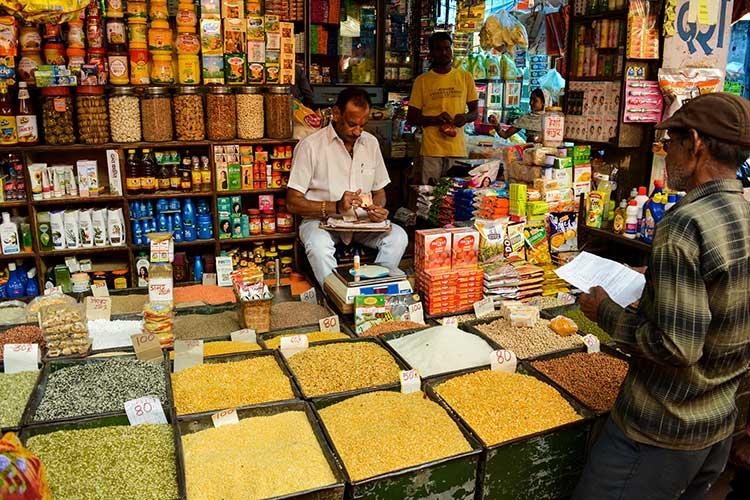
kirana

Google backing India as it becomes cautious on China

Google plans to invest US$10 billion over the next five to seven years to help accelerate the adoption of digital technologies in India.

Mr Sundar Pichai (pictured below), who was born in the country and is currently chief executive officer of parent Alphabet Inc., made the announcement at the annual Google for India event via video conference.

google3

He said, “This is a reflection of our confidence in the future of India and its digital economy”.

The US$10 billion funds are expected to be invested in partnerships, operations, infrastructure, the digital ecosystem, and equity investments. Google will focus on several key areas:

  • Providing affordable access and information for every Indian in their own language, including Hindi, Tamil, and Punjabi
  • Developing new products and services focused on India’s unique needs
  • Encouraging businesses as they continue or embark on their digital transformation
  • Utilising technology and artificial intelligence for social good, in areas like health, education, and agriculture

INTO INDIA can report there are more than 500 million internet users in India, second only to China, with growth that has attracted all the American technology giants.

google 6

Google is already using AI to predict floods in India

For those watching political and strategic shifts away from China – earlier this month, Google stopped its plans to offer a new cloud service in China and other politically sensitive countries.

tradewar3

India has had a surge of foreign interest in its digital economy. In the last few months, investors including Facebook Inc., Qualcomm Inc. and Intel Corp. have put around US$16 billion in the digital services unit of India’s largest conglomerate, the retail-to-telecom giant Reliance Industries Ltd.

Google, Facebook, Amazon.com Inc., and others are investing billions into the market.

As China seems less attractive for investors, India has the opportunity to shine and show its true attractions to investors and business.


Indian startups are driving growth and change

There are many drivers of India’s economic growth and transformation – but certainly punching above their weight are Indian startups.

There were over 50,000 startups in India in 2018.

India has the third largest startup ecosystem in the world.

The success is partly driven by corporate India (which is providing much of the funding) and by the Indian Government policies.

Bengaluru is in the world’s top 20 startup cities and ranks in the top 5 of the “fastest growing”.

Some of the best known Indian startups include Ola Cabs, Snapdeal (e-commerce), OYO (hotels), Swiggy (food delivery), Big Basket (food e-commerce) and BYJU’s (ed tech).

Watch this space.

Can you trade with India without leaving home?

As Covid19 has made us all (Australia, UK, USA, Canada etc) more cautious, we are reluctant to travel.

Add to that a leap in Indian online e-commerce for all kinds of products and services.

Is the future of trade with India digital? Do relationships matter any more?

We have always said that the key to long term success with India is in the careful and gradual development of close working relationships. This has to be done face to face, but these days can be supported via phone and video calls.

Deakin University is the prime example of success through perseverance and relationship building – they have had a presence in India for over 25 years.

Ravneet Pawha has led Deakin in India for most of that time and she is now the Deputy Vice President – Global and CEO – South Asia. She knows everybody in decision making on education in India. Ravneet is a regular promoter of Australia and our education at conferences and in Indian media.

ravneet

The Australian citrus industry is taking a closer look at India but their CEO has told members it could take five years to build a market.

citruspic

So relationship still matters in dealing with India.

For our diplomacy, we need closer relationships at Indian central and state government levels.

For education, we need to follow the lead of Deakin University and be on the ground over there, building collaborative relationships.

And for products and services, while online is becoming the way of the future, products and services will only become trusted and valued as people have a relationship with your brand.

Australian PM Morrison has been gradually building a closer relationship with India PM Modi and this is producing some progress on agreements and cooperation.

Relationship – it is the way forward with India.

ModiMorrisonSmile2

10 essential tips for doing business with India

Doing business with India? Here are some tips that might help your experience, but keep in mind you will find many variations and contradictions of these points in the very diverse and exciting India market:

The language barrier is real – even English

India has some 26 major languages, but your Indian counterpart will almost certainly speak English, which itself can be a problem – it creates the illusion of communication and understanding. Many of us speak English and think western – your Indian partner speaks English and thinks Indian, so take care to build real understanding. Also keep in mind there are “many Indias” with many different languages and ways of thinking.

business2

You are in a different culture

Visitors to most of Asia and China are visually reminded all day that they are in a vastly different culture. But often, especially in offices, India can appear quite westernised and individuals also give that impression. Better to open your mind and see things and people more clearly, looking beyond the surface level “westernisation” – exploring cultural differences expands your horizons and you will find many charming similarities.

Be patient and you will get there faster

Adopt a patient long term view – India is a 5 to 10 year game. It is very easy to get MOU’s (Memorandum of Understanding) signed with fanfare in India but too many do not produce any outcome. One way to improve our cultural dexterity would be to take a long-term view and apply lots of patience.

Narendra-Modi-Mohammed-bin-Zayed-Al-Nahyan

Businesses should not start out on market entry unless they are prepared to commit at least five years to making it work. Governments need the same longer-term perspective. Rushed trade missions, political announcements and photo opportunities amount to very little – we see them as an achievement, but they are just a beginning.

Relationships take time – but they are everything

India is a collective culture which means relationships are the number one factor in success, and building relationships takes time. Many who see India as not a short-term transaction opportunity can find success, but not for long as someone with a better price comes along. A better strategy is to aim for longer success through a focus on building relationships. The first trade meeting in India can be exciting and positive, but from the India side this is just seen as an introduction and they will wait to see if the relationship grows. Trust and relationship take time.

ModiMorrisonSmile2

“Yes” can mean “maybe” or “no”

See beyond the politeness: Indians are among the most courteous and generous hosts on the planet. On top of this, their culture demands that they never provide an outright rejection or “no” statement, even when this is clearly the only answer. The dumbest question for a business to ask in India is “can you help me with market entry for my products?” The answer will always be “yes” and you will sit idle for a long time back home until you realise this is not the right question. Within Indian culture built so solidly on relationship above all else, the word “no” is a real relationship breaker and is rarely or never used. “Yes” can in fact mean “maybe” or even “no” and you need to look for the signs. Like most of Asia, Indians are indirect communicators.

Prepare for the collective

Most westerners come from a culture of the individual, but the Indians they meet are firmly placed in a collective culture.  A visitor to an Indian company will often find four or five Indians in the meeting, and often it is not clear who is in charge. Many Indian leaders will not speak up or even speak at all in these meetings – in the collective someone else does the talking while they do the evaluating.

It will be slow and fast

Modern India can be slow or fast and it is hard to know which you will encounter. Sometimes delivery seems to take forever, yet on other occasions it is faster than the west. This means to succeed there you need incredible patience, so don’t send your least patient executive to India. Being able to respond positively under both slow and fast delivery is the key.

The visitor can be shocked and unprepared for the speed of modern India. Businesses need to go prepared to deliver on a product or service right now, not just having some idea for a future opportunity. Trade missions from around the world arrive weekly, so they have plenty of choice. Fast and slow, east and west – India is a living and dynamic paradox.

business 4

India is many countries in one

Differences are not just seen in the North, South, East and West, India is truly many countries in one and you need to be ready for cultural diversity. While Mumbai is the fast and flashy financial capital, it is also a tough place because everything is done on grand scale and at great speed. New Delhi is more formal and stuffy, also more liveable, and is more than a political capital – it is a powerful business city. Chennai is one of my favourites, embracing that slower southern pace and the values that shine in southern businesses. Regions have varying strengths, so research is the key. Recent moves to allocate Smart Cities across India can provide insights into alternative gateways for you.

Navigate through the spider web

While the west strives for simplicity and certainty, Indian business leaders know that life is like trying to find your way through a spider web – where does it begin, where does it lead, who can tell? Consistent with this view, most Indian corporations offer an incredibly diverse range of products and services – whereas western business tends to focus on just one area. In most cases Indian companies are willing to buy from you but are also looking for the deal to include some intellectual property sharing arrangements – think about these before you head over there.

Learn the art of flexibility and patience

Being patient and flexible is an asset, even if you come from a country that likes to be blunt, direct and structured. Most Indian communication is indirect, so it can take some time to work out what the real issues are. India is full of surprises and you cope best through being flexible. Dropping any “one rule for all” approach is a good start.

If you are thinking of going, India’s great thinker Rabindranath Tagore can be your inspiration: “You can’t cross the sea merely by standing and staring at the water.”

business


Abu Dhabi invests big time in India’s Jio

India has close economic and diplomatic ties in the Middle East. They just got stronger.

Abu Dhabi Investment Authority (ADIA) invested US$ 806.28 million in Jio Platforms, taking the total capital raised by its digital services subsidiary to around US$ 14.19 billion in just seven weeks.

The UAE is India’s third largest trading partner and more than three million Indians live in the Emirates.

So far, Jio Platforms has raised US$ 13.89 billion from seven marquee global investors.

JioFiber-1-770x433

ADIA, which is a globally diversified investment institution, invests funds on behalf of the government of Abu Dhabi through a strategy focused on long-term value creation. It has made several investments in India, mostly through its private equities department.

Jio Platforms is at the forefront of India’s digital revolution.

Jio, with 388 million users, combines all of RIL’s digital and telecom initiatives, including Jio digital services, mobile and broadband, apps, tech capabilities such as artificial intelligence, Big Data, and Internet of Things, and other investments such as in Den Networks, Hathway Cable, and Datacom.

India offered flexibility on RCEP – the world’s biggest trading bloc

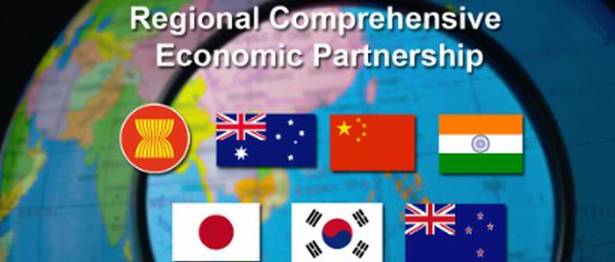
RCEP – the initials that describe potentially the world’s biggest trading bloc.

RCEP needs India back – it walked out during earlier negotiations.

To urge India back to the negotiations for the Regional Comprehensive Economic Partnership (RCEP), its 15 member countries have offered New Delhi the option of deferring commitments related to opening up its market.

Reports on the RCEP move come on the eve of online discussions between Indian PM Modi and Australian PM Morrison. I hope they can advance the talks.

ModiMorrisonSmile2

The move was reported in The Hindu Business Line.

According to some diplomatic sources, the deferral means that India does not need to worry about RCEP’s impact on the broadening of its trade deficit with China and other member countries when it signs the RCEP agreement.

India quit talks with the RCEP — which includes the 10-member ASEAN, China, Japan, Australia, South Korea and New Zealand — in November 2019, as it could not agree on crucial issues including the level of market opening being demanded by the members, especially China.

“If India agrees to the package then it can enjoy the benefits of all other aspects of the RCEP pact such as investments, services and intellectual property rights, without having to worry about the fate of industry and farmers,” the diplomat further said.

The RCEP, once completed, could be the largest trading bloc in the world, accounting for 45 per cent of the world’s population and 40 per cent of world trade.


Australia should join with India to become the “food bowls” of the Indian Ocean

India and Australia can become the major “food bowls” of the Indian Ocean region, if the two countries can find a way to collaborate in horticulture  The region includes some of the world’s fastest growing middle classes, including much of Africa, the Middle East, India and its neighbours and Southeast Asia.

This is one of the conclusions of our study of “India-Australia Horticulture Collaboration” which was part funded by the Australia India Council, DFAT.

The Indian horticulture sector already faces pressure for change, presenting Australia with a once in a lifetime opportunity to build a collaborative commercial relationship with India.
horti2

Pressures for change in India are market driven as the middle class grows, Government driven with a push to bigger farms, mining industry driven as it seeks to play a positive community development role and horticulture industry driven, as farmers want innovation as a pathway to better incomes.

Indian market becoming health conscious

Market driven changes result from a growing middle class anxious about the content, health outcomes and quality of the vegetables and fruits they buy. Plus, a whole range of vegetables labelled as “exotic” in India now face rapidly rising demand – broccoli, cherry tomatoes, capsicums, parsley, celery, cabbages, zucchini and asparagus. Berries are becoming sought after, especially blueberries and strawberries.

Government driven changes are creating one of the biggest historical shifts in rural India – the new Farmer Product Organisations (FPO).  The Government has set an aim for 10,000 of these collaborative ventures. An FPO is a grouping of at least 10 and up to 500 farmers into a collective including marketing. The Government will fund these FPO’s and possibly farm subsidies will be distributed via them.

horti4

The FPO structure is currently in need of support services to enable them to secure business acumen, market linkages, better insurance terms, quality assessment infrastructure, precision agriculture solutions for better crop management, access to finance, IoT based applications and more.

At the same time India’s agricultural research centres (Central, State and private) are very keen to be part of the solution and become a focus for knowledge and training in horticulture techniques new to India. Their demand for displays and services around hydroponics and protected cropping is very high.

Miner driven changes result from delays and obstruction from farmers, and awareness that by supporting horticulture innovation around mines, they can contribute to increasing the income of farmers and provide new income for rural women – thereby making a contribution to the livelihoods of the communities they operate in.

Indian farmer driven changes follow complaints of declining incomes and knowing they have an inability to meet the needs of the new middle class, at home and in the Indian Ocean region. Women in rural communities are seeking new ways to add income to households.

citruspic

While farmers are traditionally conservative, there is growing awareness in India of the need for “new skills and innovations for new products”.

India will want collaboration, not high pressure selling

Facing these demands for change, India is not inclined to simply import and adopt western approaches – rather, it seeks to create Indian style innovations with global partners who can adapt to this demand. The Israel and Netherlands governments have established free standing centres of horticulture excellence, with low levels of interest and participation. Australia can move into this space if it is prepared to adapt to what India wants.

horti6

What will be needed for these changes? Skills training and train the trainer programs, IT systems, adapted hydroponics and adapted protected cropping systems and products, post-harvest storage and to market systems and a combination of displays and training at Government and private research centres (not free standing).

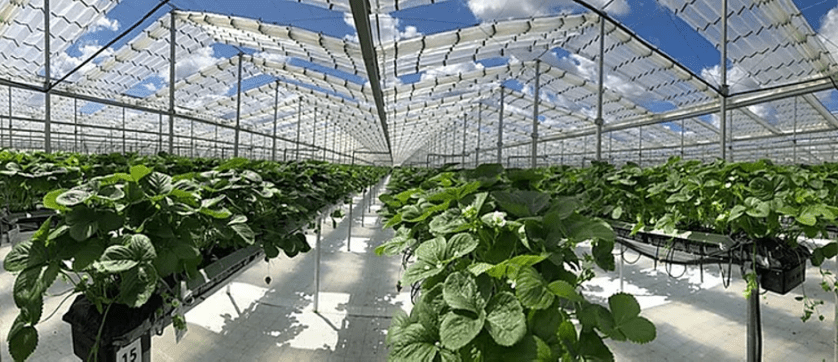
Protected Cropping (PC) opportunities are huge but need to be tailored for India – including shelter by artificial structures and materials, enabling modified growing conditions and protection from pests and adverse weather. In the mix here are greenhouses and glasshouses, shade houses, screen houses and crop top structures.

Hydroponics and Controlled Environment Horticulture (CEH)

horti7

The most modern and sophisticated form of protected cropping have been developed in Australia and we should be able to export this knowledge – might be relevant to corporate farms in India with some key adaptions, creating “modified hydroponics”. CEH combines high technology greenhouses with hydroponic (soil-less) growing systems. CEH makes it possible to consistently and reliably control or manipulate the growing environment and effectively manage nutrition, pests and diseases in crops.

Hydroponics in Australia and the west is crop production using a soilless growing medium with nutrients supplied in a liquid form. The choice of substrate can be varied to suit the crop and climatic requirements. Hydroponic growing also includes growing in a flowing nutrient stream without utilising a solid medium. This is known as nutrient film technique. For India, some adaptation of drip irrigation, soil and non-soil bases leads to “modified hydroponics” and would meet demand over there.

Agricultural research centres in India play a major role in supporting farmer innovation and skills upgrades. There is an opportunity for an Australian Centre of Protected Cropping and Hydroponics to be embedded in at least one of the Indian Government agricultural research centres, another with the State of Tamil Nadu and in a private research centre. These could be supported by a “virtual centre” with farmers accessing it via mobile phones.

This would be a major step forward in building a genuine India-Australia collaboration in horticulture, enhancing the capacity of both countries to become the food bowls of the Indian Ocean.


The “Developing India-Australia Collaboration in Horticulture” research project by Genesis Horticulture Solutions was part funded by the Australia India Council, Australian Government

 

Indian PM Modi announces A$400 billion stimulus policy

Indian prime Minister Narendra Modi has announced a A$400 billion stimulus package, one of the biggest in the world’s responses to Covid19.

The package is approximately 10% of India’s GDP.

The stimulus package is called “Atmanirbhar Bharat Abhiyaan” and aims to make India self reliant and to revive the stalled economy.

Details are still coming out but part of the program will be major reforms across areas such as land, labour and liquidity laws to underpin a boost to the “Make in India” campaign.

Other areas will likely include supply chain for agriculture, reforms to national taxation, simplification of some laws, build capable human resources and strengthening the financial system.

It is typical Modi – ambitious, unexpected in magnitude and investors are already reacting with enthusiasm.