The CSIRO is showing the way into India – and INTO INDIA congratulates them.
Under the updated India Economic Strategy (IES) released in 2022, CSIRO and India have made a commitment to draw on complementary capabilities and resource to solve shared global challenges.
They have three partnerships:
India-Australia Rapid Innovation and Startup Expansion Accelerator.
India-Australia Critical Minerals Research Partnership.
India-Australia Green Steel Partnership.
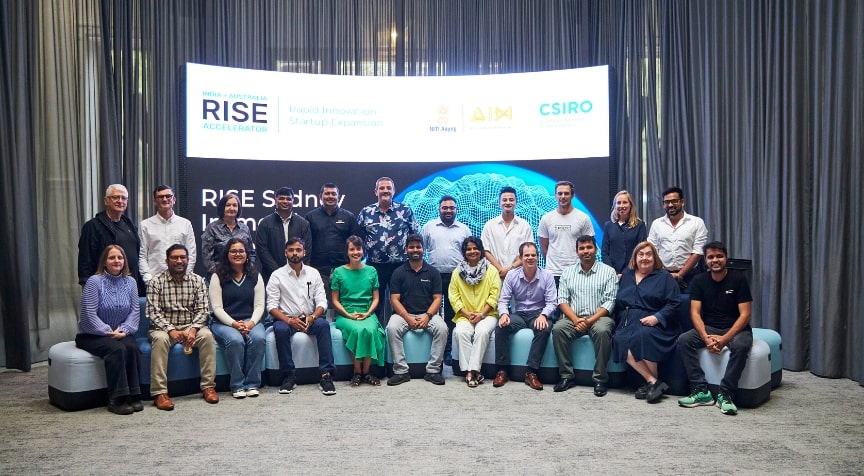
The inaugural cohort of the India Australia Rapid Innovation and Startup Expansion (RISE) Accelerator has been announced, with 15 Australian and Indian startups and small- to medium-sized enterprises (SMEs) selected to participate in Round 1 of the Program.
India-Australia Rapid Innovation and Startup Expansion Accelerator
India-Australia Rapid Innovation and Startup Expansion Accelerator (RISE) is an exciting and unique bilateral innovation program that will support Indian and Australian entrepreneurs and SMEs on their commercialisation pathways to launch innovative technology solutions to market that tackle our shared national challenges and priorities – such as the circular economy, the energy transition and food system resilience.
A partnership between CSIRO and Atal Innovation Mission (AIM), and supported by the Australian and Indian Governments.
India-Australia Critical Minerals Research Partnership
The India-Australia Critical Minerals Research Partnership (IACMRP) will work with Indian and Australian researchers, industry and government to deliver a range of projects over a 3.5-year period that aims to unlock commercial benefits of commencing, improving and integrating Indian and Australian critical minerals value chains.
India-Australia Green Steel Partnership
The India-Australia Green Steel Partnership (IAGSP) will deliver a range of research, technology and commercialisation projects over a 3.5-year period that aim to accelerate the decarbonisation of the iron-steel value chain in India and Australia.
These Partnerships have gained momentum and the India-Australia Minerals Scholars Network has been identified as a specific initiative that sits under both the IACMRP and IAGSP partnerships.
India-Australia Minerals Scholars Network
The India-Australia Minerals Scholars Network (the Scholars Network) will focus on enhancing Green Steel and Critical Minerals capabilities and connections. It is intended to be a 3.5-year initiative co-funded by the India-Australia Green Steel Partnership (IAGSP) and the India-Australia Critical Minerals Research Partnership (IACMRP).
INTO INDIA can only say – keep up the great work CSIRO.
Only 8% of Indian households own a car – so big growth is ahead
INTO INDIA has consistently said India is the growth story of this century.
Now Anish Mathew, CEO and CIO of the very successful Sundaram Asset Management Singapore Pte Ltd, has found a unique way to describe why India is indeed THE growth story.
6 big changes in India
The number of income tax filers has increased by 57.5% between FY15 and FY21. This is obviously the impact of the growing use of Aadhar (biometric unique identity card) as the preferred KYC document and the implementation of GST, both of which is pushing up the tax compliance in the country.
Indirect (GST) tax base stood at 14mn in November 2022, a 2.3x increase from mid 2017.
Number of PAN cards (unique tax identity number issued by the Income Tax Department) allotted has increased by 2.5x in the last 7 years.
80% of the railway tracks were electrified as of end FY22 as compared to 31% in FY11.
Road infrastructure measured in number of kilometres has increased by 36.6% in the last 11 years.
Major port capacity has nearly doubled in the last 8 years.
5 reasons growth will boom
Only 8% of the households owned a car, 24% an air conditioner and 38% a refrigerator.
Only 1% of Indians account for 45% of all flights.
Only 3% of Indians make up all unique card holders.
Only 2.6% of Indians invest in mutual funds.
The Indian diaspora remitted USD 100bn into the country in 2022, eclipsing the gross FDI flow during the same period.
Mathew advises that the three big growth drivers for the next decade are consumption (driven by the Demographic Dividend and rising incomes); manufacturing, and; digitisation (which is the formalisation of the Indian economy)
He makes a powerful case for investment and trade with India.
As this year comes to a close, INTO INDIA reflects on the game changer – the Economic Cooperation and Trade Agreement.
It surprised us all. Many did not expect it to be signed. Nobody expected it to be so vast in potential impact.
ECTA will save Australian exporters around $2 billion a year in tariffs, while consumers and business will save around $500 million in tariffs on imports of finished goods, and inputs to our manufacturing sector.
The tariff commitments provided by India in the agreement will open up access for Australia’s exporters of products including critical minerals, pharmaceuticals, cosmetics, lentils, seafood, sheepmeat, horticulture and wine.
Australian service suppliers will benefit from full or partial access across more than 85 Indian services sectors and subsectors. Australian suppliers across 31 sectors and subsectors will be guaranteed the highest standard of treatment that India grants to any future free trade agreement partner.
Australian services sectors to benefit include higher education and adult education, as well as business services such as tax, architecture and urban planning.
ECTA will support tourism and workforce needs in regional Australia by making 1000 Work and Holiday Program places available to young adventurous Indians. It maintains opportunities for Indian students graduating in Australia to undertake post-study work, with a bonus year of stay for high-performing STEM graduates.
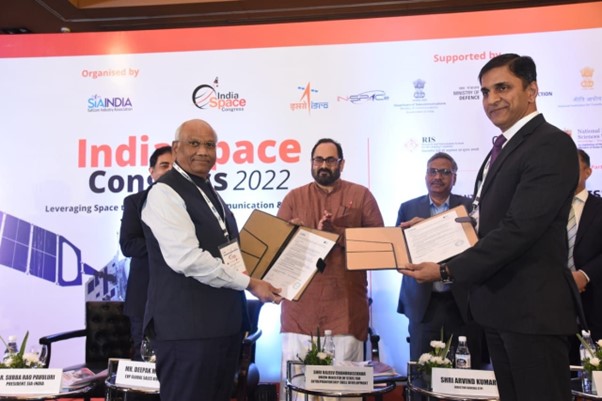
AICC’s Mahadevan Shankar (right) with SatCom President Dr Subba Rao Pavaluri in presence of Minister The Hon Shri Rajeev Chandrasekhar
India is a major centre for all aspects of satellites – the rockets are flying, the satellites launching and this is becoming a big industry.
There’s some good news in this for Australia. The Australia India Chamber of Commerce has driven this good news.
Thanks to the efforts of AICC’s Mahadevan Shankar, Convenor, Defence and Security National Industry Group – we now have super good news out of India – an MOU has been signed yesterday between the AICC and the SatCom Industry Association, India.
The signing was in the presence of Hon Shri Rajeev Chandrasekhar, Union Minister of State for Entrepreneurship, Skill Development, Electronics & Information Technology. Pictured with the documents in front of the Minister are (left) the President of SatCom Industry Association Dr. Subba Rao Pavaluri and AICC’s Mahadevan Shankar, Convenor, Defence and Security National Industry Group.
This bilateral partnership will lead to growing collaborations – and opportunities for Australian companies to engage directly with this growth sector of India.
SatCom Industry Association represents satellite operators, satellite systems, launch vehicles, ground and terminal equipment manufacturers and suppliers, satellite-based IOT/M2M solution providers, space startups, innovation hubs, academic institutions, law firms and provides interface with Government, Regulators, Policymakers and domestic & international standards’ bodies.
It has been a dynamic year for the AICC.
Members of AICC have been contributing extensively in this area past year, which has significantly motivated the progress of this bilateral 🇦🇺🇮🇳 partnership towards growing collaborations into the future.
Mahadevan Shankar says: “Sky is the limit and truly the exponential growth in space sector globally, and in particular in India, has opened up significant opportunities for Australian companies to engage directly and share in the rapid growth!”
“Big opportunities for next generation leaders, innovators & entrepreneurs to enter civilian and military use satellites and participate in the booming digital economies of future!” he said.
This is one of the best summaries of why India should be on your business and trade radar.
My good friend Hareesh Tibrewala provides the great summary – he is the Author of ‘If I Had To Do It Again’, a Social Media Strategist and Internet Entrepreneur – currently Joint CEO of Mirum India.
“Right now the Indian economy seems like the brightest spot among all large economies.
“One one hand, the whole of Europe is suffering the brunt of the Ukraine war. And irrespective of sanctions against Russia, and who is winning or losing the war, the brunt is actually being faced by Europe in form of inflation and energy issues.
“On the other hand, the US seems to be struggling to come out of Covid. There are just no people anywhere to fill in the job vacancies. Every shop or outlet has “Hiring” signs in their window. And salary levels, even for minimum wage kind of jobs seems to have increased dramatically.
“And finally China, who was powering the world economy for the past few decades seems to be floundering thanks to zero-covid policy and an unprecendented drought.
“Overall the APAC region, and specifically India, seem to be comparatively doing much better and seem stable.”
INTO INDIA has written about the extraordinary transformation that is happening in the “New India” – airports, roads, ports, urban renewal, smart cities, shopping malls, digitisation and online shopping.
But is is truly stunning to hear that India is right on the verge of being the biggest steel producer in the world.
On August 23, Minister of Civil Aviation and Steel, Mr. Jyotiraditya Scindia, stated that India would soon become the world’s top steel producer. The Minister was addressing an NMDC and FICCI-organized conference on the Indian minerals and metals business. After China, India is the second-largest producer of crude steel worldwide.
He believed that India had switched from being a net steel importer to an exporter of steel. According to him, India now consumes 78 kg of steel per person, up from 57.8 kg in 2013–14. By 2030, the government wants to produce 300 million tonnes (MT) of steel, according to Mr. Scindia.
Patrick Suckling presents the clearest short paper on climate change and what we urgently need to do
Patrick Suckling is a non-resident Senior Fellow of Asia Society Policy Institute and former Australian Ambassador for the Environment – and former Australian High Commissioner to India.
He has written one of the clearest – and briefest – papers on the importance of climate change and how we need to respond.
Some of the best “corporate storytelling” is coming out of India
The most valuable companies in India include Tata Sons, Aditya Birla and Godrej. The most valuable in the world are Apple, Alphabet (Google), Amazon, Facebook and Microsoft (with the order changing every now and then). These companies cover a wide range of sectors but there is one common element. A consistent and strategic content narrative.
That’s an area well understood by Mumbai-based The Information Company (TIC) which is positioned as a “content, creative and digital agency preferred by India’s leading corporates”.
Corporate Storytellers. That’s how they like to be known.
The Information Company – Storytellers to India Inc
TIC started in 1999 and I have known them since 2004, when I connected with Founder Kiron Kasbekar, formerly Editor of The Economic Times (Bombay), Business Editor of The Times of India, and Managing Editor of Business India.
TIC has been ‘living and breathing’ content for more than 20 years, with its foundations built by top-notch journalists who brought their expertise in impactful storytelling to the game. Since then, TIC has added technologists, graphic designers, writers, videographers, and SEO specialists to the mix to execute great communication projects.
Their storytelling services are being used by the some of India’s largest, most influential, and best brands – Tata Sons, Aditya Birla Group, Godrej, Mahindra Group, Ambuja Cement, Hindalco, Fino, Cipla, Arcelor Mittal Nippon Steel, Capgemini, Weber Shandwick, and many more.
Storytelling for a purpose
TIC doesn’t just tell stories – the focus on storytelling towards a purpose, whether that is building digital brand identity, promoting business interests, creating perceptions, or reaching out to stakeholders.
Thought Leadership
One of the most unleveraged areas of communication is ‘thought leadership’, with much of it being overt promotion or semi-advertising. Here, TIC has been able to carve out a niche – crafting the voices of corporate brand and corporate leaders, and delivering good thought leadership content that is credible, engaging, accurate and consistent.
One of their unique skills is to write authored articles on behalf clients across industries such as automotive, aviation, chemical, consumer products, energy, engineering, IT, insurance, oil & gas, pharma, mining, manufacturing and infrastructure.
Blogs for Interaction
Blogs is another area where, for many organisations, things go wrong. The most common mistake is to come across as self-promoting. Or the organisation starts a blog but tires of it – so their latest blog is two or three years ago. Not a good look.
But the blog can be immensely valuable – it is the one platform for any company to connect with all its stakeholders, interact with them, connect like-minded enthusiasts and so on – through focused storytelling. No wonder then that TIC creates over 30 blogs every month.
Websites that just don’t sit there
Owned communication assets such as websites should not be static – they need to be information rich, and continually updated. They are the first stop for information that is used by investors, clients, media, prospective customers, prospective employees, regulatory bodies. The website is a critical and strategic asset to broadcast the corporate narrative.
Tata Chemicals, Tata Trusts, Rallis, Lupin, Hindalco, Ambuja Cement Foundation, and Suzlon are just some of TIC’s website clients. And this does not include the list of intranet clients!
Visual storytelling
Sometimes, a visual story tells more than a thousand words. Infographics are mostly data driven – the magic lies in crafting a coherent story around data.
By writing compelling text and presenting it in an efficient and visually pleasing manner, TIC ensures that an engaging story emerges from each Infographic. This form of content is its way, both art and science.
Campaigns – traction and reaction
Engaging with employees – especially in an age of WFH – has taken on a new significance. Companies often rely on emailer campaigns to connect. But how do we gain traction and reaction?
Whether the campaign is to showcase business achievements, announce a product launch or an event, highlight business achievement, connect with employees or other stakeholders, TIC partners several big corporates to put in the right words to their thoughts.
Social media campaigns take the need for creativity to another level. Here too TIC builds award-winning strategic campaigns for clients such as Godrej and Hindalco.
Video now “most effective”
If a picture is worth a thousand words, a video is worth 1.8 million – that is the view of TIC, and they see video as “the most effective way to narrate a story”. Be it explainer, animated, VFX, event, HR videos or corporate films, TIC creates videos for Aditya Birla Group, Sterling & Wilson, Asian Paints, and Hindalco.
Content Overload
Beware of stepping into ‘content overload’, a sign of our times. How do you ensure ‘thumb-stopping’, shareworthy content for your brand? One easy hack is to make sure the content is dynamic, visually rich and – most important – interactive! Adding a layer of interactivity to your content – blogs, posts, videos, graphics, podcasts, whatever – will add to brand recall and engagement. Even a simple quiz, for instance, becomes interactive content and can be a game changer for your brand. And that is what TIC delivers.
Awards tell the story
Recognition is the best sequel to creativity. TIC has won a slew of awards for its work – here is just a tiny fraction of the recent accolades won:
Double Platinum at the ‘AVA Digital Awards 2022’ for Tata Sons e-magazine and a video for Sterling & Wilson Renewable Energy Ltd
‘Mint Marketing Award 2021’ for Hindalco’s #WomenAtHindalco social media campaign
Gold for Hindalco’s internal newsletter at the ‘Afaqs! Digies 2021’
Bronze for Aditya Birla Group’s #HaathUthanaZarooriHai video at the ‘Velocity Awards’
Best Content agency at ‘The Great Indian Content Marketing Awards 2021’
Contact TIC
For more on how TIC can support your communication objectives, just drop a message on enquiry@ticworks.com. Or better still, call at +91 842 581 4016 / 17.
Some things provide a “wake up call” on how quickly things are changing in modern India.
This is a great example.
India is placed third in the globe on the US Green Building Council’s (USGBC) annual ranking of the top 10 nations and areas outside of the United States for Leadership in Energy and Environmental Design (LEED) in 2021. The country has seen a 10% rise in LEED certified space since 2020. These are 146 buildings that have a total of 2.8 million gross area square meters (GSM) of space.
India has 1,649 LEED certified buildings with a total area of 46.2 million gross square metres. The Indian government has taken the lead in putting the health of its residents first, asking businesses to start with the required safety standards in place said Mr.Gopalakrishnan Padmanabhan, Managing Director – Southeast Asia & Middle East, GBCI.
Like most Indian IT giants, TCS offices are “campuses” which provide entire work and social life opportunities
According to Brand Finance, the Indian IT consultancy firm Tata Consultancy Services (TCS) has become the world’s second most valuable brand in the information technology (IT) services sector, while Accenture remains the world’s most valuable and strongest IT services brand.
According to the brand valuation consultancy’s newest Global 500 IT Services Ranking study, Infosys has emerged as the fastest growing IT services brand, with a 52% increase in brand value since last year and an 80% increase since 2020 to US$ 12.8 billion, putting it in third place.
TCS and Infosys have moved IBM from second to fourth place. IBM’s brand value is now US$ 10.6 billion, down 34% from last year and 50% since 2020.
Apart from TCS and Infosys, four more Indian firms are listed among the top 25 IT services brands: Wipro (7th), HCL (8th), Tech Mahindra (15th), and L&T Infotech (22nd).
This is an extraordinary achievement for the Indian IT sector and more is to come…














 Into India