Emerging Markets Guru Mark Mobius – India a 50-year rally

Emerging Markets guru Mark Mobius is bullish on India

Thanks to my friend Mugunthan Siva, Managing Director, India Avenue Investment Management for spotting this one!

“India is on a 50-year rally,” even when there are quick bouts of bear markets, veteran Emerging Markets investor Mark Mobius mentioned in an interview on Bloomberg Tv. “India is possibly the place China was once 10 years in the past,” he said.

A man of his word, Mark Mobius has allotted nearly half of his emerging-markets fund to India and Taiwan to assist offset a slide in China shares that has dragged down returns from creating nations as an entire.

Mobius’ bullish view on India clashes with these of analysts at Morgan Stanley and Nomura Holdings Inc, who’ve downgraded the inventory market after the benchmark S&P BSE Sensex Index greater than doubled from a March 2020 low.

“Individuals say emerging-markets look unhealthy as a result of China is dragging down the index, however they’ve got to have a look at different areas similar to India which can be going up,” mentioned Mobius, who created Mobius Capital Companions LLP after a profession at Franklin Templeton Investments.

The Mobius Rising Markets Fund has a mixed 45% of its portfolio allotted to India and Taiwan, with tech {hardware} and software program the largest holdings in these markets. Indian software program companies supplier Persistent Techniques Ltd. and eMemory Know-how Inc, a Taiwanese chip know-how supplier, have been amongst its largest stakes as of end-September. The shares have each greater than doubled this year.

9 weird things about Australians

CAUTION – these are generalisations that are meant to be helpful, but you will find exceptions.

  1. Aussie Modesty

Australians admire humility and authenticity. They loath boasting or pretentiousness. Even if their company is number one in its sector, they will often just say “we’re not too bad”, preferring understatement to boasting.

Informality and humour are always present in Australia – the Prime Minister would be greeted on a first name basis by people he or she had never met.

An unusual part of Australian humour is to make comments about someone that seem to be critical – but this is actually a sign of friendship. If I am given a project to do, an Australian might say “you will find some way to mess this one up” and this is meant as humorous and friendly.

People from countries where “face” is highly valued will find some of this humour difficult. But it is never meant to be offensive.

Because Aussies are laid back and informal, they think you will automatically like them, even though they might be giving offense with their humour.

An Australian with a PhD will not like you using the title – “just call me Steve” is their usual response to being called Dr Jones.

These characteristics can be a challenge for people from cultures which place high value on formality, titles, achievements and so on.

2. “Mates” in Australian Relationships

“Mate” is the Australian word for close friend. Once you become a mate, you will stay that way because Australians put mateship and loyalty together.

“Mates” can cross financial and social barriers – a rich person could be “best mates” with their gardener, and so on.  

This is part of the overall friendliness and openness.

3. Tall Poppy Syndrome

Australians like everyone to be in the middle – so if you are poor, you will get welfare, if you are rich, be wary of flaunting your wealth because they will try to bring you down to earth. Anyone claiming to be the best, or boasting about some valid achievement is fair game for tall poppy syndrome.

“Chopping off tall poppies” is almost a national sport.

4. A Multi-Cultural Society

Australia is a very multicultural society with a strong mix of indigenous groups, individuals with historical European roots, and a diverse mix of immigrant populations – lately this has been dominated by India and China. Approximately 25% of Australian citizens were born overseas and almost half the population had at least one parent who was born overseas.

The indigenous groups, made up of Aboriginal and Torres Strait Islanders, share rich, ancient cultures and histories.

Post-World War II Australian attracted immigrants to boost the population and work force, mainly from Europe, (especially from Greece, Italy, Germany, the Netherlands and Yugoslavia), Lebanon and Turkey.

Large numbers came from Northern Europe in the 1950s, Southern Europe in the 1960s and Vietnam (as a consequence of war) in the 1970s.

Such diversity has changed how Aussies see themselves – as a multi-cultural and multi-faith society rather than the homogenous, white, Anglo- Saxon, Protestant nation of old.

5. Meeting Etiquette

Australian culture is not very formal, so greetings are typically casual and relaxed. A handshake, smile and a simple ‘hello, how are you’ should suffice.

While an Australian may say, ‘G’day’ or ‘G’day, mate’, this is meant to be a warm and friendly greeting, but this may sound a bit off-handed to foreigners.

Aussies prefer to use first names, even at the initial meeting.  As such, avoid using titles when you first meet someone and, instead, introduce yourself with your first name only.

6. Gift Giving Etiquette

Small gifts are commonly exchanged with family members, close friends, and neighbours to mark special events such as birthdays, births, engagements or Christmas.

Trades people and service people such as cleaners, may be given a bottle of wine or a six-pack of beer!

If you are invited to someone’s home for dinner or a lunch time barbeque, it is polite to bring a box of chocolates, bottle of wine or flowers to your hosts.

Australians are relatively big meat eaters and can sometimes be insensitive to vegetarian diets – so it is important to let a future host know that you are a vegetarian.

In a culture that values humility and equality, it’s important that gifts are modest and not too expensive.

Although it’s acceptable to give high value gifts to those you’re close to, giving high value gifts to others may cause embarrassment and you may be perceived as flaunting your wealth.

Gifts are typically opened when received.

7. The Aussie “barbie” (BBQ)

The Aussie ‘barbie’ is an important part of Australian social culture.

Guests typically bring wine or beer as gifts for the host. In some cases, very informal barbecues may suggest that you bring your own meat!

As a vegetarian or someone who does not drink alcohol, let your host know these things before the event – they will adapt, and it saves embarrassment.

People tend to dress very casually at BBQs. For dinner, you can check the dress code beforehand.

In Australian culture, being overdressed can sometimes be more embarrassing than being underdressed!

You can contact the hosts ahead of time to see if they would like you to bring a dish.

Offering to help the hosts with the preparation or clearing up after a meal is well received.

How to indicate you have finished eating – lay your knife and fork parallel on your plate with the handles facing to the right.

8. Business Meeting Etiquette

Appointments are necessary and relatively easy to schedule. They should be made with as much lead time as possible. Many CEO’s will have an appointment diary covering two or three years and they like to stick to what is in the diary – meaning if you want to see them, make a request well in advance of the proposed day.

Punctuality is important in business situations. It is better to arrive a few minutes early than to keep someone waiting.

Meetings are generally relaxed; however, they are serious events.

Australians can be very direct in communication – if an Australian takes exception to something that you say, they will tell you so. It might seem offensive, but Aussies are straight shooters and expect that you can “take it” – that is, you will not get upset.

If you make a presentation, avoid hype, making exaggerated claims, or “bells and whistles”.

Australians get down to business quickly with a minimum amount of small talk.

They are quite direct and expect the same in return. They appreciate brevity and are not impressed by too much detail.

Negotiations proceed quickly. Bargaining is not customary.

They will expect your initial proposal to have only a small margin for negotiation.

They do not like high-pressure techniques.

9. Business Dress in Australia

Business dress is conservative in Melbourne and Sydney, but in recent years it is acceptable to be a little more informal – going to work in a suit but not wearing a tie has become fine. Men should wear a dark coloured, conservative business suit. Women should wear a smart dress or a business suit.  

Thanks to Commisceo Global for much of the above content.

India chasing battery manufacturing

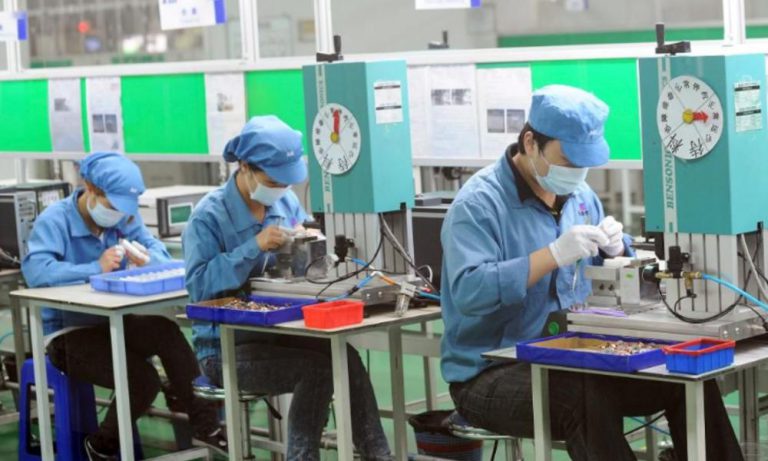
India plans to pitch to companies such as Tesla, Samsung and LG Energy to encourage them to invest in manufacturing batteries within the country, as it looks to establish a domestic supply chain for clean transport.

India will host five roadshows starting next month in countries including the United States, Germany, France, South Korea and Japan to convince battery manufacturers to set up local production.

Tesla, LG Energy and Samsung are among those who will be invited to attend, although a delegate list has not yet been confirmed.

Other companies targeted include Northvolt, Panasonic and Toshiba. The move is a part of USD 2.4 billion incentive program to boost battery manufacturing for which the government has begun inviting investment proposals from companies.

8 things we need to know about India

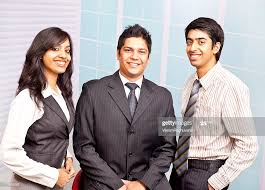
Confident young Indians like these are driving new entrepreneurial spirit

CAUTION – generalisations are just that, and you will almost always encounter those who do not fit in this list. This is offered to assist those visiting India for business, education or tourism.

1. Successful and confident

Economic success has restored Indian confidence. Indian entrepreneurs are now recognized around the world and there is a national expectation that the next Bill Gates will be an Indian. This entrepreneurial spirit permeates the nation (most dream of becoming entrepreneurs) which is now confident.

2. Never forget rural people

Indian business and political leaders may live the urban lifestyles, but they do not forget the small towns and villages at the centre of rural life – and it’s not just the politicians with an eye for votes, with major corporates such as Infosys pouring resources and funding into village developments.

3. Avoid pointing the finger

Indians become instantly passionate when challenged on subjects like their high tariffs, especially if the challenge comes from the west. The message is, point the finger at India and you can expect a robust response.

4. Oceans of patience

Indians have oceans of patience which can drive westerners crazy, but it gives them a special strength in negotiations. This patience is derived from deeply held spiritual views such as impermanence – Indians are constantly reminded of the impermanence of this life, everything changes, and they can wait when often we cannot. Who has the advantage in this situation?

5. Not just an IT miracle

Do not be fooled with the view that the Indian economic miracle is just driven by call centres and IT. Important as these are, look also at insurance, energy, retail, clean technology, manufacturing, pharmaceuticals and even agriculture as areas where efficiency is producing startling results.

6. Not especially “Asian”

While India feels great about the success of “Asia”, in many ways it does not feel particularly “Asian”. First and foremost, Indians feel Indian, and to them that is vastly more relevant than being geographically part of Asia.

7. Remember the “Father of the Nation”

Whether dealing with the young or the old, in India never forget the “Father of the Nation”, Mahatma Gandhi.

8. Equity up there with democracy

Partly because of Gandhi, Indian leaders are more concerned with equity than with spreading democracy around the world – and cannot understand the enthusiasm of the USA and its allies to champion democracy in unlikely locations.

Japan investing in India – role model for Australia?

Japanese firm SoftBank is leading investment into Indian IT and startups

Japanese investment in the Indian IT and start-up ecosystem has grown fourfold since 2016, according to a report by the National Association of Software and Services Companies (NASSCOM), in association with Nomura Research Institute (NRI).

It estimated the investment is helping create 102,000 additional jobs.

Japanese investment reached US$ 9.2 billion, mostly by large investors like Softbank.

Fintech, healthcare and mobility are the top sectors drawing investment from multiple Japanese investors followed by e-commerce, enterprise, and real estate.

Japanese policymakers see India as a trustworthy partner for accelerating Japan’s digital transformation and began investing strongly in Indian tech start-ups since 2016.

Which raises the question for Australia – can India become a favoured investment location as Aussie companies strive for next level transformation?

Don’t get too excited about the new India and Australia talks on CECA

The relationship between these two might hold the key to the current CECA talks

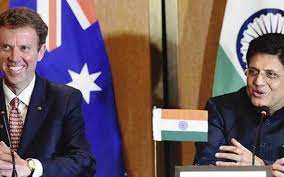
INTO INDIA is optimistic that some deals will emerge from the current round of talks on the Australia-India Comprehensive Economic Cooperation Agreement (CECA) – spearheaded by Australian Trade, Tourism and Investment Minister Dan Tehan and, Commerce and Industry Minister Piyush Goyal.

But a look at Australia’s stance and recent Indian trade policy actions is not reassuring.

India withdrew from the negotiations for the Regional Comprehensive Economic Partnership (RCEP); it renegotiated a number of its free trade agreements; it terminated most of its bilateral investment agreements; and it has failed to agree a mini-economic deal with the United States. Not to mention India’s stance in the World Trade Organisation which has been unchanged.

At the domestic level, India has imposed prohibitive tariffs in several sectors and introduced a range of incentives to attract reshoring and investment.

How does Australia’s record stack up? Eager to send more resources and agriculture to India, Australia has been reluctant to allow great services access and people movement from India. This is a thorny issue.

So our word is CAUTION – don’t get your hopes up too high – there has been little progress to show after ten years of negotiations.

So, why be optimistic now?

First, Australian professional trade negotiations have loosened up on what was a cornerstone article of faith for them – preferring the “single undertaking” negotiating model – in which nothing is agreed until everything is agreed. Now even they are talking about “early harvest” deals. But can they change their spots? The Morrison government, desperate for a trade win, hopes they can.

Second, India has direct concerns about China and is nervous about the US-China rivalry. It has sensibly decided to build up strategic and economic partnerships as a hedge. There is much talk in India about potentially good trade outcomes arising from China’s “trade war” on Australia.

But the stalemate is always market access.

Australia wants agriculture access – India is hesitant because this sector employs 40% of India’s population. India wants liberalisation of the services “mode 4”, specifically the short-term entry of business persons. India has argued that Australia’s short term business visitor regime constitutes a barrier to India’s services exports. Australia has pushed back on these demands, reflecting concerns at the potential impact on the labour market. In a nutshell – one big stalemate!

Overall, India is not a fan of Free Trade Agreements, seeing most of them widening its trade deficit. That is, India feels the other party benefits most. It has negotiated on five FTA’s over the last 11 years and only one has been signed.

True, India is looking eager, having revived trade talks with the European Union, United Kingdom, United States and Australia. But is it all just a lot of talk?

Remember, India is primarily after foreign investment, exports, making domestic industries competitive and incentivise other countries to manufacture in India. Can Australia play a role in any of this?

The key for Australia and India is to somehow align Australia’s export goals with India’s investment and new exports priorities.

Australia could partner India on technology, innovation and R&D.

Australian companies could boost investment into India – and there are good economic and government subsidy reasons to do so.

Australia has one big advantage here – critical minerals. India has high sustainable energy and e-mobility goals and will need these minerals.

Add to that, Australia has growing expertise in the hydrogen industry, while India has a National Hydrogen Mission. There are good R&D opportunities for both.

While India is the “pharmacy of the world”, Australia is a leader in biotech R&D. Biotech in dairy, marine and more could provide trade deal motivation.

But finally, there is the big blockage.

India wants to increase skill migration to Australia. Australia has opposed it. Most of the talks in the last decade have faltered at this point.

What has changed?

Border closures have left Australian businesses struggling to fill roles. Australia needs an ‘early harvest deal’ to attract skilled professionals from India.

So, despite the gloom of the past, there are reasons to have some optimism for these talks on CECA.

Watch this space.

India now chasing trade deals – having resisted for decades

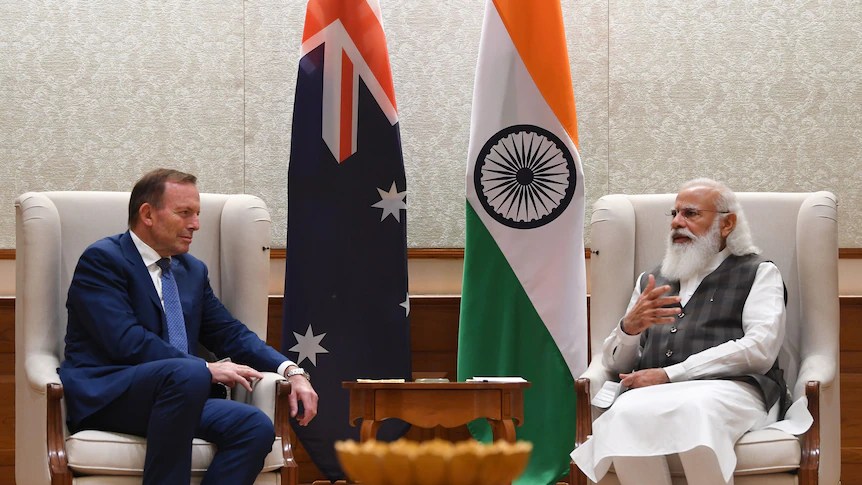
Indian PM Narendra Modi meets recently on trade with former Australian PM Tony Abbott

What has changed for India? It seems that having resisted trade deals for years, it now plans by the end of March 2022, to complete multiple quick-fire bilateral trade agreements.

Something has not changed however – the Indian government, distrustful of full scale FTA’s, is prioritizing “early harvest” pacts over comprehensive free trade agreements.

What has changed is the pandemic and the rise of China.

Therefore, the Indian government is focusing on strengthening the trade with G-7 nations with strong Indo-Pacific strategies and those with growing influence in central Asia such as the United Arab Emirates.

Australia, at a key position in the Indo-Pacific, is a high priority. As a fellow member of the QUAD, India and Australia have never been so close strategically and are keen to add trade now.

In large part, this is India’s push to do well as supply chain realignments take place – there is only a narrow window of opportunity to get these deals done.

How big is this? The government is negotiating bilateral trade agreements with 20 countries and expects to complete half a dozen deals, including those with Australia and Britain by this December and March 2022. 

India is ambitious – Mr. Piyush Goyal has set kept a target of US$ 400 billion for annual merchandise exports – almost 38% higher than US$ 290 billion achieved in last year and plans to achieve US$ 2 trillion annual merchandise exports by the end of this decade.

Outcome? Lots of deals that will not be quite world class Free Trade Agreement (FTA) but which will have some wriggle room.

KIIT & KISS Founder has been awarded the “Sandipani Gourav Maharshi Samman-2020” – dedicates award to young tribals

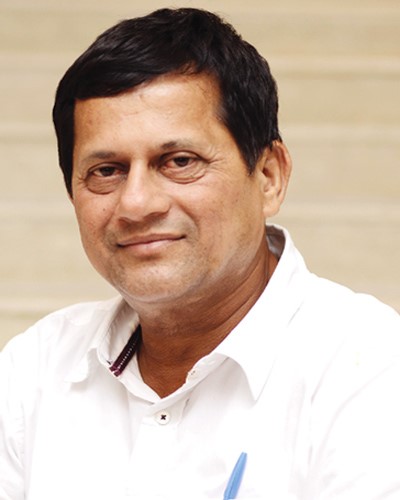
Dr Achyuta Samanta dedicates award to young tribals

Awards and recognitions are no mere feathers in the cap for the KIIT and KISS founder Dr. Achyuta Samanta, but it has become a reality about inheritance of ideals built on a foundation of benevolence and concern for others.

Dr Samanta is a social worker, educationist and philanthropist.

He has pioneered an Art of Giving program that is a force for change.

Kalinga Institute of Social Sciences – KISS, comprises of KISS Foundation, KISS School & College and KISS University. KISS Foundation is an NGO in India headquartered in Bhubaneswar, Odisha. School, College and University is the educational wing of this initiative located at the intersection of food, education and empowerment.

Dr Samanta’s ventures are powered by a belief that a better world – free from hunger, poverty & illiteracy – is possible. We provide free education, accommodation, food and healthcare to over 30,000 indigenous students currently studying at our main campus in Bhubaneswar. We are currently 20,000 alumni strong. We aim to serve an additional 10,000 students across our satellite centres which are going to be functional soon.

Dr. Achyuta Samanta, is also a Member of Parliament (Lok Sabha), Kandhamal, and has been conferred with the prestigious “Sandipani Gourav Maharshi Samman-2020” by Bharatiya Sanskrutik Sambhardhak Trust, Porbandar, Gujarat on the eve of celebration of the Silver Jubilee of the trust.

In a ceremonial event held in the presence of Shri Nimaben Acharya, Hon’ble Speaker, Gujarat Legislative Assembly, a galaxy of intellectuals and saints of the nation, this honour was bestowed upon Dr. Samanta for his exemplary dedication and lifetime contribution towards Social Work and Spiritualism. Humbled by the honour, Dr. Samanta extended his respectful gratitude towards Shri Ramesh Bhai Oza, Founder of Bharatiya Sanskrutika Sambhardhak Trust and all the members & office bearers of the trust.

It’s noteworthy that every year the trust has been honouring spiritual figures, saints, sages, intellectuals, thought leaders and social workers with coveted titles and honours namely ‘Devarshi’, ‘Brahmarshi’, ‘Rajarshi’ and ‘Maharshi’ since 1996.

 Apart from Dr. Samanta, Kokila Ben Dhirubhai Ambani was conferred with ‘Rajarshi’ Samman whereas treasurer of Sriram Janmabhumi Tirthakhetra, Pune Swami Govind Devagiri Maharaj received Devarshi Samman and former Vice-Chancellor of Sampurnanand Sanskrit University Dr. Rajaram Shukla was conferred with Brahmarshi Samman.

“Maharshi award is extremely special as it comes from the organisation led by the most revered and venerable Pujya Bhaishri, Shri Ramesh Bhai Oza ji. It will be remembered by our KIIT & KISS family and me forever. I dedicate this coveted recognition to our team that has worked relentlessly and to all the tribal young girls and boys who have struggled and have transformed their lives with resilience.”; said Dr. Samanta.

An Indian view of the Australian “Habits of an Optimist” free course

With Avinash Kshirsagar travelling in the Himalayas on my last trip to India

Yesterday was Mental Health Day – but really, it should be every day of the year. Many have found that good mental health and an optimistic outlook go together and there is a wonderful course suitable for all ages and FREE from the Centre for Optimism.

This has been reviewed by my friend Avinash Kshirsagar – a young Indian from Maharashtra state who is completing his accountancy qualifications. We met while travelling in the Himalayas and I joined him on his daily quest to find great cafes for lunch. Here is his review:

“Steve and I have had several discussions on optimism particularly a blend between optimism and realism.

We’ve shared our thoughts as well on this.

I’m very thankful to Steve that he shared with me a course on Project Optimism.

This course is all what one needs to do to be an optimist. Lots of takeaways on being positive and spreading optimism. I have highlighted the points that I particularly found were best inputs;

•             Smile like an optimist. The importance of smiling and how the optimist does it. It shared a quote by Charlie Chaplin “You’ll never find a rainbow if you are looking down.”

•             Habits of an optimist highlighted the importance of habits, and I could totally relate it to the book I’m currently reading by James Clear named “Atomic Habits.”

•             Another important aspect that was largely emphasised was Social media and being optimistic. The relationship between the two and impact of procrastination leading to a low key on positivity was very well illustrated.

•             The impact of asking oneself “What make you optimistic” ona regular basic or giving affirmations to check whether one is optimistic is relatable because I personally practice giving myself such affirmations. But this course doesn’t stop here. It teaches one to ask each other these questions so that the environment is healthy too. Imagine implementing the same in small groups. It will do wonders and promote mental health as well. This is spread optimism through optimism.

•             Optimism and success are very well connected. I would say that they complement one another. Would be of great help to those working in the corporates to check on this.

Each chapter had a questionnaire on how does one practice optimism in real life. The questions were really easy at first but didn’t seem as easy when I had to pen down the answers. They were very basic but made me press upon a lot to see where I stand. Totally worth it.

The chapters don’t have written context. It is more through video illustrations showing animated figures so that one won’t feel monotonous. Also, after each chapter they have added points through different research papers and other references. This would be of help to those who want to read more on it.

This course is a gift. It’s free of cost.

I have totally found this course worth the time and would recommend it to those who want to know what optimism is how can one practice being optimistic.

It’s not a choice. It’s a way to acceptance and leading an positive life in a realistic manner.

Thanks

Avinash Kshirsagar

India and the USA have very different world views – the 10 differences

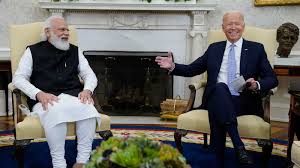
Indian PM Modi meets with US President Biden in the White House recently

There has been a lot of talk recently about India becoming part of some formal military alliance with the US – in response to the rise and actions of China.

But is this likely?

Here are 10 key differences in the world view of India and the USA

New Delhi is wary that any formal alliance with the US could draw it into almost constant military activity such as the Iraq war

India prefers to do its own strategic deals on a country by country basis – rather than manage these through a dominant US strategic alliance. For example, India and Australia have a Mutual Logistics Support Arrangement allowing each to uses each other’s bases

Historically India has never agreed to open-ended commitments that might lead to future military involvement

Of the four countries speculated to be invited to join the Five Eyes security arrangement (the four are Germany, India, South Korea and Japan) – India is the only one of these four to NOT have a treaty alliance with the US

An example of differences between India and the US is Iran and the Nuclear Non-proliferation Treaty (NPT) – the US attacks Iran on the nuclear issue, sees the NPT as something to be enforced – but India has not signed the NPT itself and sees it as discriminatory

There are differences on the “threat” from China – the US is most assertive on freedom of navigation in the South China Sea while India has been quite reserved on this issue

India is more concerned about its Himalayan border conflicts with China than the South China Sea

India generally has little or nothing to say about human rights issues in other countries. Whereas the US and its allies such as the UK and Australia are constantly calling out human rights abuses around the world

The US wants “all in” commitment from allies but India has always been non-aligned and refuses to get drawn into “us versus them” views of the world. One current example is India is finalising a logistics deal with the UK while also negotiating a similar deal with Russia

India is content to be “the world’s biggest democracy” but is not evangelical about it, accepting that all countries are different – a sharp contrast to the US wanting to remake countries in its own image and championing democracy for all