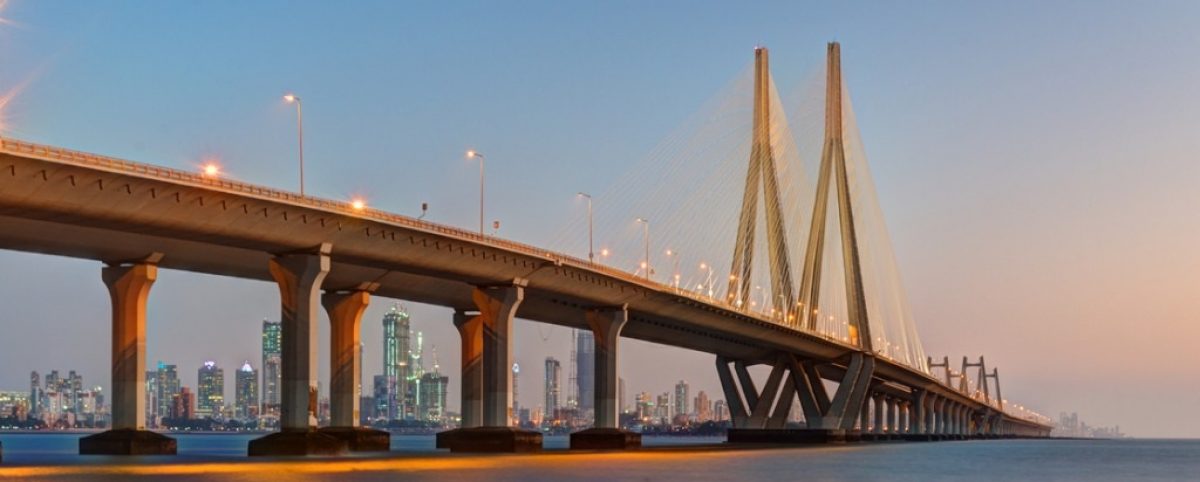

Online food consumers fastest growing sector in India

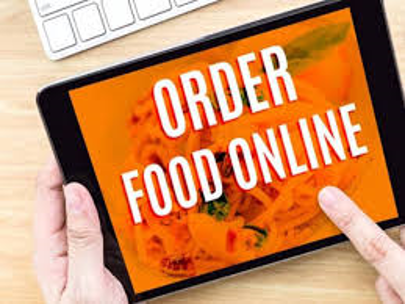
In the next two years, the Indian food-tech industry is expected to reach the US$8 billion mark, according to a report by Google and Boston Consulting Group (BCG).

The food tech space has been the fastest growing e-commerce segment in terms of reach and engagement, on the back of the rapid advancement in internet adoption and continued investments on consumer trials and delivery satisfaction.

According to the report, titled ‘Demystifying the online food consumer’, the major reasons for growth in the use of online food ordering apps includes a large variety of cuisines, good discounts and convenience.
food7

It said, “In fact, once users are satisfied with the service and start becoming habitual, they become more discerning about value – this behaviour is observable independent of town, class, social status, age and gender.”

Food tech is now in more than 500 cities in India.

Mr Rachit Mathur, MD and Partner, India Lead of BCG’s Consumer & Retail Practice added, “Overall online spending in India is rising rapidly and expected to grow at 25 per cent over the next five years to reach over US$ 130 billion.

“Riding on the wave of rapid digitization and steadily growing consumption, the reach of food-tech companies has grown six times over the last couple of years and will continue to increase further.”

The report is based on feedback of about 1,500 respondents across 12 cities.

food11

India’s FMCG market to grow 9-10% this year

Are you an FMCG exporter? Is India part of your plan?

According to market researcher Nielsen, India’s fast-moving consumer goods (FMCG) market is expected to grow 9-10 per cent in the January-December period, matching the expansion rate in 2019.

fmcg33

There are two shifts in the Indian FMCG market – one is to branded products and the other is to online e-commerce.

A shift towards branded products has been driven by the GST.

“Following the implementation of GST (Goods and Services Tax), a lot of unorganised players have exited the market across different FMCG categories,” said Mr B Sumant, ITC executive director of FMCG. “As a result, there has been a clear shift in consumption trend from unbranded to branded products.”

fmcg66

Pictured above – the top Indian FMCG stocks

FMCGs can be divided into several different categories including:

Processed foods: Cheese products, cereals, and boxed pasta

Prepared meals: Ready-to-eat meals

Beverages: Bottled water, energy drinks, and juices

Baked goods: Cookies, croissants, and bagels

Fresh, frozen foods, and dry goods: Fruits, vegetables, frozen peas and carrots, and raisins and nuts

Medicines: Aspirin, pain relievers, and other medication that can be purchased without a prescription

Cleaning products: Baking soda, oven cleaner, and window and glass cleaner

Cosmetics and toiletries: Hair care products, concealers, toothpaste, and soap

Office supplies: Pens, pencils, and markers

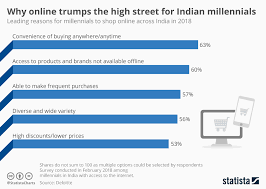
Shoppers in India are leaping from buying unbranded at “mum and dad” stores to online purchasing.  

The most popular e-commerce categories, not surprisingly, are non-consumable goods—durables and entertainment-related products. The online market for buying groceries and other consumable products is growing, as companies redefine the efficiency of delivery logistics which shorten delivery times. While non-consumable categories may continue to lead consumable products in sheer volume, gains in logistics efficiency have increased the use of e-commerce channels for acquiring FMCGs.

Amazon is backing India to the hilt

Pictured recently in India – Amazon CEO Jeff Bezos with Amit Agarwal, senior VP & country head, Amazon India, during the Amazon Smbhav event at the Jawahar Lal Nehru stadium in New Delhi

Amazon.com Inc Founder and Chief Executive Officer Jeff Bezos said on Wednesday that his company would invest an additional $1 billion to help bring small businesses online in India, and also committed to using the retail giant’s “size, scope and scale” to export $10 billion of made-in-India goods by 2025.

amazon4

Bezos has faced some problems in India, but he is bullish and active.

Seeking to reach out to critics, Bezos, donning traditional Indian attire, said his company was committed to be a long-term partner of India.

Bezos was into India so much – “I want to make a prediction for you. I predict that the 21st century is going to be the Indian century.”

Why? “The dynamism, the energy… everywhere I go here, I meet people who are working in self-improvement and growth. This country has something special, democracy,” he said.

Bezos contradicted my recent blog (India and Russia the closest relationship on earth) – “I make one more prediction for you: In this 21st century, the most important alliance is going to be the alliance between India and the US,” Bezos added.

millennialsphones

The firm aims to digitise 10 million MSMEs with the proposed investment. In addition to providing training and enrolling MSMEs into its programmes, Amazon will help them work on cloud technology through specialised Amazon Web Services offerings at low costs. It will also establish 100 “digital haats’ in cities and villages throughout India.

Amazon has invested $5 billion in India in the past five years. The e-commerce platform also announced plans to support local neighbourhood shops and kiranas. It will expand its Amazon Easy programme.

In many ways, India retail is leapfrogging from the corner store to fully online.

For those in the FMCG sector this is a pretty exciting opportunity. Time to get your India strategy right!

millennialshopping

10 reasons to look again at India in 2020

Dr Mark Morley is an Australian Trade Commissioner in India. In the last twelve months, like many of us, he has changed his view of Australia’s prospects in India. Why?

Here are 10 reasons to change – taken from his writings:

  1. Indian tourists coming to Australia has for the first time beaten the number of Aussies going to India – there were about 350,000 and each of them sees “clean and green” and innovative Australia first-hand. Plus, more than 700,000 Indians live down under.
  2. Across India, Australia has a great reputation for clean, safe and reliable supply. We are well known as a premium supplier of produce, and we have a global reputation for our quality brands.
  3. India’s ease of doing business and transparency has improved, its regional infrastructure – including roads and airports, as well as its cold chain – is improving, it now has a national GST alongside unified regulations around food importation and labelling, and a hungry entrepreneurial scene that is looking for international brands.
  4. Most importantly, and this is the game-changer for Australian FMCG producers, it has unified, national (or near national) platforms for Australian companies to connect their products with consumers. Can you believe this change? India now has a platform for Australian companies to connect their products directly with consumers.
  5. Amazon, as well as other platforms such as FlipKart and niche online marketplaces such as NetMeds, have turned the retail environment on its head.
  6. The scale and scope of the opportunity in India is now hard to ignore: Amazon India can deliver to 50% of all postcodes in India within 3 days of order, and 100% within 5 days.
  7. The Amazon platform is currently adding 200k+ Stock Keeping Units (SKU) every day, joining the 170 million SKUs already present on the site.
  8. With the cheapest mobile data accessibility in the world, 85% of Indians access online platforms via their mobile devices. This has huge implications for a market of more than 1.3b people.millennialsphones
  9. Mobile accessibility has meant that the modern retail format in India has been largely leap-frogged. Greater connectivity, greater receptivity to international brands, and greater opportunity for Australian exporters.
  10. India is a global player. But it’s not China (and that’s important for many of you with lots of eggs in the one basket). So, hasten slowly.

I would add to this list that India has 450 million millennials (those aged around 21 to 37), more than any other country and they will not live, learn, watch, listen, consume, travel, drive or behave like the previous generation.

millennialsonline

Why not start a conversation with Mark? Email  mark.morley@austrade.gov.au

austrade1

Anil Wadhwa could be reviving Australia-India trade relations – Lowy Institute – but health, agri and sport could be the key

So good to read on the Lowy Institute daily publication “The Interpreter” that India is doing something unusual in response to Australia’s Peter Varghese report – it is responding with an Australian Economic Strategy (AES). By the way, well done Lowy Institute for powering this and other national discussions.

The AES is led by former Ambassador and Secretary (East) in the Ministry of External Affairs in India, Anil Wadhwa (pictured).

Let’s not get bogged down on the failed Free Trade Agreement with India – let’s not wait forever, and, by the way, trade is progressing without it. We would prefer to have one, but we can make mutual gains without it.

The key is that the AES from India means for the first time we will have a blueprint for economic engagement with another nation – this is the view of Mukund Narayanamurthy and Danielle Rajendram writing for Lowy Institute. Well done to you both!

They point out that unlike India’s engagement with the US, Canada, UK, and Japan, our relative size means that it is highly unlikely that Australia will have a similar scale of engagement with India. So, they say the crux of the relationship, certainly from a materiality perspective for both sides, will lie in mining, energy, infrastructure, education, and tourism.

This where I differ. They see healthcare, agribusiness, and sport having relevance but “may not be as material in absolute dollar terms” – my view is that these could be the areas that unlock the “India code” and get Australia into the big game with India.

The “India growth story” is a long-term one for investors and business

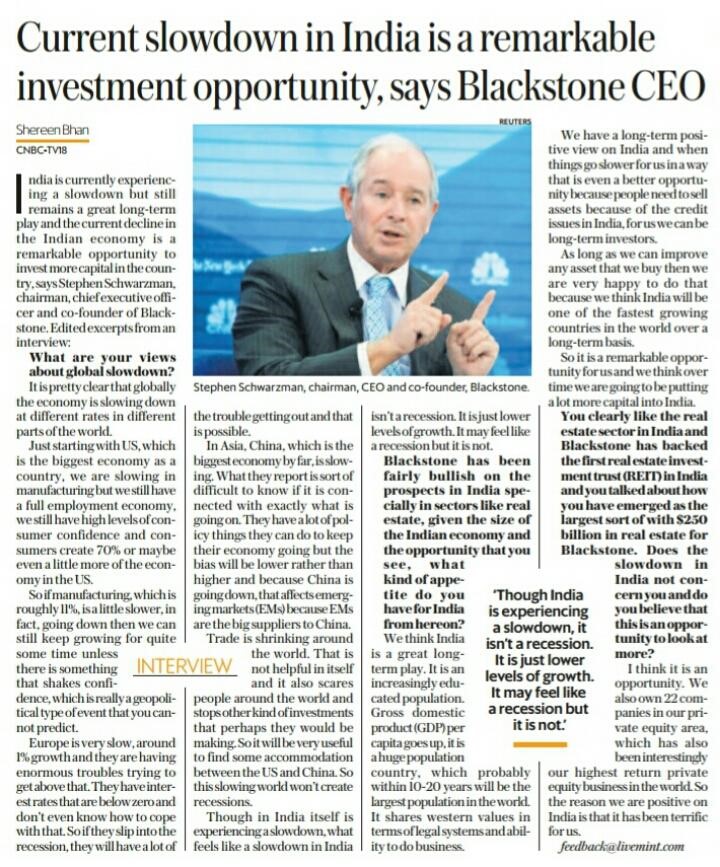
India remains a compelling long-term investment and business story – despite a lot of negative talk about the Indian economy (mostly politically motivated but also buoyed by a slow down in growth).

blackstone5

Most commentators expect the slowing to be temporary.

Take a look at the MSCI India index which has comfortably outperformed the MSCI Emerging Markets index (697.7 per cent vs. 485.1 per cent). Not too bad.

Favourable demographics is another driver with India having the world’s largest population of millennials – those aged between 21 and 38 – India has 450 million and these people will transform India. What it eats, drinks, how and where it travels, fashion, what it watches and listens to – life will change fundamentally.

More than 50 per cent of the population is under 25 years of age – a total of 600 million – with 1 million new people entering the workforce each month. Contrast this with China, which is ageing faster than any other country, with the over 60’s expected to account for 35 per cent of the population by 2050. Europe, the US and Japan face similar demographic challenges.

Urbanisation is another driver of growth – a third (34 per cent) of India’s population is urban, but it’s rising fast. Compare this to China (58 per cent) and Japan (92 per cent) – you can see the long-term growth story of India.

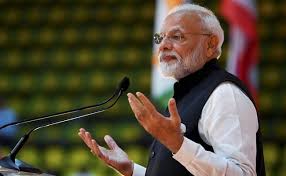
Then there is structural and economic change, with pro-business Prime Minister Narendra Modi – let’s steer clear of short-term politics but acknowledge that change has happened, and more is to come.

Visitors to India notice rapid improvement in infrastructure – road construction, plus 27 km of railway built per day, while India’s metro system is growing again, new airports and more.

Investors and businesses should be finding a way to participate in and benefit from the long-term India growth story.

India’s “richer, younger urbanites” will demand more food choices

India is self-sufficient in wheat, rice, corn and milk.

But – it is becoming “richer, younger and more urban” which inevitably means consumption patterns will shift.

Just a very broad approach here – but after over two weeks in India these are the “big 6 food imports” of the next decade:

  • Nuts (almonds and walnuts)
  • Pulses (peas, chickpeas, lentils)
  • Apples, grapes and pears
  • Chocolate
  • Beverages (juice and wine)
  • Processed fruit (dried apricots, raisins, prunes and jam)

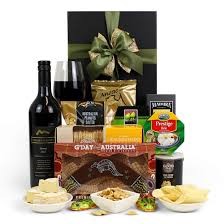
Be great to see the “Aussie Hamper” enter the gift giving market in India.

The problem with RCEP is it has forgotten to walk in India’s shoes

Many of us had “high hopes” for the Regional Comprehensive Economic Partnership (RCEP). In a world of “trade wars” this seemed a way to create the world’s largest trade pact. Exciting stuff.

RCEP wanted to cover the 10 member countries of the Association of Southeast Asian Nations (ASEAN), and the six countries with which the ASEAN bloc has free trade agreements (FTA). These included Australia, China, South Korea, Japan and New Zealand.

rcep5

But now it seems to have gone. India has called a halt to it. Or, to be more accurate, inflexible negotiations on India’s concerns have pushed India out.

Here is a problem for RCEP – under their proposed deal, India faced a potential flood of Chinese imports.

Just look at the current global situation and you might understand the Indian approach.

The Indian Government of Prime Minister Narendra Modi has rightly highlighted that “India’s farmers, traders, professionals and industries have stakes in such decisions.” Seems RECP negotiators were not listening.

We have to “walk in India’s shoes” to fully understand this – a decision to safeguard the interests of poor and effort to give an advantage to India’s service sector while not shying away from opening up to global competition across sectors. That is the Indian view.

The view from India was they would have been required to eliminate tariffs on 74% of goods from China, Australia and New Zealand, and 90% goods from Japan, South Korea and ASEAN. In the midst of an economic slowdown, India “faced the risk of becoming a dumping ground for cheap Chinese goods.”

There was a special concern of Chinese agricultural products hurting Indian farmers.

RCEP advocates have hurt themselves by refusing to “walk in India’s shoes”. That’s no way to negotiate.

rcep3


Horticulture & Hydroponics research mission from Australia to India

From 3 November to 13 November Tony Bundock of Genesis Horticulture Solutions will be leading a research project in India on “POTENTIAL AUSTRALIA-INDIA COLLABORATION ON HYDROPONIC & PROTECTED CROP PRODUCTION AND TRAINING”.

Tony is clear that the mission is not taking a “one size fits all” solution but will genuinely  research potential Australia-India Horticulture Collaboration – understanding the state of play in this sector in India – identifying business and education/skills training opportunities and partnerships. He aims to identify levels of support in both countries for showcasing best practices in controlled cropping/hydroponics and for provision of skills training and train-the-trainer through Australian education/TAFE partners.

PROJECT FIRST STAGE RESEARCH FUNDING

Funding support has been provided for the first research stage by the Australia India Council, Department of Foreign Affairs and Trade, Government of Australia.

I am really pleased to be joining Tony on this mission.