India now chasing trade deals – having resisted for decades

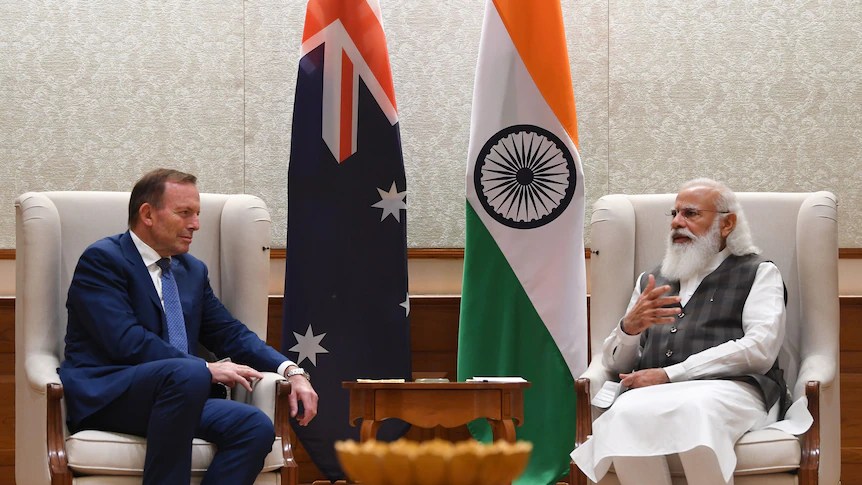
Indian PM Narendra Modi meets recently on trade with former Australian PM Tony Abbott

What has changed for India? It seems that having resisted trade deals for years, it now plans by the end of March 2022, to complete multiple quick-fire bilateral trade agreements.

Something has not changed however – the Indian government, distrustful of full scale FTA’s, is prioritizing “early harvest” pacts over comprehensive free trade agreements.

What has changed is the pandemic and the rise of China.

Therefore, the Indian government is focusing on strengthening the trade with G-7 nations with strong Indo-Pacific strategies and those with growing influence in central Asia such as the United Arab Emirates.

Australia, at a key position in the Indo-Pacific, is a high priority. As a fellow member of the QUAD, India and Australia have never been so close strategically and are keen to add trade now.

In large part, this is India’s push to do well as supply chain realignments take place – there is only a narrow window of opportunity to get these deals done.

How big is this? The government is negotiating bilateral trade agreements with 20 countries and expects to complete half a dozen deals, including those with Australia and Britain by this December and March 2022. 

India is ambitious – Mr. Piyush Goyal has set kept a target of US$ 400 billion for annual merchandise exports – almost 38% higher than US$ 290 billion achieved in last year and plans to achieve US$ 2 trillion annual merchandise exports by the end of this decade.

Outcome? Lots of deals that will not be quite world class Free Trade Agreement (FTA) but which will have some wriggle room.

Deloitte finds US firms investing more in India than in China

INTO INDIA has long called for more western investment into the growth story that is modern India.

Now, according to a survey conducted by multinational professional services network, Deloitte, a large proportion of international business leaders remain confident in India’s short- and long-term prospects and are readying plans to make additional and first-time investments in the country.

The India FDI Opportunity survey of September 2021, which questioned 1,200 business leaders of multinational corporations in the U.S., U.K., Japan, and Singapore, found that India remains an attractive destination for investments, scoring highly for its skilled workforce and prospects for economic growth.

  • 44 percent of the 1,200 business leaders surveyed are planning additional or first-time investments in India
  • Nearly two-thirds of first-time investments will be made within the next two years
  • Business perceptions of India are better in the U.S. and UK compared to Singapore and Japan
  • Recent reforms by the Indian government to improve ease of doing business are popular, but awareness of policy improvements remains low

It also said that more business leaders, especially in Japan, are making investments in India for access to the domestic market rather than using India as a springboard for exports.

“India has the strongest positive perception in the U.S. when compared to markets such as China, Brazil, Mexico, and Vietnam. The U.S. and U.K. business leaders expressed greater confidence in India’s stability,” it said.

Investment is always indirectly but powerfully linked with market entry and trade outcomes. INTO INDIA applauds the enthusiasm of the US for India and hope this is also taken up in Australia – where investment funds are high – fourth largest wealth management market in the world.

New “Business Champions” group to provide much needed top level links between India and Australia

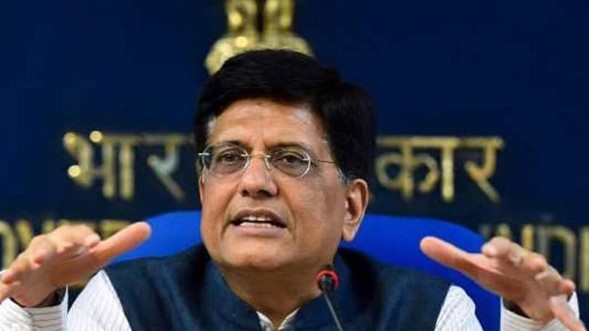
Indian Commerce Minister Mr Piyush Goyal

A new “Business Champions” group will lead top level business engagement between India and Australia – and it was launched last week in India.

INTO INDIA welcomes this move to bring the “top end” of both countries together. Business engagement at this level has not worked well in the past. Most of the business councils and chambers have provided lower level SME engagement – important as this is.

“Supply chains” is behind the enthusiasm of India for the new Australia-India Business Champions Group’s role. Mr. Piyush Goyal, Minister of Commerce & Industry, Consumer Affairs, Food & Public Distribution, Textiles, Government of India said this when addressing the Inaugural Meeting of the Australia India Business Champions.

The Minister is co-chairing the group with Australian Trade Minister, the Hon Dan Tehan.

“The Australia-India Business Champions Group’s key aim is to liberalise and deepen bilateral trade between both the nations and pave the way for collaborative economic growth.” stated Mr. Dan Tehan MP, Minister of Trade, Tourism and Investment, Government of Australia.

Major business organisations leading the group are the Confederation of Indian Industry (CII) and the Business Council of Australia (BCA). Both represent almost all the major business corporations in both countries.

Mr. Chandrajit Banerjee, Director General, CII, pointed to areas such as mining, education, defence, space and emerging sectors which the group can take forward.

Ms. Jennifer Westacott AO, CEO, BCA, highlighted that we must strengthen and reform regional and global institutions, so they deliver for our citizens.  She said the Business Champions would engage directly with the top tier of Australian and Indian Governments on matters critical to business. 

Other panelists at the meeting included H E Mr. Manpreet Vohra, High Commissioner of India to Australia, H E Mr. Barry O’ Farrell AO, High Commissioner of Australia to India, Dr. Anish Shah, MD & CEO, Mahindra & Mahindra Ltd, Ms. Julie Shuttleworth, CEO, FFI, Mr. Rakesh Bharti Mittal, Vice Chairman, Bharti Enterprises, Mr. Mike Cannon-Brookes, Co-Founder and Co-CEO, Atlassian, Mr. Nitish Jain, President, SP Jain School of Global Management, Ms. Verena Lim, Asia CEO, Macquarie Group, Mr. Girish Ramachandran, President, Tata Consultancy Services Asia Pacific, Professor Duncan Maskell, Vice Chancellor, University of Melbourne.

Australia: home to 48 of the world’s top 50 most innovative companies

Bosch and Monash University team up on “smart agriculture”

When you think Australia you might call to mind minerals, vast fields of agriculture or cricket.

But there is another reality about Australia – it’s a smart place.

International companies are leveraging Australia’s talent, government support and research to boost productivity, competitiveness and growth – according to data from Austrade and Boston Consulting Group.

Forty-eight out of Boston Consulting Group’s top 50 most innovative companies operate in Australia. These companies have partnered with Australian organisations to research additive manufacturing, renewable hydrogen technology and cloud supercomputing, among other areas.

Advanced manufacturing: General Electric

GE subsidiary GE Additive and the University of Sydney are establishing a high-tech manufacturing hub. The Sydney Manufacturing Hub will advance Australia’s capability in metal additive manufacturing technology.

Agricultural technology: Bosch

Bosch Australia and Monash University are co-developing Australia’s first smart agriculture research facility. The facility will contain a prototypical ‘smart farm’ to test: artificial intelligence; automation; robotic and advanced sensor technology solutions

Energy: Hyundai

Hyundai, Fortescue and CSIRO are working together to develop renewable hydrogen technology. The group seeks to:

  • develop new hydrogen technologies with the potential for bulk transport
  • build a renewable hydrogen refuelling facility, to deploy hydrogen fuel cell coaches
  • build the first combined hydrogen production and refuelling facility in Western Australia. 

Healthcare: Johnson & Johnson

The Johnson & Johnson Innovation Partnering Office @ Monash is a hub for researchers and early-stage companies. The facility allows them to develop novel pharmaceutical, medical devices, and consumer healthcare solutions.

Technology: Amazon Web Services and Intel

Amazon Web Services, Intel and AARNET established Australia’s first cloud supercomputing facility. Based at RMIT University, the facility focuses on advanced data processing and computing.

So, from the land of minerals, farming and cricket – there is also an advanced technology reason to team up with the Aussies.

India a prime target for Aussie exports and investment – Austrade

Austrade’s Ashley Brosnan puts the case for Australian businesses to quickly get into India:

Australian businesses continue to see opportunities across a range of sectors including education, mining and resources, infrastructure, agri-food, and digital services. Thanks to the steady success of some great Australian brands, Australia is already a trusted supplier and investor.

However, India remains a challenging place do business. Expansion requires a high degree of market literacy and on-the-ground experience. Local partners help exporters and investors to navigate markets and regulation – and these partners can prove invaluable.

Despite this, the Government of India has signalled that India is ‘open for business’. It is emphasising investment and competitiveness as factors that will support the economy and encourage a return to growth.

The effects can be observed already in global rankings. India has moved up 63 places in the World Bank ‘ease of doing business’ rankings in recent years.

Austrade is helping Australian companies to explore India

The Australian Government is investing heavily in developing commercial links between Australia and India. The Australia-India Comprehensive Strategic Partnership agreed by Prime Ministers in June 2020 creates further opportunities for Australian business.

The Partnership seeks to build supply chain resilience between the two countries. It strengthens and diversifies trade and investment links with a focus on education, critical minerals and technology cooperation.

Today, Austrade posts across India are working intensively with Australian businesses to understand market, identify opportunities, make connections and help companies negotiate contracts.

India consumer spending skyrockets

India’s consumer spending a “revolution”

Austrade’s Ashley Brosnan on India’s consumer spending “revolution”:

The biggest revolution taking place is the rapid rise of a huge, diverse and wealthy consumer market. Despite the impacts of the pandemic, domestic demand is likely to be a major driver of recovery and growth over the next decade, making up 60% of the overall economy.

E-commerce is taking off as smartphone usage multiplies. India already has over 1 billion internet users and the digital economy’s contribution to GDP is projected to grow 15–20% by 2024.

Incomes are also rising strongly. India’s median income per household is expected to reach A$13,867 by 2025. The World Economic Forum considers that consumer expenditure in India will grow by a factor of four up to 2030.

This means over 80% of Indian households will be middle-income in 2030 – an increase of 140 million. Another 20 million will be considered high income.

India’s emerging and aspirational middle class is seeking premium food and beverage, healthy lifestyle products, technical infrastructure, quality healthcare and education, entertainment and consumer goods.

Trends in consumer demand are encouraged by a substantial, highly-skilled Indian diaspora in Australia, which is set to number 1.4 million in 2031.

India could be world’s third largest economy as soon as 2030

Two facts demonstrate India’s amazing economic growth:

First, today India is the world’s 6th largest economy.

Second, as soon as 2030, it is likely to be the 3rd largest.

Mugunthan Siva, CEO of India Avenue Investment Management (Sydney and Mumbai) makes a compelling case for India focused, actively managed high conviction funds and the investment themes he likes include technology, manufacturing, construction, rural, real estate, B2B and market share leaders.

You can read more here:

https://www.livewiremarkets.com/wires/why-india-could-be-third-placed-by-2030

India Avenue website:

UK and India pragmatic negotiators achieve a trade and investment deal

INTO INDIA has been advocating for Australia to do what deals can be done with India, and “park” a Free Trade Agreement for later on.

The UK-India Virtual Summit has done just that.

Their newly created Enhanced Trade Partnership (bureaucratic speak for “these are the things we can agree on now) will create immediate opportunities for British businesses in India across industries including food and drink, life sciences and the service sector.

Non-tariff barriers on fruit and medical devices will be lowered, allowing British businesses to export more of their products to India and boosting UK growth and jobs. It also commits both sides to addressing immediate market access barriers as well as continuing to seek further opportunities on the road to an FTA. That is, “parking” the FTA for later on – it is just too hard to achieve.

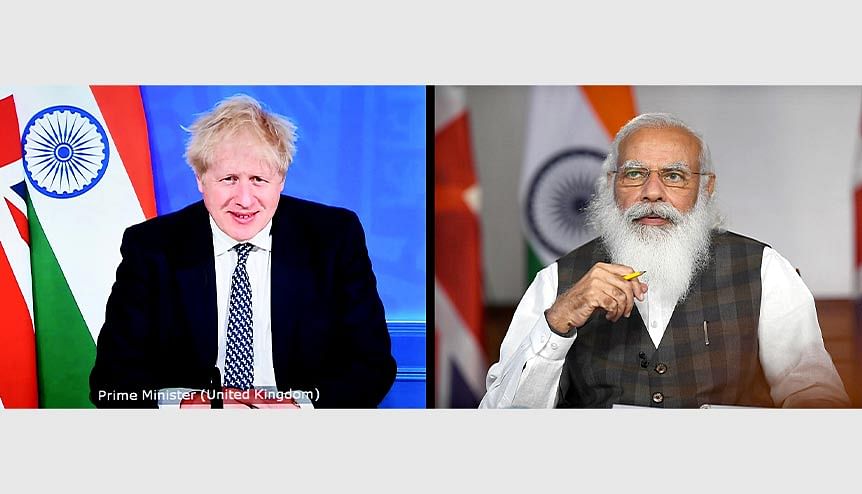
Prime ministers Narendra Modi and Boris Johnson held their Virtual Summit this week and agreed on a “Comprehensive Strategic Partnership” – the first European country to gain this status.

Australian PM Morrison achieved a CSP with India in 2020 and set out collaboration across science and technology, maritime issues, defence and more.

CSP deals are a sign that India is become more outward looking and – like everyone else – concerned about the behaviour of China.

The trade and investment package unveiled by the British government contains over £533 million of new Indian investment into the UK, covering areas such as healthcare and technology.

British businesses have also secured new export deals with India worth more than £446 million, which is expected to create more than 400 British jobs.

I hope our Australian trade officials are going through all the detail to see if any deals Australia has with India can now be updated on a deal-by-deal basis.

IMF Projects India’s Growth Rate to Jump to Impressive 12.5 Per Cent in 2021

My good friend Mugunthan Siva is the CEO of India Avenue Investment Management – an India and Australia investment company – and he has advised me of great news for the Indian economy and investors.

The International Monetary Fund is now forecasting India to grow GDP at 12.5% in 2021 – the only double digit forecast amongst developed and emerging economies.

Expected global growth of 6% will also play a role in India’s growth given its incrementally increasing role in supply chains, the rise again of the IT outsourcing industry and its strength in pharmaceutical manufacture and export.

In 2022 the IMF forecasts a further 6.9% GDP growth for India – once again the leader of the pack. If India continues to grow like this the US$5tn goal of the Modi’s Government appears within reach in the next 4-5 years.

According to Mugunthan, India’s equity market is evolving nicely given the pivot post COVID. Market breadth has normalised and active managers are dominating the landscape again, as they should in an inefficient equity market like India’s. The next 3 years should see a strong recovery in corporate profit.

Vishal Kampani, JM Financial, applauds the Indian budget

Commenting on the recent Indian Budget, Vishal Kampani, Managing Director, JM Financial Group, said “the Finance Minister has laid the foundation for next-generation growth and deserves a big round of applause.”

The Union Budget 2021-22 presented by Finance Minister Nirmala Sitharaman on Monday has laid out the road map for India to achieve sustainable growth in the years to come by delivering on key expectations. By choosing growth imperatives over fiscal puritanism, the FM has clearly indicated where the government’s focus and priorities rightly lie.

Read more at:

https://www.fortuneindia.com/macro/budget-to-propel-growth-but-implementation-is-the-key/105141