Don’t get too excited about the new India and Australia talks on CECA

The relationship between these two might hold the key to the current CECA talks

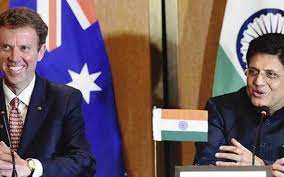
INTO INDIA is optimistic that some deals will emerge from the current round of talks on the Australia-India Comprehensive Economic Cooperation Agreement (CECA) – spearheaded by Australian Trade, Tourism and Investment Minister Dan Tehan and, Commerce and Industry Minister Piyush Goyal.

But a look at Australia’s stance and recent Indian trade policy actions is not reassuring.

India withdrew from the negotiations for the Regional Comprehensive Economic Partnership (RCEP); it renegotiated a number of its free trade agreements; it terminated most of its bilateral investment agreements; and it has failed to agree a mini-economic deal with the United States. Not to mention India’s stance in the World Trade Organisation which has been unchanged.

At the domestic level, India has imposed prohibitive tariffs in several sectors and introduced a range of incentives to attract reshoring and investment.

How does Australia’s record stack up? Eager to send more resources and agriculture to India, Australia has been reluctant to allow great services access and people movement from India. This is a thorny issue.

So our word is CAUTION – don’t get your hopes up too high – there has been little progress to show after ten years of negotiations.

So, why be optimistic now?

First, Australian professional trade negotiations have loosened up on what was a cornerstone article of faith for them – preferring the “single undertaking” negotiating model – in which nothing is agreed until everything is agreed. Now even they are talking about “early harvest” deals. But can they change their spots? The Morrison government, desperate for a trade win, hopes they can.

Second, India has direct concerns about China and is nervous about the US-China rivalry. It has sensibly decided to build up strategic and economic partnerships as a hedge. There is much talk in India about potentially good trade outcomes arising from China’s “trade war” on Australia.

But the stalemate is always market access.

Australia wants agriculture access – India is hesitant because this sector employs 40% of India’s population. India wants liberalisation of the services “mode 4”, specifically the short-term entry of business persons. India has argued that Australia’s short term business visitor regime constitutes a barrier to India’s services exports. Australia has pushed back on these demands, reflecting concerns at the potential impact on the labour market. In a nutshell – one big stalemate!

Overall, India is not a fan of Free Trade Agreements, seeing most of them widening its trade deficit. That is, India feels the other party benefits most. It has negotiated on five FTA’s over the last 11 years and only one has been signed.

True, India is looking eager, having revived trade talks with the European Union, United Kingdom, United States and Australia. But is it all just a lot of talk?

Remember, India is primarily after foreign investment, exports, making domestic industries competitive and incentivise other countries to manufacture in India. Can Australia play a role in any of this?

The key for Australia and India is to somehow align Australia’s export goals with India’s investment and new exports priorities.

Australia could partner India on technology, innovation and R&D.

Australian companies could boost investment into India – and there are good economic and government subsidy reasons to do so.

Australia has one big advantage here – critical minerals. India has high sustainable energy and e-mobility goals and will need these minerals.

Add to that, Australia has growing expertise in the hydrogen industry, while India has a National Hydrogen Mission. There are good R&D opportunities for both.

While India is the “pharmacy of the world”, Australia is a leader in biotech R&D. Biotech in dairy, marine and more could provide trade deal motivation.

But finally, there is the big blockage.

India wants to increase skill migration to Australia. Australia has opposed it. Most of the talks in the last decade have faltered at this point.

What has changed?

Border closures have left Australian businesses struggling to fill roles. Australia needs an ‘early harvest deal’ to attract skilled professionals from India.

So, despite the gloom of the past, there are reasons to have some optimism for these talks on CECA.

Watch this space.

India’s Economy “Picking up Steam” Says S&P

Australian exporters – take another look at India

S&P Global Ratings said that after stalling post the second wave of the Covid pandemic, India retained the country’s BBB-sovereign rating with a stable outlook.

INTO INDIA has urged Australian firms looking for new markets to take another close look at opportunities in India.

S&P said that growth will improve over the July-September quarter, pointing to high-frequency indicators such as goods and services tax receipts and motor vehicle sales. Record forex reserves, and India emerging as an external creditor to the world has also supported the rating and stable outlook, S&P said.

Data released in July showed India’s economy expanded 20.1% year-on-year in the April-June quarter on a low base though sequentially it was down 16.9% over the previous quarter. 

S&P anticipates another Covid wave in India, but with rising vaccination coverage, it expects this to be less severe both in terms of health and economic impact. India’s vaccinations have crossed 700 million and in the first week of September, the daily average has been over 7.6 million doses.

Source THE INDIA EXPERT blog of Gunjan Bagla

CONCLUSION – INTO INDIA asks exporters and investors – if you are not now heavily committed to India, now is the time to take action.

India now chasing trade deals – having resisted for decades

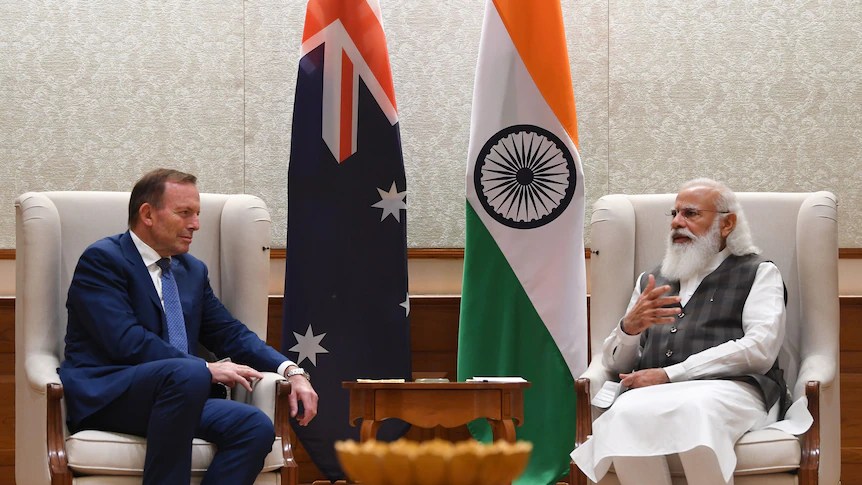
Indian PM Narendra Modi meets recently on trade with former Australian PM Tony Abbott

What has changed for India? It seems that having resisted trade deals for years, it now plans by the end of March 2022, to complete multiple quick-fire bilateral trade agreements.

Something has not changed however – the Indian government, distrustful of full scale FTA’s, is prioritizing “early harvest” pacts over comprehensive free trade agreements.

What has changed is the pandemic and the rise of China.

Therefore, the Indian government is focusing on strengthening the trade with G-7 nations with strong Indo-Pacific strategies and those with growing influence in central Asia such as the United Arab Emirates.

Australia, at a key position in the Indo-Pacific, is a high priority. As a fellow member of the QUAD, India and Australia have never been so close strategically and are keen to add trade now.

In large part, this is India’s push to do well as supply chain realignments take place – there is only a narrow window of opportunity to get these deals done.

How big is this? The government is negotiating bilateral trade agreements with 20 countries and expects to complete half a dozen deals, including those with Australia and Britain by this December and March 2022. 

India is ambitious – Mr. Piyush Goyal has set kept a target of US$ 400 billion for annual merchandise exports – almost 38% higher than US$ 290 billion achieved in last year and plans to achieve US$ 2 trillion annual merchandise exports by the end of this decade.

Outcome? Lots of deals that will not be quite world class Free Trade Agreement (FTA) but which will have some wriggle room.

Deloitte finds US firms investing more in India than in China

INTO INDIA has long called for more western investment into the growth story that is modern India.

Now, according to a survey conducted by multinational professional services network, Deloitte, a large proportion of international business leaders remain confident in India’s short- and long-term prospects and are readying plans to make additional and first-time investments in the country.

The India FDI Opportunity survey of September 2021, which questioned 1,200 business leaders of multinational corporations in the U.S., U.K., Japan, and Singapore, found that India remains an attractive destination for investments, scoring highly for its skilled workforce and prospects for economic growth.

  • 44 percent of the 1,200 business leaders surveyed are planning additional or first-time investments in India
  • Nearly two-thirds of first-time investments will be made within the next two years
  • Business perceptions of India are better in the U.S. and UK compared to Singapore and Japan
  • Recent reforms by the Indian government to improve ease of doing business are popular, but awareness of policy improvements remains low

It also said that more business leaders, especially in Japan, are making investments in India for access to the domestic market rather than using India as a springboard for exports.

“India has the strongest positive perception in the U.S. when compared to markets such as China, Brazil, Mexico, and Vietnam. The U.S. and U.K. business leaders expressed greater confidence in India’s stability,” it said.

Investment is always indirectly but powerfully linked with market entry and trade outcomes. INTO INDIA applauds the enthusiasm of the US for India and hope this is also taken up in Australia – where investment funds are high – fourth largest wealth management market in the world.

New “Business Champions” group to provide much needed top level links between India and Australia

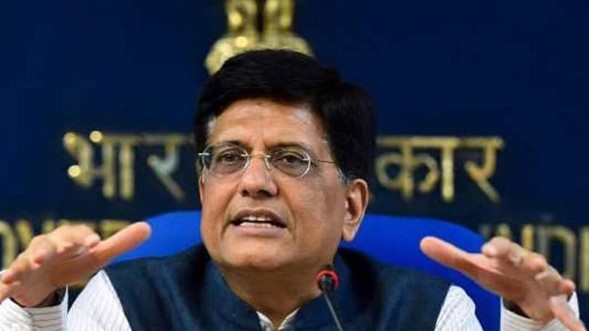
Indian Commerce Minister Mr Piyush Goyal

A new “Business Champions” group will lead top level business engagement between India and Australia – and it was launched last week in India.

INTO INDIA welcomes this move to bring the “top end” of both countries together. Business engagement at this level has not worked well in the past. Most of the business councils and chambers have provided lower level SME engagement – important as this is.

“Supply chains” is behind the enthusiasm of India for the new Australia-India Business Champions Group’s role. Mr. Piyush Goyal, Minister of Commerce & Industry, Consumer Affairs, Food & Public Distribution, Textiles, Government of India said this when addressing the Inaugural Meeting of the Australia India Business Champions.

The Minister is co-chairing the group with Australian Trade Minister, the Hon Dan Tehan.

“The Australia-India Business Champions Group’s key aim is to liberalise and deepen bilateral trade between both the nations and pave the way for collaborative economic growth.” stated Mr. Dan Tehan MP, Minister of Trade, Tourism and Investment, Government of Australia.

Major business organisations leading the group are the Confederation of Indian Industry (CII) and the Business Council of Australia (BCA). Both represent almost all the major business corporations in both countries.

Mr. Chandrajit Banerjee, Director General, CII, pointed to areas such as mining, education, defence, space and emerging sectors which the group can take forward.

Ms. Jennifer Westacott AO, CEO, BCA, highlighted that we must strengthen and reform regional and global institutions, so they deliver for our citizens.  She said the Business Champions would engage directly with the top tier of Australian and Indian Governments on matters critical to business. 

Other panelists at the meeting included H E Mr. Manpreet Vohra, High Commissioner of India to Australia, H E Mr. Barry O’ Farrell AO, High Commissioner of Australia to India, Dr. Anish Shah, MD & CEO, Mahindra & Mahindra Ltd, Ms. Julie Shuttleworth, CEO, FFI, Mr. Rakesh Bharti Mittal, Vice Chairman, Bharti Enterprises, Mr. Mike Cannon-Brookes, Co-Founder and Co-CEO, Atlassian, Mr. Nitish Jain, President, SP Jain School of Global Management, Ms. Verena Lim, Asia CEO, Macquarie Group, Mr. Girish Ramachandran, President, Tata Consultancy Services Asia Pacific, Professor Duncan Maskell, Vice Chancellor, University of Melbourne.

Business with India? Leave your ego behind and let Indians run the business

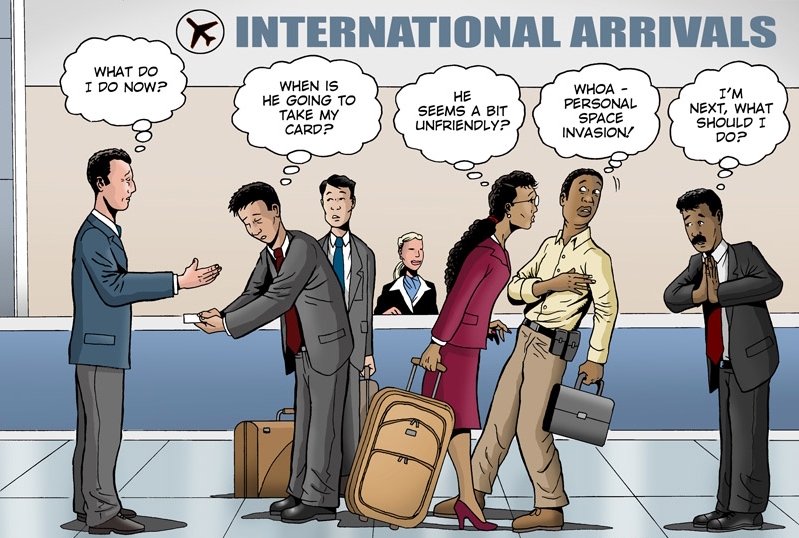
Pretty much every western company that has succeeded in India has done so on the support of a strong local Indian team across all levels. To do this, they have effectively left their ego behind.

Those who struggle typically want to transfer their “culture” to India so they put their expat team in charge of the local team. This is ego centred and mostly does not work. These are mainly companies that do not trust the locals and are over-confident about their own “head office culture”.

Being preoccupied with transferring “the way we do things in our company” to India makes them blind to “the way Indians do things there” which is the most important insight for future success.

So – local management teams are essential in India (and probably anywhere you go in Asia) and that team should lead and manage your enterprise throughout India. This does not mean you do not provide the support of some expats – of course good companies do, but this is to empower the local team. Expats can come and go as needed – but your business needs longevity in India and that is what an Indian management team can provide.

Smart companies that go into Asia also ensure they hire Asians into the HO team, so you have Asians running your enterprise on the ground in Asia and Asians at the right level in HO guiding and advising the HO team.

Real access to family and business networks in India (and probably all of Asia) is mostly only achieve by Indians.

Conclusion – if you want to succeed in business in India, rely on Indians to run your Indian business.

Affordability and lack of credit holding back India’s digital economy – but not for long

Nitin Jain is CEO and principal fund manager at Kotak Mahindra Asset Management (Singapore)

While predicting rapid growth, Nitin Jain of Kotak Mahindra Asset Management (Singapore) says there might be one catch – the India digital economy has to overcome one big hurdle – affordability. This is matched by a shortage of consumer credit.

Nitin Jain explains:

With per capita incomes of about $2,000 and large infrastructural challenges, to offer a value proposition at a mass level is extremely challenging, and requires large capital.

2021 has been a breakout year with more than $20bn in funding so far this year and almost $10bn in July 2021 alone. Prior to this the average was just $8bn-$10bn per year.

The future is looking bright for India to become a credit-rich country enabled and backed by data. Fintechs with buy mow pay later (BNPL) businesses will help fuel the data backed credit boom.

With one of the youngest economies with about 1.4 billion people, the highway to growth is long.

India already have more than 100 million users on Amazon, and travel, transport, ed tech, food tech, gaming, SaaS in enterprise and mass, are seeing millions getting added every month.

Traditional businesses tend to grow in an algebraic way, but digital businesses are growing at geometric scale and some potentially at logarithmic scale. 

We as investors are keenly analysing these changes and investing in upcoming opportunities and remain hawk-eyed on potential disruptions.

A vibrant digital ecosystem throws in immense possibilities of large capital coming to India.

Tens of billions have been invested by global investors in Chinese internet businesses and India is at a similar stage and with the recent chaos, potential realignments can accelerate the flows.

Y2K was a watershed moment for India IT services and 20 years later, Covid-19 will likely be a watershed moment for the Indian digital economy.

Indian economy primed for growth – old and new

Nitin Jain CEO and principal fund manager of Kotak Mahindra Asset Management (Singapore)

For investors, India is at a very interesting juncture, according to Nitin Jain of Kotak Mahindra Investment Management.

The old economy is set to make a comeback after a Covid-19 hiatus and the digital economy is primed for hyper growth – perfect combination!

Nitin Jain says: “The latter is becoming more pertinent when we see serious regulatory challenges emanating from the biggest new economy play in the world, China.”

On the day when the China ed-tech companies and other new economy stocks were reeling under the fear of profits being taken away, Zomato, a fast growing Indian food tech company had its listing day gains of more than 50%.

Close on the heels are many other digital businesses which are getting ready for listing.

Indians are already hooked to the internet and now we are seeing transaction-related internet businesses gaining mega scale. 

In fact, around 750 million have access to a mobile payment system tied with the Aadhar card, a biometric card which uniquely identifies an individual and is very easily accessible by any business, government services, and healthcare services securely, seamlessly and at almost no cost.

So – time to review your investment and business/market entry strategies?

Tony Abbott might have overstated it – but he is more right than wrong on India

Tony Abbott wants Australia to make a big shift towards India and away from China.

Despite some hysterical responses from two former Aussie PM’s, Tony Abbott has by and large got it right on India and we should work towards the closer relationship he believes is possible – and necessary!

Consider this verbal stoush:

“The answer to almost every question about China is India. Although currently not as rich as China … India is perfectly placed to substitute for China in global supply chains … India has revived the Quadrilateral Security Dialogue, and the first in-person Quad summit is expected before the end of the year. Under Modi, India has invited Australia to join the annual Malabar naval exercises that will soon involve India, the US, Japan, Australia and also the UK … It will be an impressive show of strength, demonstrating the democracies’ commitment to a free and open Indo-Pacific … If Australian business and officialdom were to make the same effort with India that they’ve long made with China, there’s potential for a ‘family’ relationship with India that was never likely with China.”

– Former prime minister Tony Abbott in The Australian (10/8/21)

“No, (Abbott’s comment) is just wrong. We all agree our relationship with India has been underdone over the years … India has got a very deep longstanding protectionist political culture. They weren’t even prepared to sign up to RCEP … You have got to be realistic about what you can achieve in terms of trade. They are different countries, different economies. We should be aiming to have much stronger deeper relations with India …  Every prime minister should and will do that. But the idea that can sort of delete China and insert India is just nonsense.”

– Former prime minister Malcolm Turnbull at a La Trobe University webinar (10/8/21)

“We have got to be deeply realistic about one thing (about the Quad). Is it the assumption of future Australian governments, like Tony Abbott’s view in today’s press, that the Indian navy is going to go steaming into the South China Sea to defend Uncle Sam’s interest if the balloon goes up over Taiwan? I think not   …  We need to ask some very hard military questions about the core strategic utility of this (the Quad) for the longer term … We need to go into this with wide eyes open, not the blithering idiot remarks we’ve seen from Abbott in today’s newspapers.”

– Former prime minister Kevin Rudd also at La Trobe University

“The one thing we should not be doing is saying to India, this is to line you up to be the next member of ANZUS to take on China. I agree with what Kevin said, that equally just plays into the paranoia of China … We have to just move gently, avoid extravagant language (with India) …  Frankly, extravagant claims of the type we were talking about a moment ago are not helpful.”

– Malcolm Turnbull again

“India is the world’s emerging democratic superpower and my god don’t we need another democratic superpower in the world right now. Isn’t it so important that a country like Australia do everything it can to ensure India does take its rightful place up there at the head of the world’s great democracies.”

– Tony Abbott, Australia India Address (17/8/2021) 

Well, what do you think?

Winning in India – less about sales and more about culture and relationships  

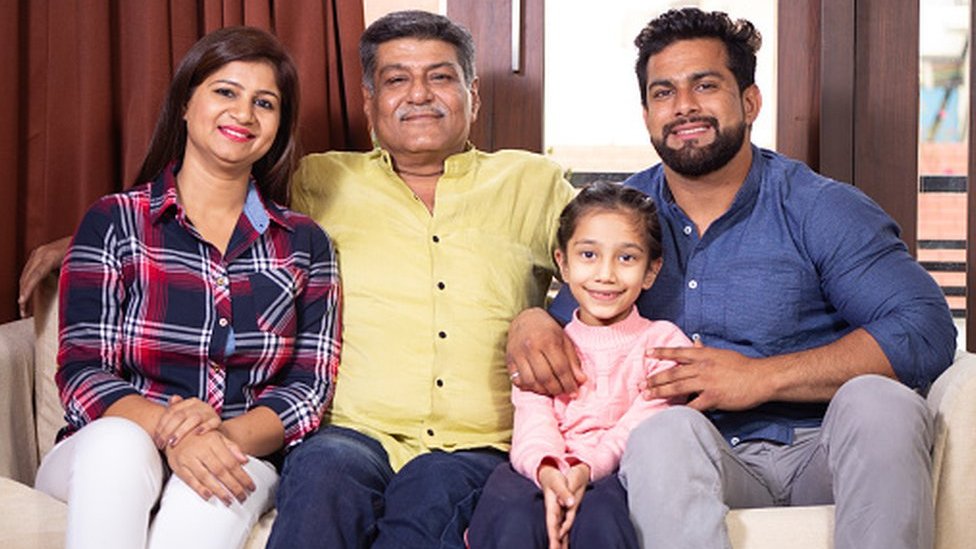
Most Indians continue to live in joint families – your business host might be the same so be curious about their life and culture

When a company sends a salesperson into the Indian market, the goal is to fill the order book as quickly as possible – there is no time for that person to build ongoing relationships.

The result at best is a quick transaction based on price.

It rarely lasts.

India is a country where relationships drive and impact all aspects of business. That is “how they do things there” and expect us to be the same.

Some tips for relationship building in these tough times:    

You can build good relationships during Covid by hosting a zoom or similar catchup to see how things are going – no big agenda, share experiences and listen.     

You can join groups and chambers and be seen as a player.  
     
You can accept the intangibility of relationships and give your key executives time and resources to build them.      

You can look up Indian culture, architecture and history so you can have informal conversations about things close to their heart.

You will need strong curiosity and listening skills.

Really, decisions about future business with India need to be C-Suite and Boardroom driven, based around a minimum three-year strategy. And giving your people the right to spend time on the intangible of relationships is the best first step.