Why is the Indian American diaspora so successful and now influential in the US?

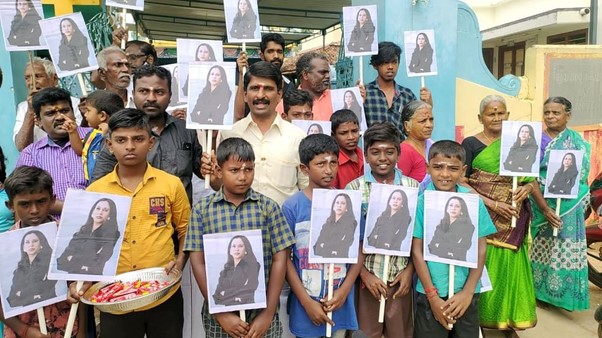
The power of India in the US. People hold placards of Kamala Harris, as she prepares to take her oath as vice-president of America, at her ancestoral village in Thulasendrapuram.

Migrants from India are the most successful migrant group in the USA and now they are becoming influential and leading in politics. Even President Joe Biden recently quipped that “Indian Americans are taking over the country”.

These Indian Americans have played a “stellar role” in education, technology and entrepreneurship. Now public administration and politics.

Companies in the US headed up by Indian American CEO’s right now include Google, Microsoft, Albertsons, Micron Technology, Mastercard and Adobe Inc.

Biden should feel close to the Indian migrants – his speech writer (Vinay Reddy), Vice President (Kamala Harris) and the leadership of NASA’s Mars Mission (Swati Mohan) all have Indian heritage. But this is just the tip of the iceberg.

Indians are a small migrant group – around 3.8 million migrated making up 1.2 per cent of the US population.

But this diaspora is the richest, most educated and among the most successful ethnic groups in the USA.

Why?

Indian entrepreneurial drive makes them unique among migrants

The National Academies of Science, Engineering and Medicine of the US in its report titled The Economic and Fiscal Consequences of Immigration had said in 2015-16 that “Indian immigrants are the most entrepreneurial of any group including natives, and immigrant businesses represent more than a quarter of businesses in the transportation, accommodation, and recreation and entertainment sectors.”

Indians have chased better education

According to Pew Research Center data from September 2017, about 32 per cent of Indian Americans have a bachelor’s degree and 40 per cent are post-graduates. The comparable figures for all Asian Americans are 30 per cent and 21 per cent, respectively. If all Americans are considered, Indians stand out even more as only 19 per cent of Americans have undergraduate degrees and 11 per cent have post-graduate education.

Indians make more money

The Indian community in the US earn a lot more than all other ethnic groups, white Americans included. A recent survey by Coalition for Asian Pacific American Community Development found that the average income of Indian American families is $120,000, compared to the overall US average of $88,000.

So, why are Indians the most successful?

A recent book titled The Other One Percent: Indians in America bySanjoy Chakravorty, Devesh Kapur and Nirvikar Singh found some answers.

Singh hypothesises that “There is no ‘secret sauce’. There are no peculiarly Indian cultural traits (that make Indian Americans more successful than others)…. They came very carefully selected. They were not coming from poverty. The simplest policy prescription may be this: Make sure everyone has access to education,” he told the media.

The immigration of Indian Americans really began in 1965 when the US lifted caps it had placed on immigrants from some countries. Since then, the visa process has favoured the entry of mostly upper class, educated Indians, their close relatives, students with very high scores and skilled workers.

Summarising why Indians succeed in America

They are a migrant group with access to educational resources and having a stable financial background. Without these two, migrants generally stay at lower levels of income and influence.

You have not seen the best yet!

80 per cent of second-generation Indian Americans are under the age of 25 years. This means their political influence and commercial success is likely to grow further in the years and decades to come. The Indian American population is expected to almost double to 2 per cent of the US population by 2030. They are mostly concentrated in New York, New Jersey, Washington DC, California and Texas.

Indians now standing out in public service

President Biden has appointed significant numbers of Indian Americans to his team – Uzra Zeya, Under Secretary of State for Civilian Security, Democracy, and Human Rights, State Department; Mala Adiga, Policy Director to Dr Jill Biden; Aisha Shah, Partnership Manager, White House Office of Digital Strategy; Sameera Fazili, Deputy Director, US National Economic Council (NEC); Sumona Guha: Senior Director for South Asia at the National Security Council, White House; and Sabrina Singh: Deputy Press Secretary, Vice President White House.

In addition, two Indian Americans, Nikki Haley and Bobby Jindal, have already ruled states such as Louisiana and South Carolina as governors.

The story of Indian Americans is amazing right now – and will continue to grow.

Deakin University shows how to attract Indian students in the Covid era

Iain Martin, President and Vice-Chancellor of Deakin University

Australia is a leading destination for Indian students going overseas for education – and Deakin University has been a pioneer and leader in building a strong presence in the Indian market.

The coronavirus outbreak has impacted plans for many. However, some universities have started offering scholarships and fee cuts to attract Indians.

Iain Martin, President and Vice-Chancellor of Deakin University spoke to Careers360 about the impact and the measures taken.

Q. How many Indian students have applied to Deakin in 2020? Has COVID-19 impacted the admissions?

 A. Over the three intakes in 2020, over 8,500 applications have been received from Indian students. Yes, the COVID-19 pandemic has had a huge impact, especially with the closed borders prohibiting international students to travel. However, we are working very closely with our Indian partners and networks on innovative opportunities for students to begin their studies online and transition to on-campus study once travel restrictions ease. Deakin is a leader in digital education and we are well-positioned to offer our international students an excellent experience.

Q. Is Deakin offering financial sup-port to Indian students?

A. Deakin University is offering a 30 percent bursary to all Indian students enrolling during these times. Deakin has also awarded 100 percent meritorious scholarships to four deserving Indian students who will be commencing studies in November 2020.

Q. How is Deakin working on blended learning?

A. The university is offering students the opportunity to start their studies online at home through Deakin’s innovative Cloud Campus and then transfer on-campus once the borders are open for travel. Deakin has an inclusive and student-focused culture and a reputation for using innovative digital solutions to provide an engaging and personalised learning experience. One of the benefits of joining a huge online community is the incredible support students get every step of the way.

Students are able to connect with Deakin’s teachers, study mentors, student success coaches and tutors whenever they need to so that they never lose momentum on the way to achieving their study goals. Our dedicated IT support staff are available out-side regular hours, plus you can access our online library 24/7.

Q. What are the challenges and opportunities for international universities in India with the introduction of New Education Policy 2020? Is Deakin planning to set-up a cam-pus in India?

A. The NEP 2020 provides an exciting opportunity for international universities to facilitate ‘knowledge exchange’ with India. The National Education Policy 2020 allowing international education providers to come to India is a step ahead in developing its higher education ecosystem. It will definitely assist in fostering the ‘study in India’ campaign of the Indian government.

The challenges will be clear once we understand the modalities and implementation of these opportunities. Deakin has been engaging in India over the last 26 years and continues its future-focused journey of “in India, with India, for India”. The National Education Policy 2020 has helped propel our strategic vision in this new normal and we will continue to work with our existing partnerships through hybrid models of engagement including digital and face-to-face learning environments.

Thanks to Careers 360 for this information.

https://news.careers360.com/deakin-university-covid-plan-blended-learning-and-scholarships

Thanks also to Ravneet Pawha, Deputy Vice President Global and CEO India for Deakin University.

Australia Day honours for Robert Johanson – still changing relations of India and Australia for the better

Below (L-R) Robert Johanson, Chairman Bendigo Bank and Australian Friends of Asha Slums; Dr Kiran Martin; Anne Rathbone, Owner of Yering Station Winery, and Harish Rao from Friends of Asha Australia

Robert Johanson AO was honoured in the Australia Day honours by appointment as an Officer of the Order of Australia. This recognises his distinguished service to the banking sector, to relations between Australia and India, and to tertiary education governance and financial administration.  
Robert has brought respect for all and considered commentary to his many roles and especially as Chair of the Australia India Institute – from 2010 to 2019.   He served for 31 years on the board of the Bendigo and Adelaide Bank, 13 of which were as Chair of the bank’s board.
 
Robert was also Deputy Chancellor of University of Melbourne from 2007 to 2017.   He has also been the Chair of the Board of the Australia India Institute in Delhi since its inception in 2015, a role which thankfully he continues to hold – this continues his relationship with India and ongoing support of Australia India connections. 
 
Robert has a strong personal commitment to making a difference for those in need and has served as the Chair of the Australian Friends of Asha, the Australian branch of Asha India. Asha is a charitable organisation created by Dr Kiran Martin in 1988 which works with people in India residing in slums and benefiting more than 700,000 people from over 91 slum colonies of Delhi. Australian Friends of Asha was launched by former Governor of Victoria The Honourable Alex Chernov AC QC in November 2012 and aims to provide support to Asha and promulgate its work throughout Australia.

Gandhi exhorted us to “be the change you want to see in the world” and Robert has contributed more than any other to the positive change in the relationship between Australia and India.  
Below is Robert Johanson with Mahinder Shrivas who thanks to Asha went from a Delhi slum to Trinity College at Melbourne University

Will your “reset” include new approaches to India?

Australia and India have never been closer. The last year has seen major advances in strategic and defence engagement and cooperation.

Now, as business and organisations reset, does India play a role in your future plans?

Growth in India is outstanding and assured – largely because of a young population boosting domestic demand.

It is a complex and very different market, but one which rewards the right entry strategy and long term engagement plans.

Time for India to be part of your reset?

First INTO INDIA blog for the year 2021 – and it has to be against racism

The disturbing instances of racism against an Indian cricketer are a reminder that racism is always there and we need to oppose it. It was good to see 6 people ejected from the ground and well done by the Indian cricketer for calling it out.

Racism hurts individuals and communities.

Individuals

A study of over 800 Australian secondary school students found that racism had huge mental health impacts on young people who experience it, including:

  • ongoing feelings of sadness, anger, depression and being left out
  • headaches, increased heart rate, sweating, trembling and muscle tension
  • a constant fear of being verbally or physically attacked
  • not wanting to go to school
  • having little or no trust in anybody apart from family. 1

Communities

Australia is now a very culturally diverse country – about half of us were born overseas or had one or more parents born overseas. When racial tensions develop, they don’t just affect one or two of us – they affect us all… as neighbours, workmates, friends and fellow Australians.

Racism creates a society where people don’t trust and respect each other.

When it’s allowed to flourish, it lessens us as a people.

Let’s all take a strong stand against racism.

(Thanks to the Australian Human Rights Commission for some of the above)

6 steps to bring India and Australia closer in 2021

6 steps to strong India-Australia ties in 2021

  1. Australian Prime Minister Scott Morrison and Indian Prime Minister Narendra Modi get on well – they can turn that into specific outcomes by continuing the close dialogue.
  2. PM Modi is a politician who likes to think outside the square, so innovative ideas from Australia will be welcome in Delhi.
  3. Two-way trade is at around A$30 billion and can grow – aiming for slow and steady rather than dramatic boosts will work well for both sides.
  4. Food security and food quality provide collaboration opportunities for both countries. India offers the advantage of diversifying Australian global agricultural exports away from wheat and beef and towards vegetables and fruit.
  5. More interaction at all levels of politics (State and Federal, Ministers and Members) will help because India is a complicated political puzzle with Modi pushing more decision making down to state level and competition between states is increasing – and there are 29 of those!
  6. Creatively looking for ways to collaborate will work well and move our trade from “transactional” to “relationship”.

With these steps we will see strong India-Australia ties in 2021.

Can China become a likeable, trusted power?

China is living in a hostile external environment – mostly of its own making.

Recent aggressive rhetoric plus trade restrictions on Australia and border battles with India are leading examples of how China is projecting itself and the world is worried.

But China also means to become moderately prosperous by 2035. It will need to overcome global misgivings if this is to be achieved.

Andrew K.P. Leung is an independent China strategist and has written about this for the South China Morning Post.

Here are 10 steps China should take, according to Leung

First, get the message firmly across that China is neither able nor willing to unseat the US as the global superpower. China cannot compete with America, which has a military presence in 80 countries and whose military expenditure is 38 per cent of the global total – more than the next 10 countries’ combined.

Second, cut out the wolf warrior rhetoric, whether in diplomacy or on social media.

Third, work with the US and the World Health Organization to end the global pandemic.

Fourth, actively cooperate with the Biden administration on climate change.

Fifth, conduct regular joint naval patrols with the US forces in wider waters of the South China Sea.

Sixth, set aside territorial disputes and work with neighbouring countries in the South China Sea on the joint management and exploration of natural resources, including fisheries, habitats and deep-sea energy resources.

Seventh, embrace free and fair trade. For starters, seek to join the Comprehensive and Progressive Agreement for Trans-Pacific Partnership (CPTPP), which a Biden presidency may wish to join too.

Eighth, China should help North Korea become a rising economic powerhouse like Vietnam.

Ninth, reform the Belt and Road Initiative. Make it more transparent and include more participants.

Tenth, meet more milestones on the path to reform and opening up, whether or not they have been set in the 14th five-year plan – including issues like market reciprocity, state-owned enterprise subsidies, transparency, rule of law, human rights and goals including technological self-reliance and quality growth.

Leung writes that China has vowed to double the size of its economy and become moderately prosperous by 2035.

China is unlikely to act on Leung’s 10 suggestions – but to move on some would send positive signals to the world.

Andrew K.P. Leung is an independent China strategist. 

 andrewkpleung@gmail.com

7 fatal mistakes in Indian market entry

India is super exciting, vibrant, colourful and amazingly friendly. People are accessible and available. Deals can be signed and MOU’s are much loved. The population of over 1.2 billion is soon to become the largest in the world and is soon to overtake China.

While India will probably not be “another China”, it is becoming a global power in its own right and an economy that will soon not be too far behind the USA and China.

So, it makes sense to be there real quick, yes?

YES be there – but watch out for these fatal mistakes

  1. Trying to do the whole country at once will exhaust and confuse you – even Indian companies take years to cover it. Select your best one or two points of entry and the rest will follow.

2. Going in quick on price might seem exciting – but who is actually winning out of this deal? You become a disposable and cheaper provider – so your future is very short term.

3. Appointing the first person who says “yes” seems exciting and then nothing happens. Later you might work out every Indian says “yes” – in their culture, they have to. It takes time to find a “yes” that is real.

4. Focusing on injustice, slums, inequality and the Indian way might be something you think is important but of course it is pretty offensive to your hosts. Sure the traffic is diabolical, but there is no benefit in whinging.

5. A short time frame such as one year is a real killer for Indian market entry. It needs to be a minimum 3 years. If you cannot give it time, go somewhere else.

6. Going it alone sounds brave – but is stupid and wasteful. India is all about relationships and collaborations. And you will need “hand holding” by someone who knows the ropes.

7. Ignoring cultural differences is a recipe for misunderstanding and disappointment. Cultural differences between India and the west are massive – and what we have in common is also massive. You need to understand them both.

Melbourne set to attract more movies and digital games creativity – maybe Bollywood too?

Great move by my home town, Melbourne – Victoria’s thriving creative industry received a massive boost with the State Government announcing a record investment of $33.8 million in the 2020-21 Budget in local screen productions to allow more global and local projects to be shot here.

This includes international film Blacklight which started shooting in Melbourne last week. The Liam Neeson feature is one of a number of productions currently shooting in Victoria while adhering to strict COVIDSafe protocols.

Some $19.2 million will be allocated to attract international and interstate screen projects through a new Victorian Screen Incentive. This incentive will target physical productions, visual effects, animation, post-production and, for the first time, digital games projects.

There will be $4.7 million for the development and production of local content across film, television, online and games and $8.6 million to continue Film Victoria’s successful local production investment and industry and skills development programs, on top of Film Victoria’s ongoing operational funding.

As Docklands Studios Melbourne prepares to break ground on its $46 million sixth sound stage, $1.3 million will be allocated to create a trade and technical hub close to the studios for screen crews and support businesses.

Melbourne is a creative city – so if you are a creative, time to take a look…

For more information, visit https://www.film.vic.gov.au/funding/incentives/

To learn more about Victoria’s thriving digital games sector, visit https://www.invest.vic.gov.au/opportunities/technology/digital-games

Contact us to explore opportunities to be a part of Victoria’s thriving creative industry.

India and Australia have a trade relationship that can grow

A great source of information about Asia is ASIALINK here in Australia – and for those interested in India their INDIA STARTER PACK is valuable.

Australia’s economic relationship with India has expanded significantly in recent years – particularly exports of minerals and energy, as well as our provision of education services to tens of thousands of Indian students.

We now have the basis to do more. It will take some marketing creativity and a realisation that brand “Australia” goes down well in India.

Two-way goods and services trade between Australia and India totalled AUD 27.4 billion in 2017. Major Australian exports to India included coal (AUD 9.2 billion), education-related travel (AUD 3.4 billion) and vegetables (AUD 1.38 billion). Our main imports from India were refined petroleum (AUD 1.6 billion), medicines (AUD 335 million), pearls and gems (AUD 274 million) railway vehicles (AUD 199 million). 

The total value of Australian goods exports to India for 2017 was AUD 15.7 billion, making it our fifth-largest goods export market. We exported an additional AUD 4.4 billion in services to India, a figure primarily made up of education-related travel services and other personal travel.

Time to review your India market entry strategy? Let’s talk.