Despite the huffing and puffing, China and the USA remain at the top of India’s trading partners

China trade is holding at much the same level as USA

China and the USA might fluctuate in terms of who is the biggest trading partner of India, but the one stable thing is that they both remain around the same level as India’s biggest trading partners.

If you pay attention to the posturing over border clashes with China and the “contain China” rhetoric of the QUAD, you will be surprised that very little has changed in India’s trading relationships. There might be change ahead, but it is not happening now.

In Fiscal 21, China two-way trade is at US$86 billion, USA US$80 billion, and UAE US$43 billion.

The countries that India IMPORTS vastly more than it exports are (roughly in order) China, Germany, Saudi Arabia, Australia, Japan, Kuwait, Indonesia, Iran, Switzerland and Iraq.

While the US trade does favour the US, it is the closest major trading partner to delivering anything remotely close to trade balance – India exports roughly US$38billion while it imports US$50 billion.

Smaller partners that Indian EXPORTS dominate the relationship are Bangladesh and Sri Lanka.

India now chasing trade deals – having resisted for decades

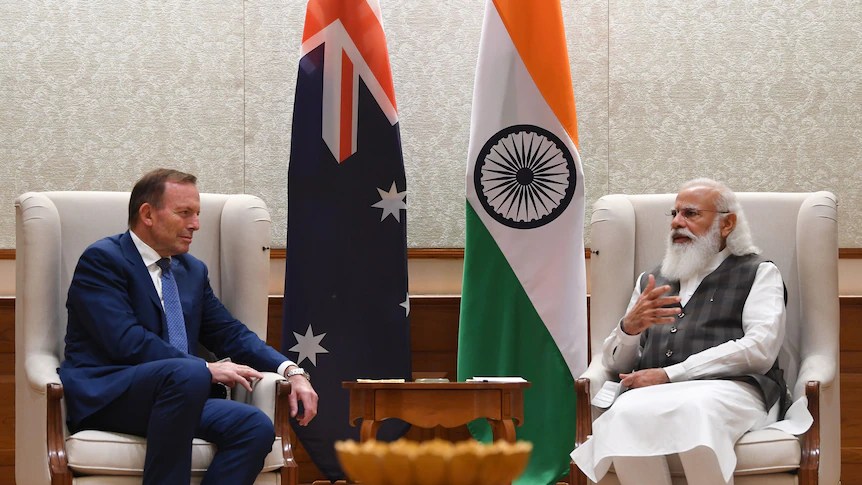
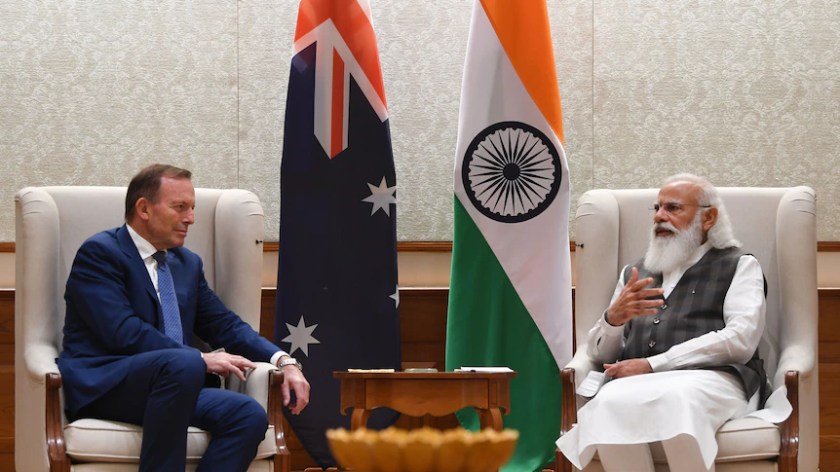
Indian PM Narendra Modi meets recently on trade with former Australian PM Tony Abbott

What has changed for India? It seems that having resisted trade deals for years, it now plans by the end of March 2022, to complete multiple quick-fire bilateral trade agreements.

Something has not changed however – the Indian government, distrustful of full scale FTA’s, is prioritizing “early harvest” pacts over comprehensive free trade agreements.

What has changed is the pandemic and the rise of China.

Therefore, the Indian government is focusing on strengthening the trade with G-7 nations with strong Indo-Pacific strategies and those with growing influence in central Asia such as the United Arab Emirates.

Australia, at a key position in the Indo-Pacific, is a high priority. As a fellow member of the QUAD, India and Australia have never been so close strategically and are keen to add trade now.

In large part, this is India’s push to do well as supply chain realignments take place – there is only a narrow window of opportunity to get these deals done.

How big is this? The government is negotiating bilateral trade agreements with 20 countries and expects to complete half a dozen deals, including those with Australia and Britain by this December and March 2022. 

India is ambitious – Mr. Piyush Goyal has set kept a target of US$ 400 billion for annual merchandise exports – almost 38% higher than US$ 290 billion achieved in last year and plans to achieve US$ 2 trillion annual merchandise exports by the end of this decade.

Outcome? Lots of deals that will not be quite world class Free Trade Agreement (FTA) but which will have some wriggle room.

Deloitte finds US firms investing more in India than in China

INTO INDIA has long called for more western investment into the growth story that is modern India.

Now, according to a survey conducted by multinational professional services network, Deloitte, a large proportion of international business leaders remain confident in India’s short- and long-term prospects and are readying plans to make additional and first-time investments in the country.

The India FDI Opportunity survey of September 2021, which questioned 1,200 business leaders of multinational corporations in the U.S., U.K., Japan, and Singapore, found that India remains an attractive destination for investments, scoring highly for its skilled workforce and prospects for economic growth.

  • 44 percent of the 1,200 business leaders surveyed are planning additional or first-time investments in India
  • Nearly two-thirds of first-time investments will be made within the next two years
  • Business perceptions of India are better in the U.S. and UK compared to Singapore and Japan
  • Recent reforms by the Indian government to improve ease of doing business are popular, but awareness of policy improvements remains low

It also said that more business leaders, especially in Japan, are making investments in India for access to the domestic market rather than using India as a springboard for exports.

“India has the strongest positive perception in the U.S. when compared to markets such as China, Brazil, Mexico, and Vietnam. The U.S. and U.K. business leaders expressed greater confidence in India’s stability,” it said.

Investment is always indirectly but powerfully linked with market entry and trade outcomes. INTO INDIA applauds the enthusiasm of the US for India and hope this is also taken up in Australia – where investment funds are high – fourth largest wealth management market in the world.

New “Business Champions” group to provide much needed top level links between India and Australia

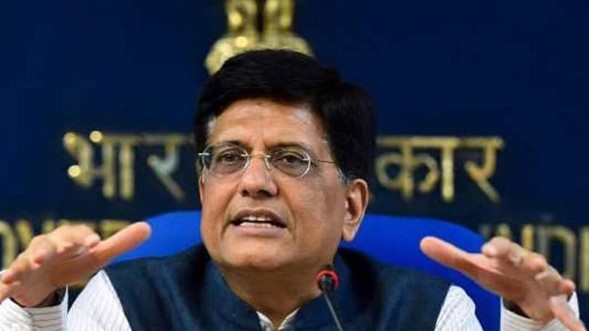
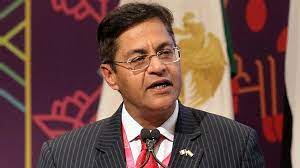
Indian Commerce Minister Mr Piyush Goyal

A new “Business Champions” group will lead top level business engagement between India and Australia – and it was launched last week in India.

INTO INDIA welcomes this move to bring the “top end” of both countries together. Business engagement at this level has not worked well in the past. Most of the business councils and chambers have provided lower level SME engagement – important as this is.

“Supply chains” is behind the enthusiasm of India for the new Australia-India Business Champions Group’s role. Mr. Piyush Goyal, Minister of Commerce & Industry, Consumer Affairs, Food & Public Distribution, Textiles, Government of India said this when addressing the Inaugural Meeting of the Australia India Business Champions.

The Minister is co-chairing the group with Australian Trade Minister, the Hon Dan Tehan.

“The Australia-India Business Champions Group’s key aim is to liberalise and deepen bilateral trade between both the nations and pave the way for collaborative economic growth.” stated Mr. Dan Tehan MP, Minister of Trade, Tourism and Investment, Government of Australia.

Major business organisations leading the group are the Confederation of Indian Industry (CII) and the Business Council of Australia (BCA). Both represent almost all the major business corporations in both countries.

Mr. Chandrajit Banerjee, Director General, CII, pointed to areas such as mining, education, defence, space and emerging sectors which the group can take forward.

Ms. Jennifer Westacott AO, CEO, BCA, highlighted that we must strengthen and reform regional and global institutions, so they deliver for our citizens.  She said the Business Champions would engage directly with the top tier of Australian and Indian Governments on matters critical to business. 

Other panelists at the meeting included H E Mr. Manpreet Vohra, High Commissioner of India to Australia, H E Mr. Barry O’ Farrell AO, High Commissioner of Australia to India, Dr. Anish Shah, MD & CEO, Mahindra & Mahindra Ltd, Ms. Julie Shuttleworth, CEO, FFI, Mr. Rakesh Bharti Mittal, Vice Chairman, Bharti Enterprises, Mr. Mike Cannon-Brookes, Co-Founder and Co-CEO, Atlassian, Mr. Nitish Jain, President, SP Jain School of Global Management, Ms. Verena Lim, Asia CEO, Macquarie Group, Mr. Girish Ramachandran, President, Tata Consultancy Services Asia Pacific, Professor Duncan Maskell, Vice Chancellor, University of Melbourne.

Australia: home to 48 of the world’s top 50 most innovative companies

Bosch and Monash University team up on “smart agriculture”

When you think Australia you might call to mind minerals, vast fields of agriculture or cricket.

But there is another reality about Australia – it’s a smart place.

International companies are leveraging Australia’s talent, government support and research to boost productivity, competitiveness and growth – according to data from Austrade and Boston Consulting Group.

Forty-eight out of Boston Consulting Group’s top 50 most innovative companies operate in Australia. These companies have partnered with Australian organisations to research additive manufacturing, renewable hydrogen technology and cloud supercomputing, among other areas.

Advanced manufacturing: General Electric

GE subsidiary GE Additive and the University of Sydney are establishing a high-tech manufacturing hub. The Sydney Manufacturing Hub will advance Australia’s capability in metal additive manufacturing technology.

Agricultural technology: Bosch

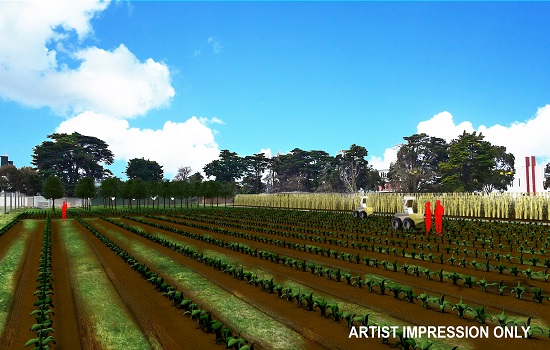
Bosch Australia and Monash University are co-developing Australia’s first smart agriculture research facility. The facility will contain a prototypical ‘smart farm’ to test: artificial intelligence; automation; robotic and advanced sensor technology solutions

Energy: Hyundai

Hyundai, Fortescue and CSIRO are working together to develop renewable hydrogen technology. The group seeks to:

  • develop new hydrogen technologies with the potential for bulk transport
  • build a renewable hydrogen refuelling facility, to deploy hydrogen fuel cell coaches
  • build the first combined hydrogen production and refuelling facility in Western Australia. 

Healthcare: Johnson & Johnson

The Johnson & Johnson Innovation Partnering Office @ Monash is a hub for researchers and early-stage companies. The facility allows them to develop novel pharmaceutical, medical devices, and consumer healthcare solutions.

Technology: Amazon Web Services and Intel

Amazon Web Services, Intel and AARNET established Australia’s first cloud supercomputing facility. Based at RMIT University, the facility focuses on advanced data processing and computing.

So, from the land of minerals, farming and cricket – there is also an advanced technology reason to team up with the Aussies.

Australian critical minerals, infrastructure, energy, technology, agribusiness, education and space – step up to the table for FTA talks with India

The Australian Trade Minister, The Hon Dan Tehan MP, last week pointed to Indian FTA priority areas such as critical minerals, infrastructure, energy, technology, agribusiness, education and space.

He announced a speeding up of talks with India last week and chose the launch of the Canberra chapter of the Australia India Chamber of Commerce to also announce an update of the India Economic Strategy.

This is a great time for business to step forward. You can have a say. You can be at the FTA discussion table.

The Minister said he had asked former Prime Minister, Tony Abbott, to visit India for meetings around the Comprehensive Economic Cooperation Agreement (which is an FTA).

He announced to the AICC that both countries were hopeful of concluding negotiations this year – a dramatic ramping up of the pace.

The AICC has the Hon. Ted Baillieu AO as its Founding Patron.

Australian Trade Minister announces boost to India FTA talks at launch of Australia India Chamber of Commerce chapter in Canberra

Major announcements made at launch of Canberra chapter of Australia India Chamber of Commerce.

The Australian Trade Minister, The Hon Dan Tehan MP, chose the launch of the Canberra chapter of the Australia India Chamber of Commerce to announce both a speed up to negotiations on a Free Trade Agreement and an update of the India Economic Strategy.

The Minister said he had asked former Prime Minister, Tony Abbott, to visit India for meetings around the Comprehensive Economic Cooperation Agreement (which is an FTA).

He announced to the AICC that both countries were hopeful of concluding negotiations this year – a dramatic ramping up of the pace.

The Minister pointed to trade and investment in areas such as critical minerals, infrastructure, energy, technology, agribusiness, education and space.

AICC in Canberra is led by Tony Huber, a Director within DFAT and former Consul in Mumbai, and Deepak Raj Gupta, former Member of the ACT Legislative Assembly.

If India’s tier 1, 2 and 3 cities attract Mercedes, maybe they should attract you?

India’s High Commissioner to Australia, HE Mr Manpreet Vohra, spoke at a recent Australia India Chamber of Commerce function

Really interesting comments made recently by the outstanding Indian High Commissioner in Canberra – His Excellency Mr Manpreet Vohra:

We all know the mega cities of India such as Mumbai, and everyone wants to be there, but what about the tier 1, 2 and 3 cities which account for:

50% of all Mercedes Benz sales in India

60% of Amazon sales

50% of the entire digital economy

You can see why India is set to be the world’s fastest growing large economy in the years 2021 and 2022.

Well done to the Australia India Chamber of Commerce for this event.

Bengaluru is India’s “must visit” city for all kinds of tech

New research based on data by Dealroom.co data and analysis by London & Partners – the Mayor of London’s international trade and investment agency – found Bengaluru as the world’s fastest growing tech ecosytem.

Bengaluru, often dubbed the Silicon Valley of India, has firmly cemented its tech credentials. The second Indian city was Mumbai, which made it into the top 10 fast-growing ranking at sixth place.

While Bengaluru, the capital city of the southern Indian state of Karnataka, grew 5.4 times from $1.3 billion in 2016 to $7.2 billion in 2020, the Maharashtra capital of Mumbai grew 1.7 times from $0.7 billion to $1.2 billion in the same period.

Bengaluru is also ranked sixth for the world’s tech venture capitalist (VC) investments, on a global list topped by Beijing and San Francisco, New York, Shanghai and London making up the top five. Mumbai comes in at No. 21 in the worldwide ranking, with Boston and Singapore among the other high-ranking cities.

Bengaluru is dynamic and global in feel, with sleek offices and countless quality bars and restaurants.

It used to be India’s “garden city” but has become a global “tech city”.

For EdTech, MedTech, AgriTech and in fact “any Tech”, Bengaluru is your India starting point.

It is also home to the dynamic Victorian Government Business Office led by Michelle Wade – essential to talk with them about your India entry plans.

India a prime target for Aussie exports and investment – Austrade

Austrade’s Ashley Brosnan puts the case for Australian businesses to quickly get into India:

Australian businesses continue to see opportunities across a range of sectors including education, mining and resources, infrastructure, agri-food, and digital services. Thanks to the steady success of some great Australian brands, Australia is already a trusted supplier and investor.

However, India remains a challenging place do business. Expansion requires a high degree of market literacy and on-the-ground experience. Local partners help exporters and investors to navigate markets and regulation – and these partners can prove invaluable.

Despite this, the Government of India has signalled that India is ‘open for business’. It is emphasising investment and competitiveness as factors that will support the economy and encourage a return to growth.

The effects can be observed already in global rankings. India has moved up 63 places in the World Bank ‘ease of doing business’ rankings in recent years.

Austrade is helping Australian companies to explore India

The Australian Government is investing heavily in developing commercial links between Australia and India. The Australia-India Comprehensive Strategic Partnership agreed by Prime Ministers in June 2020 creates further opportunities for Australian business.

The Partnership seeks to build supply chain resilience between the two countries. It strengthens and diversifies trade and investment links with a focus on education, critical minerals and technology cooperation.

Today, Austrade posts across India are working intensively with Australian businesses to understand market, identify opportunities, make connections and help companies negotiate contracts.