India growth 2021 12.6% – the only world economy to be over 10%

Prime Ministers Modi and Morrison are close – and should talk more about trade.

Rapid recovery in 2021

Austrade’s Ashley Brosnan points to India’s post-coved economic recovery based on fast rollout of the vaccine, falling caseloads, economic stimulus and Foreign Direct Investment – it has every angle covered:

The OECD projects that India’s economy will grow 12.6% in 2021. This will make India the only major country to achieve double digit growth in 2021.

It should be acknowledged that the Indian economy is among the worst affected by the pandemic, which has resulted in strict, multi-month lockdown restrictions. GDP fell 10.3% in 2020 damaging household income and business confidence.

But rapid economic growth in 2021 will be driven by an expansive vaccine rollout, falling COVID-19 caseloads, and extensive economic stimulus.

Not forgetting that India is now a top 10 destination for Foreign Direct Investment.

India to lead growth in post pandemic global economies

Austrade’s Ashley Brosnan has the stats and facts at his fingertips and he is certainly bullish on the future of India:

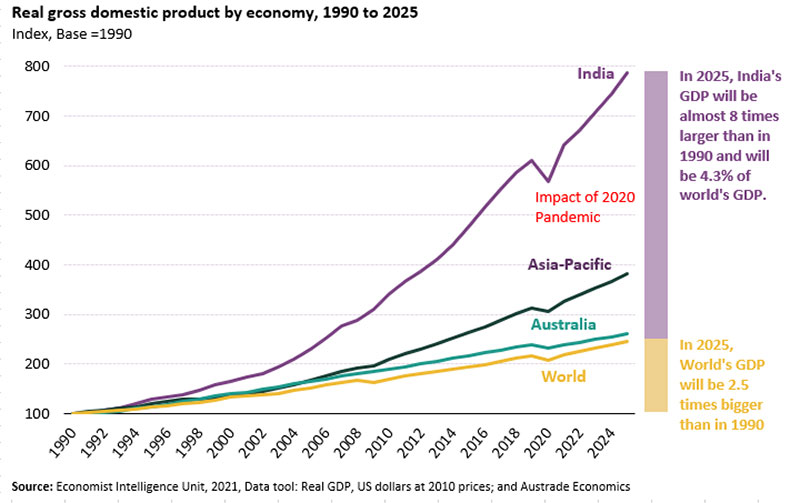
No longer just ‘rising’, India is now a significant and influential global player. India has recorded strong economic growth over the past 4 decades to become world’s third largest economy in terms of purchasing power parity (PPP).

Following the pandemic, rapid growth is set to resume. The Indian economy is projected to expand by an average annual real rate of 5.8% from 2021–2040, which is faster than the global average and the average for the Asia-Pacific region.

Take a look at this chart!

India great agritech market but an insider advises “find local partners”

Agritech booming in India but be careful about market entry

A recent story in EVOKE, an agritech site, really caught my eye with a piece of sound advice.

It was so good to read the Managing Partner of Omnivore, Mark Kahn, with his greatest piece of advice to those not already there: do not to move to India immediately. Omnivore is the largest and oldest player in the Indian agritech venture scene

“I’ve never seen a foreign startup succeed in India that was selling directly. Sometimes we have very well-meaning people that relocate their lives here and think they’re going to be able to build an organisation from the ground up and the reality is it’s just very difficult.

“The best thing you could do is get some Indian members on your team, co-create solutions that bridge the gap between whatever you’ve developed earlier and whatever our local farmers actually need and find local partners.

“You should be manufacturing in Australia or maybe India, but you don’t want to build a distribution system yourself and even if you try, you’re not very likely to succeed.”

He pointed to agritech related to water and drought resistance as two high priority opportunity areas.

The agritech opportunities are huge, but INTO INDIA has been advising for a long time that you need partners and a collaborative mindset to really succeed in India.

Can trade steer the Indo-Pacific towards recovery?

Trade presents as a very mixed story for countries in the Indo-Pacific region – there appears to be both peril and opportunity ahead.

On the peril side – lockdowns, disrupted supply chains, security tension and travel restrictions.

What’s on the opportunity side?

Not much, but we should be optimistic.

The plunge in world trade could be bottoming out. Weak global growth could turn into moderate growth. Closed borders might soon open. And tensions around key areas of trade, technology and security (ie around China) could stop festering.

Or maybe pigs might fly?

What do you think is ahead?

Let’s build a secure Indo-Pacific but talk of war is not helping

First mission of the UK’s new mega aircraft carrier The Queen Elizabeth, was into the Indo-Pacific which is the world’s hottest region right now.

Globally the key strategic location of the world is moving this way – to the Indo Pacific region – and it is happening with some urgency.

Why?

Because of the economic success, military preparedness, activity in the region and the general rise of China.

Urgent discussions are happening among democracies and those in the region – such as India – are seeking defence support to balance things with China.

It is all happening in a rush.

India is fast tracking strategic discussions and arrangements and just completed some ground-breaking strategic deals with the UK and the European Union.

Of symbolic importance, the first mission of the UK’s new mega aircraft carrier (The Queen Elizabeth) was into the Indian Ocean.

The language of all these deals is about China – without mentioning the name. For example, most seek “an open, free, inclusive and rules-based Indo-Pacific region, underpinned by respect for territorial integrity and sovereignty, rule of law, transparency, freedom of navigation and overflight in the international seas, unimpeded lawful commerce, and peaceful resolution of disputes”.

That’s a lot of words but it adds up to one word – China.

A secure region is good for us all. A region too keen to go to war is not good for us.

On the extremes of the discussions are those who eagerly await the “drums of war” – let’s just remember that these are either the same people or in the same lineage as those who took the west into disasters such as Afghanistan, Iraq and many more right back to and including the Vietnam War.

They have been wrong every time.

Can the Indo-Pacific region achieve peace without repeating these mistakes?

Deakin University again leads the way with India

When organisations ask how to engage with India, the answer can be found in how Deakin University has built the India relationship.

Deakin has demonstrated patience, long term commitment, adaptability and real community engagement with India.

Their latest announcement takes it to another level:

“Deakin University’s relationship with India has been a key part of who we are for more than 27 years. Our Indian students and staff are an integral part of the Deakin community and we have been shocked and saddened seeing the COVID-19 crisis unfold. 

“After careful consideration about what we can do to help make a difference to the Indian community, we’ve decided to join forces with our long-time partners, Tata Trusts, through their initiative ‘One Against COVID-19’ to lend financial support and encourage our community and partners to do the same.

“Funds will go to the areas most in need, specifically to aid with:

  • Repairing/upgrading facilities
  • Staff training, and
  • Expert project management to improve the efficacy and efficiency of the health response

“These funds would be in addition to the existing Student Emergency Assistance Fund which supports Deakin students experiencing financial distress and would go directly to the individuals and public services in need in India.”

To Vice Chancellor Iain Martin and Ravneet Pawha, Deputy Vice President Global – well done for shining a light in the relationship with India.

India could be world’s third largest economy as soon as 2030

Two facts demonstrate India’s amazing economic growth:

First, today India is the world’s 6th largest economy.

Second, as soon as 2030, it is likely to be the 3rd largest.

Mugunthan Siva, CEO of India Avenue Investment Management (Sydney and Mumbai) makes a compelling case for India focused, actively managed high conviction funds and the investment themes he likes include technology, manufacturing, construction, rural, real estate, B2B and market share leaders.

You can read more here:

https://www.livewiremarkets.com/wires/why-india-could-be-third-placed-by-2030

India Avenue website:

Swami Vivekananda can teach us about cultural differences between India and the west

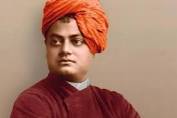
My Swami Vivekananda blog continues to gain reactions – he shows us how rich, diverse and deep is Indian culture and thought. He was the multitalented, multifaceted teacher, Hindu monk and spiritual guru, born in 1863. With his extremely popular and respected speeches of all times starting with “Brothers and sisters of America”, he introduced Hinduism at the parliament of world religions in Chicago way back in 1893.

Through study of his quotes, we can gain special insight into the cultural (thinking) differences between India and the west.

This learning comes with no judgement, no sense of one culture being better than another – it is offered in the spirit of understanding.

SV – “Truth can be stated in a thousand different ways, yet each one can be true.” 

This goes to the heart of cultural difference – the west treats truth as an “absolute”, meaning there is no room for difference or “relative” truth as stated in India.

This can show up in business activity, where the westerner sees the plan as fixed and set in concret(absolute), while the Indian sees it as just a plan, capable of change (relative).

SV – “All knowledge that the world has ever received comes from the mind; the infinite library of the universe is in our own mind.”

Here the west takes a materialist and scientific view of knowledge, seeing the role of the mind to gain knowledge from the external world.

SV – “Bless people when they revile you. Think how much good they are doing by helping to stamp out the false ego.” 

In the individualistic culture of the west, from a young age we are trained to “stand up for ourselves” so the likely response from a westerner when reviled is to defend or even to attack. “The best form of defence is attack” is a common western phrase.

SV – “Things do not grow better; they remain as they are. It is we who grow better, by the changes we make in ourselves.” 

This internal view is very different from the west, where growing better is generally reflected in possessions, honours and achievements – in external things.

SV – “The world is the great gymnasium where we come to make ourselves strong.” 

The big picture view of the world from the west is that it was put here for our benefit – so use it. At its worst, this has led to pollution and climate change. At its best, it is the basis of many innovations that benefit us all.

SV – “Do one thing at a Time, and while doing it put your whole soul into it to the exclusion of all else.” 

Multi-tasking has been highly fashionable in the west for decades and technology is the great enabler of it. But when you see a person totally focused on one task, you see how effective we humans can be.

SV – “All differences in this world are of degree, and not of kind, because oneness is the secret of everything.”

The concept of “oneness” is very foreign and strange to many westerners. They see differences as being of kind, and view the world through the lens of the individual, which is the opposite of “oneness”.

SV – “We are what our thoughts have made us. So, take care about what you think. Words are secondary, thoughts live and travel far.”

Thoughts are seen in the west as a totally private thing and secondary to what we do and say. Without words, a westerner could view thoughts as a waste of time.

SV –“Neither seek nor avoid, take what comes.”

This is a remarkably different view of life from how the west sees it. A westerner will strongly seek to either possess the attractive that comes or repel the negative that comes. In other words, far from “acceptance”, westerners take an activist approach to whatever life presents. It’s like a constant struggle.

SV – “In a conflict between the heart and the brain, follow your heart.”

“Think it through” is a much repeated piece of western advice, where the brain is given vast superiority over the heart.

SV – “The great secret of true success, of true happiness, is this: the man or woman who asks for no return, the perfectly unselfish person, is the most successful.”

For many westerners this is a strange concept. Happiness is seen as something the individual must find and keep for themselves. Many would see virtue in sharing and being unselfish, but they would see it as folly to be “perfectly unselfish”.

The above are just my interpretations – offered in the hope that they give useful understanding of cultural differences. We can learn from each other. What do you think?

India’s millennials drive a shift to consumer demand

India’s millennials – what a shock – are borrowing for consumables.

This is a massive generational shift in India where previous generations believed in first saving and then buying – even if it took years or ultimately going without.

Consumer credit companies such as TVS Credit and Bajaj Finserv have been increasing the share of their offerings to these niche segments not covered by conventional lenders and NBFCs.

The loans are known as EMI’s (equated monthly instalments) and are used to buy various goods, including mobile phones, consumer durables and small-ticket items on easy, no-cost EMIs via loans or credit cards.

It is the segment of youthful, low-income but tech-savvy consumers that fintech lenders are targeting – half the small loans are of Rs5,000 or less.

The country’s largest AI-enabled consumer lending platform, ZestMoney, noted in a report that it had seen more than 125% growth in EMI funding.

E-commerce majors such as Amazon, Myntra, Flipkart, MakeMyTrip, Decathlon and Paytm, among others, have seen a substantial surge in online sales in the past year due to EMI financing schemes – and digital payments mean no cash.

The New India is not afraid of debt – signalling a major uplift in consumer demand for decades to come.

Adani takes giant steps towards becoming the world’s leading renewables company

Adani Group taking giant steps towards becoming the world’s largest solar power player by 2025.

Adani is taking a massive lead in India into green energy renewables.

But in Australia it is still seen as “the Indian coal company” because of its activities in Queensland – in this market the Adani reputation has taken a hit as a result.

The reality is Adani is a leader in green energy and just got a lot bigger!

Adani Green Energy Limited (AGEL), this week signed share purchase agreements for the acquisition of 100% interest in SB Energy India from SBG (80%) and Bharti Group (20%). 

SB Energy India has a total renewable portfolio of 4,954 MW spread across four states in India.

Adani is super serious about renewables – the transaction marks the largest acquisition in the renewable energy sector in India. The transaction values SB Energy India at an enterprise valuation of approximately USD 3.5 billion.

The target portfolio consists large scale utility assets with 84% solar capacity (4,180 MW), 9% wind-solar hybrid capacity (450 MW) and 7% wind capacity (324 MW).

With this acquisition, AGEL will achieve total renewable capacity of 24.3 GW (1) and operating renewable capacity of 4.9 GW.

You’ve got to hand it to Gautam Adani who has the vision to be the leader in sustainable energy transition globally and makes it one of the largest renewable energy platforms in the world.

Mr Adani created a vision in January 2020, wherein he laid out our plans to become the world’s largest solar player by 2025 and thereafter the world’s largest renewable company by 2030.