
Just quietly, the “gig economy” is changing how we work and India is a good example

India’s gig economy is rapidly expanding, with predictions that the workforce will grow from 7 million in 2021 to 23.5 million by 2030.

This growth is stunning and signals a major shift in how we work.

INTO INDIA sees the gig economy as offering flexibility for both sides, remote working and other opportunities.

But the reality of being self employed is that you can also be “self unemployed”.

You can see why employers are so keen on this – providing access to a diverse talent pool while cutting costs. As companies embrace gig work, sectors like pharmaceuticals and technology are increasingly relying on freelance experts to meet their needs.

The gig workforce is growing – but it is still a tiny percentage of the total workforce – in India expecting to go from 1.5% in 2021-22 to 4.1% by the 2029-2030 financial year.

The pandemic is responsible for most recent changes in everything – and this is no exception.

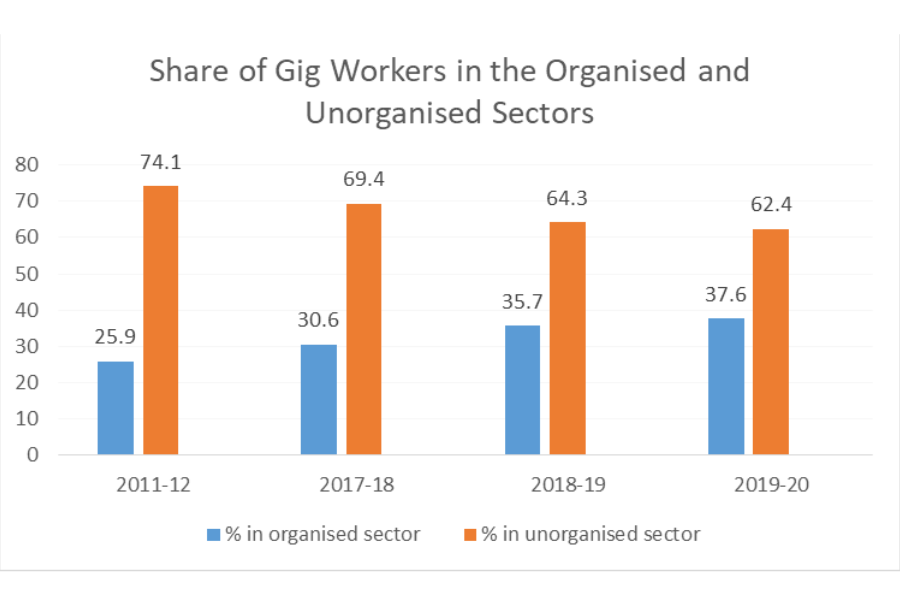
Globally, the gig economy is expected to reach a gross volume of $455 billion by 2023, up from $368 billion in 2021. In India, there is a noticeable increase in organized sector gig work compared to a decline in the unorganized sector, reflecting a growing trend towards investing in gig workers.

Source: NITI Aayog Report

INTO INDIA notes that trust between gig workers and employers is improving, with longer project durations becoming more common. Kapil Joshi, Deputy CEO of Ques Corp, observes that the average tenure for freelance projects has increased from 9 months to over a year since the pandemic, indicating growing trust in freelance coders for larger projects.

Historically, “flexibility” has meant flexibility for employers at the expense of employees. But this one might be different, because employees (some) are demanding gig work in preference to full time jobs.

We’ll see how this one goes over time.

Xentrix Studios Australia Animated Cricket Series ‘Snick and Willow’ to add real spin to our India relations

Xentrix Studios Australia has created a brilliant animated cricket series which will score big runs in both India and Australia – bringing us closer together on our favourite topic, cricket.

Don’t read what I say – watch this and be impressed…

The whole project is championed by famous cricketer Lord Ian Botham and was developed in collaboration with parent company, Xentrix Studios India.

Ken Cantrill, Head of Creative of Xentrix Studios Australia and Co-Creator of Snick and Willow. “The series is destined to be a massive success.”

Lord Ian Botham
Lord Ian Botham

This series is more than cricket, bridging cultures and inspiring young audiences worldwide. That is why INTO INDIA is so excited.

It educates about teamwork, courage, and the spirit of sportsmanship.

Can’t wait for it to come out – rumour is it will be launched during the Australia vs India Boxing Day Test this summer in Melbourne.

Want to know more about Xentrix?

https://www.xentrixstudios.com/

CSIRO brilliant programs of collaboration and innovation with India

The CSIRO is showing the way into India – and INTO INDIA congratulates them.

Under the updated India Economic Strategy (IES) released in 2022, CSIRO and India have made a commitment to draw on complementary capabilities and resource to solve shared global challenges.

They have three partnerships:

  • India-Australia Rapid Innovation and Startup Expansion Accelerator.
  • India-Australia Critical Minerals Research Partnership.
  • India-Australia Green Steel Partnership.

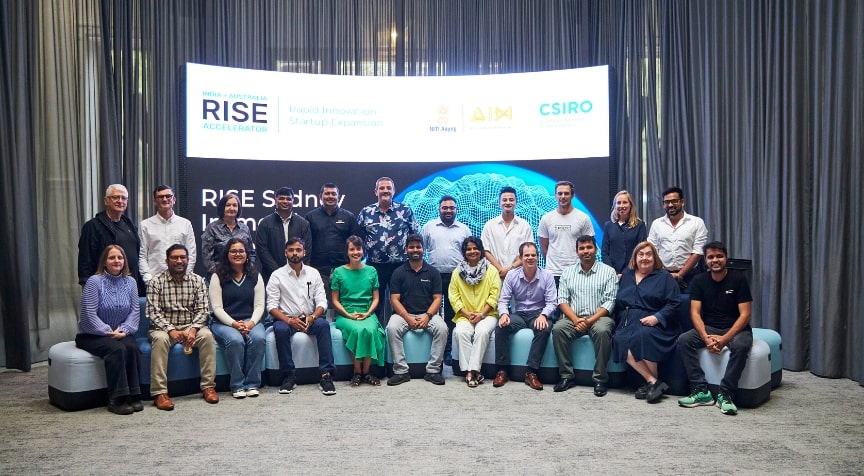
The inaugural cohort of the India Australia Rapid Innovation and Startup Expansion (RISE) Accelerator has been announced, with 15 Australian and Indian startups and small- to medium-sized enterprises (SMEs) selected to participate in Round 1 of the Program. 

India-Australia Rapid Innovation and Startup Expansion Accelerator

India-Australia Rapid Innovation and Startup Expansion Accelerator (RISE) is an exciting and unique bilateral innovation program that will support Indian and Australian entrepreneurs and SMEs on their commercialisation pathways to launch innovative technology solutions to market that tackle our shared national challenges and priorities – such as the circular economy, the energy transition and food system resilience.

A partnership between CSIRO and Atal Innovation Mission (AIM), and supported by the Australian and Indian Governments.

India-Australia Critical Minerals Research Partnership

The India-Australia Critical Minerals Research Partnership (IACMRP) will work with Indian and Australian researchers, industry and government to deliver a range of projects over a 3.5-year period that aims to unlock commercial benefits of commencing, improving and integrating Indian and Australian critical minerals value chains.

India-Australia Green Steel Partnership

The India-Australia Green Steel Partnership (IAGSP) will deliver a range of research, technology and commercialisation projects over a 3.5-year period that aim to accelerate the decarbonisation of the iron-steel value chain in India and Australia.

These Partnerships have gained momentum and the India-Australia Minerals Scholars Network has been identified as a specific initiative that sits under both the IACMRP and IAGSP partnerships.

India-Australia Minerals Scholars Network

The India-Australia Minerals Scholars Network (the Scholars Network) will focus on enhancing Green Steel and Critical Minerals capabilities and connections. It is intended to be a 3.5-year initiative co-funded by the India-Australia Green Steel Partnership (IAGSP) and the India-Australia Critical Minerals Research Partnership (IACMRP).

INTO INDIA can only say – keep up the great work CSIRO.

Australian banker says “this is India’s century”

This is the best, strongest vote of confidence in India from one of Australia’s leading corporations.

Mark Whelan, Group Executive at ANZ: “The time is very much appropriate to grow here. If you look at the basics of the Indian economy and where its place is in the world, this is India’s century”.

Rufus Pinto, Country Head, India, Australia and New Zealand Banking Group, outlined the rapid recent growth of ANZ in India: “ANZ India started our Institutional Banking operations in 2011. 13 years of existence across three branches today with over 80 bankers supporting the top Financial Institutions; Local Large Corporates and MNC’s working together with our home markets of Australia and New Zealand, and ~30 markets in our global network providing our clients a seamless agile offering.

“ANZ in India today house almost 20% of our global workforce, with our Global Capability Centre in Bengaluru,” he said.

This is change on a grand scale for a leading Aussie company.

Yes, this is India’s century.

Time to get on board?

Did you know Gallipoli played a huge role in Australia-India friendship?

Congratulations to the Australia India Institute for this celebration.

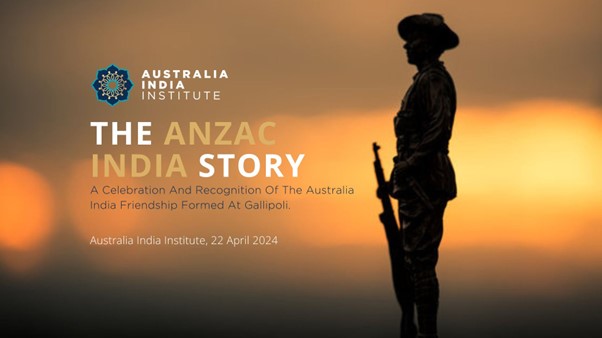
The Australia India Institute has celebrated the untold history of the ANZAC-India relationship formed at Gallipoli in 1915. 

Serving alongside the ANZACs for their entire campaign were troops of Britain’s Indian Army – gunners and drivers of two Indian mountain batteries. An Indian infantry brigade and a large Supply and Transport force soon joined them, with over 16,000 Indians serving on Gallipoli. 

The Institute hosted the untold story of the Anzac-India friendship, with one of Australia’s most distinguished military social historians Professor Peter Stanley.

He shared the role Indian troops played and the remarkable positive relationship that grew at Gallipoli between Anzacs and Indians.

Assistant Foreign Minister Tim Watts and Indian Consul General Melbourne Dr. Sushil Kumar, were part of this significant event. Indian Veterans who attended.

As part of this celebration of this unrecognised history, Mark Trayling presented the Bahadur painting to the Institute. The Bahadur painting was painted-by-mouth by Mr Ghosh, a resident of the Paraplegic Centre for Armed Forces in Pune, India. 

Salary hikes on way for young Indian professionals and executives

Want a decent salary hike? The best place to be right now could be India.

According to insights from Randstad India, corporate salary increments in India are projected to range from 8-11% this year, with junior professionals expected to receive the highest increases of 10-11%.

This shift reflects a growing trend towards skill-based compensation, allowing professionals with specialized expertise to negotiate salaries more flexibly.

It amounts to a big financial boost for India’s growing middle class.

Companies are increasingly focusing on hiring and upskilling freshers and junior-level candidates to meet organizational needs, yielding positive outcomes across industries.

Conversely, senior professionals may see “lower” salary hikes, averaging 8-9%, while medium-level professionals can expect around 9-10% increments.

Why pays the best?

Sectors like internet/e-commerce, manufacturing, and BFSI are likely to offer the highest increments, driven by factors such as value-added models in e-commerce and technological advancements in manufacturing.

Read more here:

https://www.businesstoday.in/industry/top-story/story/average-salary-hike-to-be-around-8-11-this-year-in-india-randstad-india-424497-2024-04-05

The many levels that make up India engagement for one major Australian company

Shayne Elliott, CEO, ANZ Bank, pictured at Gateway of India, Mumbai, on a recent visit.

Australia’s ANZ Bank has proven that a long association with India (they started in 1986) can achieve a strong balance of business over there.

Patience is a great business builder.

And flexibility makes for sustainability.

Adaptation to the many levels of opportunity has worked for this bank.

Read more detail here:

https://bluenotes.anz.com/posts/2023/06/anz-news-india-growth-shayne-elliott?pid=bln-link-td-bln-06-23-tsk-rufus-india

Might be some lessons in there that can help with your India ambitions?

Old and new in India celebrated in stunning textiles exhibition at Melbourne Museum

Art in both traditional and contemporary form is alive and thriving in India, judging by a beautiful exhibition at the Melbourne Museum.

Sutr Santati curated by Lavina Baldota of the Abheraj Baldota Foundation is worth seeing for the quality and innovation of the objects, which is matched by the display which adds to the beauty.

I was enthralled – but when I saw the great Mahatma Gandhi featured in one of the pieces, I just stopped and admired the way this exhibition pays homage to the history of free India and yet celebrates modern innovation.

It made me realise that it is only a little over 75 years when India had some of the finest FREEDOM FIGHTERS in the history of human struggle to be free.

Make sure you see this soon!

Celebrating 75 years of India’s independence, Sutr Santati showcases 75 hand-woven textiles created by contemporary Indian designers.

In May 2023, Melbourne Museum welcomes international exhibition Sutr Santati: Then. Now. Next. Stories of India woven in thread. Conceived and curated by Lavina Baldota of the Abheraj Baldota Foundation, the exhibition brings together diverse textile traditions of the country, conceived and created by some of its most prominent artisans, craftspeople and designers.

Sutr Santati means ‘continuity of thread’ in Hindi. As the exhibition title, it is a metaphor for ongoing dialogues in Indian culture and society, which shape its evolution, bridging the past with the future. The exhibition’s curatorial vision seeks to promote the ideals of organic and slow consumerism in reflecting India’s identity and the inherent collective, collaborative efforts which are required to push towards such goals.

The themes, techniques and materials of specially commissioned fabrics in the exhibition are viewed through the lens of innovation. In doing so, they reinforce the value of fabric – an important legacy of Indian independence – to define the country’s contemporary artistic landscape, and to push its creativity into the future.

Heartiest congratulations to Lynley Crosswell, CEO, Museums Victoria, and Rohini Kappadath, General Manager, Immigration Museum – you have given us a special opportunity to gain insights into India.

Austrade and DFAT doing the heavy lifting in building India-Australia ties

I cannot think of a time when so many BIG STEPS have paid off for Australia – thanks in large part to the great work of Austrade, DFAT and State Government business offices in India.

In the last six months there have been record numbers of ministerial visits both ways – and when government opens the doors, education and business can step through.

Of special note is the work in education of Monica Kennedy, Austrade Mumbai. As she reported – “From Deakin University‘s splendid announcement of setting-up a branch campus in #India, to University of Melbourne‘s partnership with three major Indian Universities – it warrants all the attention it is receiving.

“Team Australian Trade and Investment Commission (Austrade) is proud and elated to have played a part in these historic announcements.”

Check out just a couple of all the overwhelming media mentions of the developments.

Read some of the stories here:
https://bit.ly/3yxBNYo
https://bit.ly/3FcD1fJ
https://bit.ly/3Jvwgbt

Keep up the good work!

Online meetings present the challenge – how do I introduce myself?

Zoom, Teams and other online meetings are now part of our lives. In many of these meetings, you are called upon to introduce yourself. Maybe everyone is introducing themselves.

It can get the pulse raising and the mind in overdrive. What will I say? Where should I focus? Will they like me? Meanwhile, we are missing out on all the other interesting introductions happening.

The stress can be negative – or positive. Through practice, we can come to recognise stress when it arises and use it for good – ah, now, better concentration, sharper reflexes, and so on. In contrast, if we have a negative reaction to stress it can mess up our introduction – nervous, shaky voice, tongue-tied, rambling on….

So, what is the easiest way to introduce yourself?

Like all public communication, the secret is to keep it simple.

The simplest way to introduce yourself is in three parts (and this might mean just three sentences) – present, past and future. People love this approach – they recognise the structure, simplicity and like a note about the future.

A present-tense statement to introduce yourself: “Hi, I’m Stephen, and I’m a communication consultant and author. My current focus is mentoring and writing.”

Past tense might be just two or three points about your background and gives you credentials and credibility. An example: “My background is in corporate communication, and I have previously advised top 100 corporates and big four professional services firms.”

Future tense is all about projecting optimism and enthusiasm – two very likeable characteristics. In a meeting this should relate to the topic. “In the next 12 months I plan to do more writing towards a new book and meetings like this give me not only content, but the motivation to keep exploring”.

Simple? Present, past and future. Each can be as long or short as the occasion requires – but always err on the side of shorter. Trust me – you will gradually enjoy (and smile) while introducing yourself.