Time to make an FTA with India a top priority – my rant!

What is the Australian Government doing to get a Free Trade Agreement with India? Very little, maybe nothing.

Austrade certainly knows the importance of increasing India trade: “With trade wars, powerful neighbours, and the odds on a recession narrowing within the next two years, considering Indian market entry has never been more mission-critical for Australian business.”

One statistic shows why the FTA makes a difference – according to the Australian Bureau of Statistics, in 2016–17 (the latest year for which there is data), only 2,087 Australian exporters engaged with India (no FTA), compared to 7,214 for China (we have FTA).

Time for Prime Minister Morrison to make this a personal priority, engage with Indian PM Modi and overcome any remaining obstacles to a free trade deal.

Our China exports are around A$190 billion while India is far behind at around A$20 billion.

We can do much better than this – but it takes an FTA to kick start it.

Come on Australia!

India-Australia trade relations set to grow at critical time

Many of us have championed closer economic ties between Australia and India. It is now more important than ever to get closer to India.

As Austrade expresses it – “With trade wars, powerful neighbours, and the odds on a recession narrowing within the next two years, considering Indian market entry has never been more mission-critical for Australian business.”

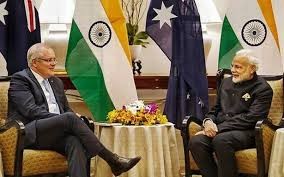
AusIndiaFlags

Some key statistics:

•In 2018, Australia’s total exports to India grew 10% to A$22.3 billion. India ranked number five in Australia’s export destinations.

•Two-way trade increased by a similar percentage to A$30.4 billion, making India Australia’s sixth largest two-way trade partner.1

•Australian investment in India increased almost 12% to A$15.6 billion, slightly ahead of India’s investment in Australia at A$15.1 billion.

However – and here is why Australia needs to balance trade – according to the Australian Bureau of Statistics, in 2016–17 (the latest year for which there is data), only 2,087 exporters engaged with India, compared to 7,214 for China.

Time to think India.

Family businesses in India are the world’s most upbeat

Family businesses in India are on a growth trajectory, with 89 per cent of them expecting to grow in the next two years, according to a survey.

The global survey, ‘Family Business Survey 2019’ by PwC, was done among 2,953 family leaders across 53 countries, including 106 family business leaders, between April 20 and August 10, 2018.

The survey has revealed that 89 per cent of family businesses in India expect to grow in the next two years, with 44 per cent of them looking at growing aggressively and 45 per cent expecting steady growth.

“Regulatory changes are getting family businesses to bring in order and professionalise the business, and disruptive technology is pushing them to transform. These new market dynamics are cultivating a renewed sense of ambition in family businesses, making them resilient in the face of change,” PwC India Partner and Leader, Entrepreneurial and Private Business, Ganesh Raju K said.

In terms of expansion, a little more than half of the family businesses are open to internationalisation, while 40 per cent are looking at diversification, the survey said.

Nearly half of the family businesses in India are open to mergers and acquisitions both within India and outside thus reinforcing the belief that inorganic growth will facilitate synergies and achieve incremental revenue, it said.

A lot of Indian family business owners are looking at private equity or venture capital funding or are looking at listing their business on stock exchanges.

Further, the survey said, more and more companies looking at professionalising their business functions are distinguishing between ownership and management as they feel partnering with the right talent might help family businesses to adapt to the changes.

About 73 per cent of Indian family businesses have the next generation working in the business and 60 per cent plan to pass on the management or ownership to the next generation.

It also found that 92 per cent of family businesses in India allow family members to work in the business. When it comes to spouses or partners, three-fourth of family businesses allow them to own shares and two-third allow them to work in the business.

BUT – there is some evidence the next generation of young Indians will want to branch out and create their own startups rather than the traditional path of joining the family firm.YoungIndians 2

RMIT University is changing the India-Australia education relationship

After decades where Australian universities have often been accused of taking the money for Indian students but not giving back – innovative ways of “giving back” have emerged from Melbourne’s RMIT University.

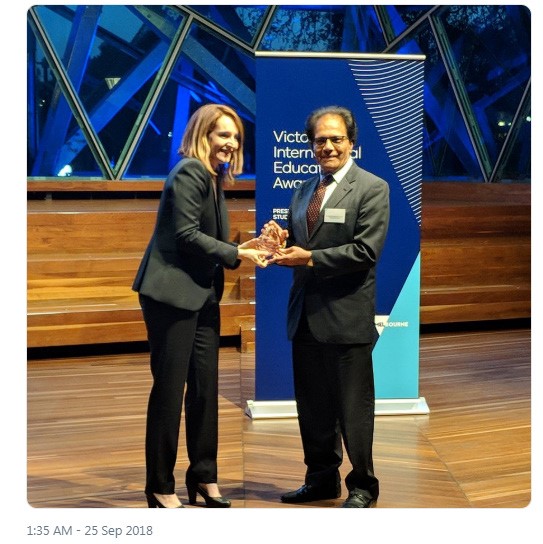
These efforts have been led by Professor Suresh Bhargava, Associate Pro Vice-Chancellor India, who received a Victorian Government “Victorian International Education Award for Excellence in Innovation in Partnership and International Engagement” for its work in India. (Pictured above)

What has RMIT University done?

It seems to me they have created a unique blend of Government, research, industry and universities across India to form an amazingly extensive network of relationships – as shown in this diagram.

rmit

The RMIT-AcSIR Program has at least eight leading Indian research centres and laboratories involved in a program which will target 100 PhD students.

As Dr Alan Finkel AO, Australia’s Chief Scientist, said: “Very few of us have the opportunity to do something that is first in the world and worthwhile. One without the other is common. Both together is ground-breaking.”

Dr Megan Clark, Head of the Australian Space Agency, also commented: “This is a wonderful achievement and will make such a difference for the future.”

Difference – RMIT University is setting out the groundwork for a new collaboration which will bring India and Australia closer together.

With the Modi Government poised to shake up Indian higher education and global relationships, now is a good time for all of our universities to build on this leadership from RMIT University.

Diverse India on show as new MP’s sworn in this week

Multicultural India was on show this week when newly-elected members of the Indian Parliament (Lok Sabha) were sworn in.

Linguistic diversity was in full play with the oath being taken in different languages as several newly-elected members sported colourful attire, traditional shawls and headgears while a section wore a saffron look.

320 of the 542 MPs took the oath during the first day of the two-day long swearing-in ceremony.

Prime Minister Modi was the first to take oath as member of the lower house, nearly four weeks after leading the BJP to a resounding victory in the Lok Sabha polls with the party retaining power winning 303 seats.

Modi20192

Addressing the media outside parliament before the commencement of Parliament session, Modi set the tone for the business in the House, saying the opposition need not “bother about their numbers” as their every word is “valuable” to the government.

The remaining 222 members will take oath on Tuesday.

The world’s biggest democracy is on show!

The next steps will be critically important for Adani in Australia

Now that the Adani mine in Queensland has passed what seems to be the final hurdle, while it will still be a focus of protests it is now important for Adani Group to create and build a long term image and relevance in Australia. Adani Group is widely misunderstood here.

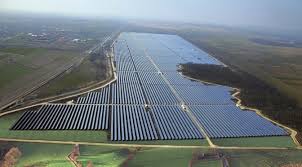
Few if any Australians are aware of the diversified role of Adani in areas such as solar power (below).

adanisolar

There have been mistakes. While “overstating” projects might be good communication in many countries, it is a disaster in Australia which is the home of the “tall poppy syndrome” (want to chop you down) and cynicism. In Australia it is best to under-estimate a project and then deliver beyond expectations.

This initial approach hurt the project and much of the bravado might well have been the Queensland Government – but dealing effectively with local politics is another important task for the group.

Here are some challenges, opportunities and ideas for the future brand of Adani in Australia:

  1. Build up the media, political and community profiles of your local Australia team
  2. Create some leadership profile opportunities for Mr Adani
  3. Clarifying the Adani approach of “vertical integration” which is not well understood in Australia
  4. Accept that protests and negative media will continue but strive to at least get your proper share of media space
  5. Carefully select the media you will deal with – and provide media tours of Adani in India – with full transparency
  6. Support and become involved in coordinated media relations programs with Indian High Commission in Canberra
  7. Have Mr Adani seen as a “promoter of Australia” by leading an annual group of Indian business leaders to visit and explore opportunities in Australia
  8. Bring some scientific R&D work to Australia – for example with RMIT University as a collaborator – this has the advantage of giving Adani relevance outside of Queensland
  9. Create an alliance with Indian foundations which are high profile here – for example ASHA Foundation educates slum dwellers and is well known for having a slum young person graduate from Melbourne University. Provide scholarships for more to come here
  10. Create or support a meeting of leading Australian and Indian resources and environmental scientists in some annual dialogue
  11. Have a regular presence in Canberra
  12. Develop some “owned media” content that is highly professional, well written and not propaganda
  13. Facilitate Australian business and political missions to India, leveraging close contacts

Some inspiring quotes from Indian PM Narendra Modi

We are harbingers of peace. We come from the land of Gandhi and Buddha.

All religions and all communities have the same rights, and it is my responsibility to ensure their complete and total protection. My government will not tolerate or accept any discrimination based on caste, creed and religion.

Modi20192

The diversity of India, of our civilization, is actually a thing of beauty, which is something we are extremely proud of.

I believe that a government has only one religion – India first. A government has only one holy book – our Constitution. A government has only one kind of devotion – towards nation.

Our country does not believe in the concept of your God and my God. We believe that all gods are one. We have different ways of accepting Him. All ways lead to Him.

Our country does not believe in the concept of your God and my God. We believe that all gods are one. We have different ways of accepting Him. All ways lead to Him.

Modi 2.0 – What will Modi do in 7 major policy areas?

Health

Telemedicine and diagnostic laboratories

More medical colleges

National immunisation programs

Modernisation

50 cities to have metros

Toilets for all Indians

State road network expansion

Inclusion

Banking access for all

Pension for small shop keepers

Poverty reduced to single digit

Economy

Grow to $5 trillion by 2025 and $10 trillion by 2032

Infrastructure spend

Credit scheme for MSME’s

Governance

Simultaneous elections

Time-bound delivery of public services

Upgrade governance standards

Education

Indian institutions to rate in top 500 in world

Medical and specialist doctors

Foreign Policy

Increase diaspora interaction

Multilateral cooperation on terrorism and corruption

Increase diplomatic corp

PLUS since this is PM Modi, expect the unexpected in this new 5 year term as Indian Prime Minister.

Gandhi’s inspiration lives on today

Mohandas Karamchand Gandhi was an Indian activist who was the leader of the Indian independence movement against British colonial rule, becoming known as “The father of the nation”. Employing nonviolent civil disobedience, Gandhi led India to independence and inspired movements for civil rights and freedom across the world.

I well remember campaigns against the Vietnam War – I was one of so many who used silent protest, peaceful marches and so on, all inspired by Gandhi. It was so special recently to visit his Ashram in Gujarat, and I have previously been to his burial site and other special locations in other cities.

Gandhiashram

Apparently he also influenced Martin Luther King in the USA who used peaceful means, also Nelson Mandela and the Dalai Lama.

Incredible wisdom.

“In a gentle way, you can shake the world.”

Thank you Mahatma Gandhi.

gandhisatyagraha


Australia – just be quiet and accept that China and India are the new powers and we are not top of their minds

Australia should calm down on Asia and just build healthy relationships.

Media and politicians react hysterically to even the smallest policy shift out of China. We sweat over the relationship. And if China has any dispute with a neighbour, we want to jump in and offer our advice.

We should just quietly get used to the new reality that China is now the world’s second biggest economy and is about to become the biggest.

change - secret

And when it comes to India, Australia cannot see beyond divisions and communal unrest. Objectively looking at the numbers will tell us India is a stable, growing economy that in our region will be a close number two to China.

Australians will agonise over whether getting closer to India is a good buffer to China.

Forget it – just get closer to India because that in itself is a good idea. Same for China.

Get over it. Things have changed.

Now – how do we build sensible and quiet relations with China and India – two countries that probably don’t think about Australia too often?