
Lost in Translation? Auto-translate? Handy, but it’s not the whole story!

INTO INDIA sees too many online communications that use English without cultural finesse – or use Hindi just as a translation exercise.

Communicating across cultures is always more complex than that.

Our preference for India is to use experts in India to provide the translation PLUS the cultural nuance.

Our friends at THE INFORMATION COMPANY are a good example.

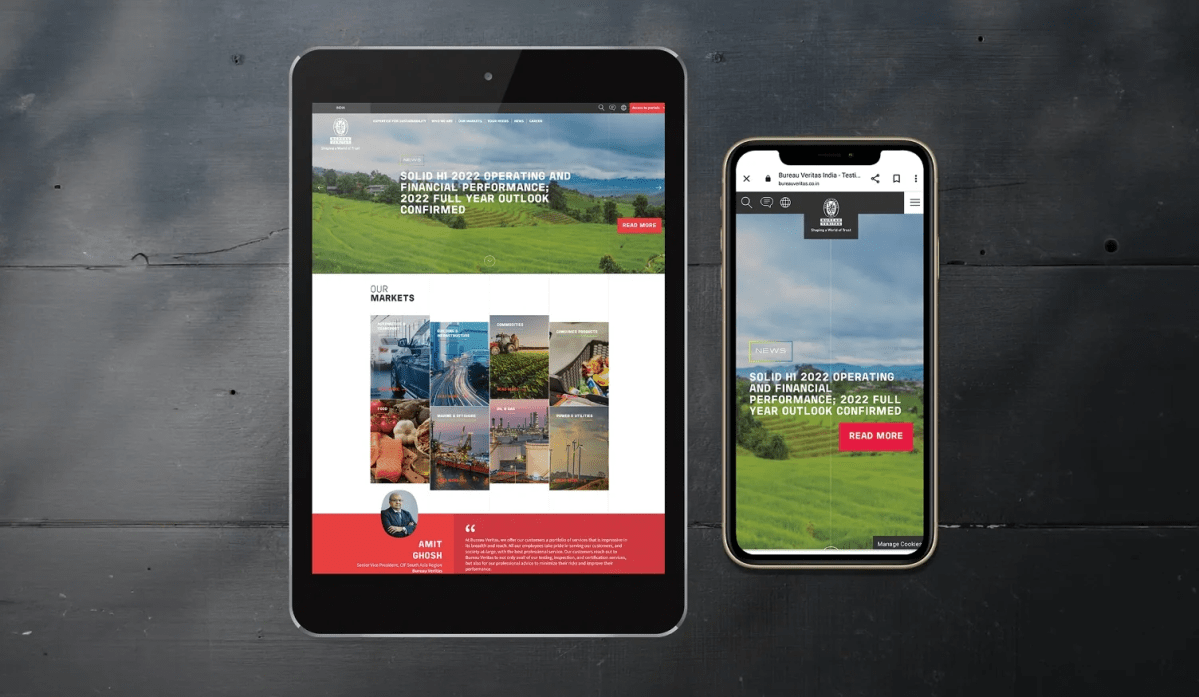
TIC recently created a multilingual website for Bureau Veritas.

TIC and the Bureau Veritas website was built from the ground up in English, Spanish, and Japanese. Bureau Veritas’ business and leadership has a key presence in said countries, making it all the more necessary to give it a truly organic and ‘local’ UX!

But TIC knows this isn’t just a language switch—it’s a cultural switch! Each version features tailored content that resonates with local audiences, refined URLs, and meta-descriptions. It’s more than translation; it’s a seamless experience that speaks directly to users in their native tongue. The result? A multilingual website that doesn’t just translate—it connects. Now that’s what we call speaking the user’s language!

INTO INDIA is happy to connect you (FREE) to our friends at TIC.

“Let’s talk it over” is a western obsession which does not work in India

Cultural differences can be extreme – and yet as human beings we share so much in common and want the same things – we want happiness, safety, ease of living, connections and more.

But the west has a huge obsession about the power of talking.

There is a dispute – “Let’s talk it over”.

An argument at home – “Let’s talk it over”.

We in the west truly believe this works – despite substantial evidence that “talking it over” entrenches division, builds argument and can lead to much unhappiness.

What is a cultural alternative?

I recently heard India’s Gurudev Shri Shri Ravi Shankar responding to a question from a couple who could not live well together but could not separate.

They asked “Should we talk it over?”

His response was do not focus on each other and the differences.

Instead focus on a goal. Focus on the few things you enjoy about each other.

But above all, he said don’t talk it over because – my summary – that only makes the fighting worse.

He and his wisdom will be in Sydney, Melbourne and Perth in October.

Just quietly the IPEF could be replacing the TPP and building a stronger Indo-Pacific

We haven’t been hearing much about the Trans Pacific Partnership (TPP).

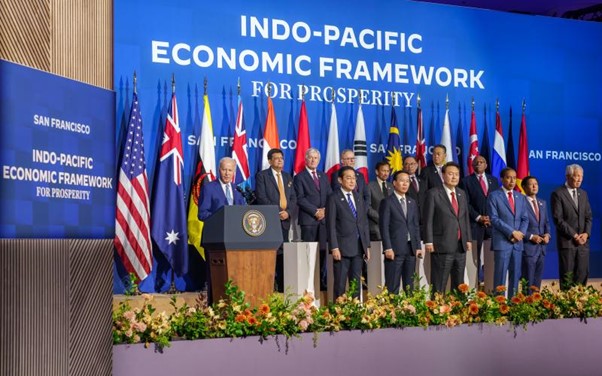
But we might be about to hear more about the Indo-Pacific Economic Framework (IPEF).

It is quietly working towards many of the goals of the ambitious TPP.

IPEF aims to establish “high-standard commitments” in four pillars: (1) Connected Economy (selected trade issues); (2) Resilient Economy (supply chains); (3) Clean Economy (clean energy, decarbonization, infrastructure); and (4) Fair Economy (tax, anti-corruption issues). Pictured is India’s Piyush Goyal with the signed supply chain agreement.

Today, approximately two years since the launch of the Indo-Pacific Economic Framework for Prosperity (IPEF) in Tokyo, the 14 IPEF partners are – Australia, Brunei Darussalam, Fiji, India, Indonesia, Japan, Republic of Korea, Malaysia, New Zealand, Philippines, Singapore, Thailand, the United States, and Vietnam.

Low profile, step by step the IPEF could build a solid Indo-Pacific community of nations. This has been much needed for some time now.

Might change your life – or you might just have fun. Gurudev coming to Australia in October

“An Evening with Gurudev Sri Sri Ravi Shankar” is coming to Melbourne, Sydney and Perth in October.

I love this Art of Living program.

If you can get tickets – go! For Melbourne:

For me, it involves breathing techniques that lead to such a relaxed state of bliss. And attendees are fun people to be around.

At second level of what I like, Gurudev does not ever complicate things – he provides simple wisdom.

A Life Changed – think about this quote:

In my 20s, I was consumed by depression and everything felt hopeless. One day, my sister told me about a nearby event featuring a talk and meditation session with Sri Sri Ravi Shankar. As soon as I walked in, I felt something shift inside me. His words seemed to answer the questions in my mind, and I was filled with peace I had never known before.

After the session, meeting Gurudev in person was an experience beyond words. It was as if a heavy burden had been lifted off my shoulders. The bliss and boundless energy I experienced stayed with me for months. When this initially faded, I began addressing my depression, but this time with a much calmer and more peaceful approach. Because I learnt the SKY breathing practice with the Art of Living, it has changed my life for the better. I have accomplished things I once thought impossible and have found inner peace.

https://www.artofliving.org/au-en

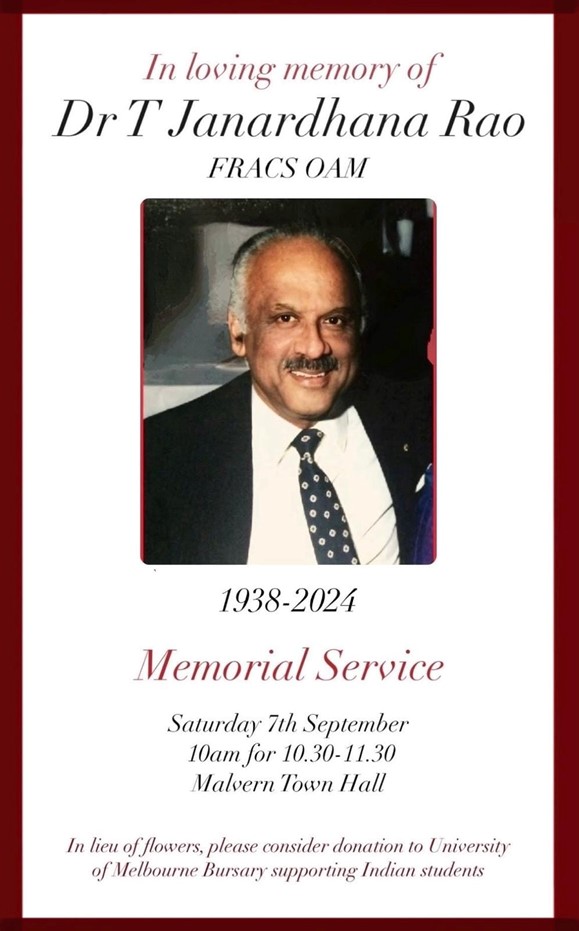
Reflecting on the life of T Janardhana Rao – a great India-Australian – 1938-2024

Dr T Janardhana Rao MBBS, MS, FRACS, FACS, OAM has passed away. This leaves a huge gap in Melbourne – and in those who love India and Australia.

He was an outstanding surgeon and honorary Indian Consul for so many decades that he has left his imprint across the Indian-Australian and broader community.

My abiding memory of Jana is the way he was always respectful, kind, seeking cooperation and building relationships. Quietly spoken and very considered in his comments, he was a strong believer that the two countries would benefit from much closer ties across politics, trade, culture and the arts.

Jana taught me so much about the Indian way of thinking and of concepts such as acceptance and patience. When staying with Jana and Vimila in their Chennai home, the highlight for me was the morning walk with Jana prior to breakfast. It was “walk and talk”.

Jana was a role model for all who want to change things – do so with respect and patience, bringing all with you rather than dividing.

His charitable legacy and foundation will leave a lasting impact, but it is his and his family story as a migrant family that shows us what can be done and how we can achieve better together.

A Memorial Service will be held at Malvern Town Hall, Saturday 7 September, 10am for 10.30 commencement. All are welcome.

Just quietly, the “gig economy” is changing how we work and India is a good example

India’s gig economy is rapidly expanding, with predictions that the workforce will grow from 7 million in 2021 to 23.5 million by 2030.

This growth is stunning and signals a major shift in how we work.

INTO INDIA sees the gig economy as offering flexibility for both sides, remote working and other opportunities.

But the reality of being self employed is that you can also be “self unemployed”.

You can see why employers are so keen on this – providing access to a diverse talent pool while cutting costs. As companies embrace gig work, sectors like pharmaceuticals and technology are increasingly relying on freelance experts to meet their needs.

The gig workforce is growing – but it is still a tiny percentage of the total workforce – in India expecting to go from 1.5% in 2021-22 to 4.1% by the 2029-2030 financial year.

The pandemic is responsible for most recent changes in everything – and this is no exception.

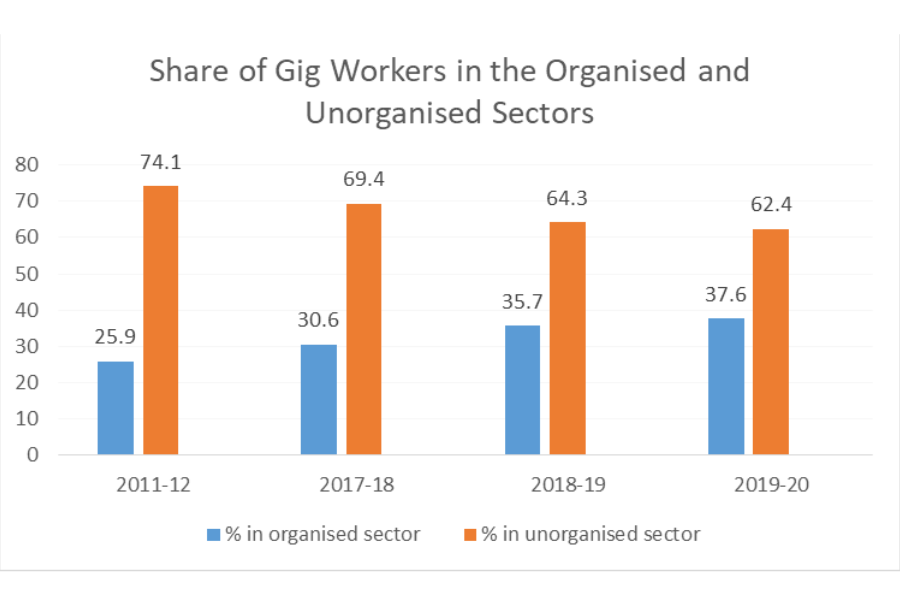
Globally, the gig economy is expected to reach a gross volume of $455 billion by 2023, up from $368 billion in 2021. In India, there is a noticeable increase in organized sector gig work compared to a decline in the unorganized sector, reflecting a growing trend towards investing in gig workers.

Source: NITI Aayog Report

INTO INDIA notes that trust between gig workers and employers is improving, with longer project durations becoming more common. Kapil Joshi, Deputy CEO of Ques Corp, observes that the average tenure for freelance projects has increased from 9 months to over a year since the pandemic, indicating growing trust in freelance coders for larger projects.

Historically, “flexibility” has meant flexibility for employers at the expense of employees. But this one might be different, because employees (some) are demanding gig work in preference to full time jobs.

We’ll see how this one goes over time.

Xentrix Studios Australia Animated Cricket Series ‘Snick and Willow’ to add real spin to our India relations

Xentrix Studios Australia has created a brilliant animated cricket series which will score big runs in both India and Australia – bringing us closer together on our favourite topic, cricket.

Don’t read what I say – watch this and be impressed…

The whole project is championed by famous cricketer Lord Ian Botham and was developed in collaboration with parent company, Xentrix Studios India.

Ken Cantrill, Head of Creative of Xentrix Studios Australia and Co-Creator of Snick and Willow. “The series is destined to be a massive success.”

Lord Ian Botham
Lord Ian Botham

This series is more than cricket, bridging cultures and inspiring young audiences worldwide. That is why INTO INDIA is so excited.

It educates about teamwork, courage, and the spirit of sportsmanship.

Can’t wait for it to come out – rumour is it will be launched during the Australia vs India Boxing Day Test this summer in Melbourne.

Want to know more about Xentrix?

https://www.xentrixstudios.com/

CSIRO brilliant programs of collaboration and innovation with India

The CSIRO is showing the way into India – and INTO INDIA congratulates them.

Under the updated India Economic Strategy (IES) released in 2022, CSIRO and India have made a commitment to draw on complementary capabilities and resource to solve shared global challenges.

They have three partnerships:

  • India-Australia Rapid Innovation and Startup Expansion Accelerator.
  • India-Australia Critical Minerals Research Partnership.
  • India-Australia Green Steel Partnership.

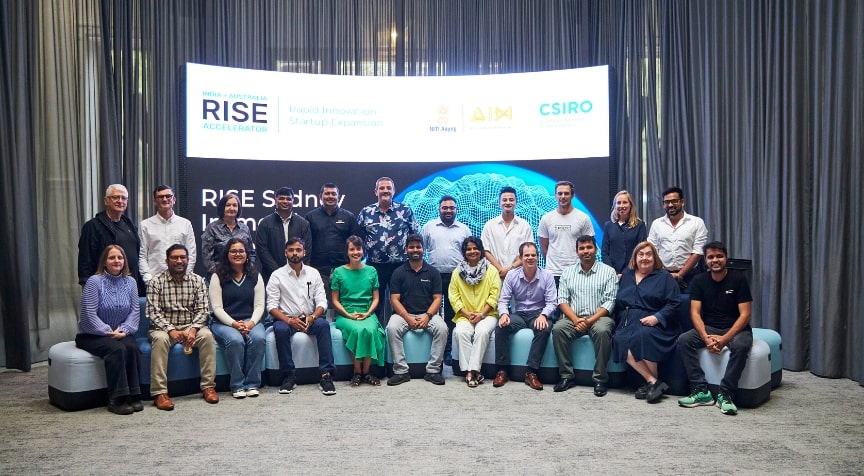
The inaugural cohort of the India Australia Rapid Innovation and Startup Expansion (RISE) Accelerator has been announced, with 15 Australian and Indian startups and small- to medium-sized enterprises (SMEs) selected to participate in Round 1 of the Program. 

India-Australia Rapid Innovation and Startup Expansion Accelerator

India-Australia Rapid Innovation and Startup Expansion Accelerator (RISE) is an exciting and unique bilateral innovation program that will support Indian and Australian entrepreneurs and SMEs on their commercialisation pathways to launch innovative technology solutions to market that tackle our shared national challenges and priorities – such as the circular economy, the energy transition and food system resilience.

A partnership between CSIRO and Atal Innovation Mission (AIM), and supported by the Australian and Indian Governments.

India-Australia Critical Minerals Research Partnership

The India-Australia Critical Minerals Research Partnership (IACMRP) will work with Indian and Australian researchers, industry and government to deliver a range of projects over a 3.5-year period that aims to unlock commercial benefits of commencing, improving and integrating Indian and Australian critical minerals value chains.

India-Australia Green Steel Partnership

The India-Australia Green Steel Partnership (IAGSP) will deliver a range of research, technology and commercialisation projects over a 3.5-year period that aim to accelerate the decarbonisation of the iron-steel value chain in India and Australia.

These Partnerships have gained momentum and the India-Australia Minerals Scholars Network has been identified as a specific initiative that sits under both the IACMRP and IAGSP partnerships.

India-Australia Minerals Scholars Network

The India-Australia Minerals Scholars Network (the Scholars Network) will focus on enhancing Green Steel and Critical Minerals capabilities and connections. It is intended to be a 3.5-year initiative co-funded by the India-Australia Green Steel Partnership (IAGSP) and the India-Australia Critical Minerals Research Partnership (IACMRP).

INTO INDIA can only say – keep up the great work CSIRO.

Australian banker says “this is India’s century”

This is the best, strongest vote of confidence in India from one of Australia’s leading corporations.

Mark Whelan, Group Executive at ANZ: “The time is very much appropriate to grow here. If you look at the basics of the Indian economy and where its place is in the world, this is India’s century”.

Rufus Pinto, Country Head, India, Australia and New Zealand Banking Group, outlined the rapid recent growth of ANZ in India: “ANZ India started our Institutional Banking operations in 2011. 13 years of existence across three branches today with over 80 bankers supporting the top Financial Institutions; Local Large Corporates and MNC’s working together with our home markets of Australia and New Zealand, and ~30 markets in our global network providing our clients a seamless agile offering.

“ANZ in India today house almost 20% of our global workforce, with our Global Capability Centre in Bengaluru,” he said.

This is change on a grand scale for a leading Aussie company.

Yes, this is India’s century.

Time to get on board?

Did you know Gallipoli played a huge role in Australia-India friendship?

Congratulations to the Australia India Institute for this celebration.

The Australia India Institute has celebrated the untold history of the ANZAC-India relationship formed at Gallipoli in 1915. 

Serving alongside the ANZACs for their entire campaign were troops of Britain’s Indian Army – gunners and drivers of two Indian mountain batteries. An Indian infantry brigade and a large Supply and Transport force soon joined them, with over 16,000 Indians serving on Gallipoli. 

The Institute hosted the untold story of the Anzac-India friendship, with one of Australia’s most distinguished military social historians Professor Peter Stanley.

He shared the role Indian troops played and the remarkable positive relationship that grew at Gallipoli between Anzacs and Indians.

Assistant Foreign Minister Tim Watts and Indian Consul General Melbourne Dr. Sushil Kumar, were part of this significant event. Indian Veterans who attended.

As part of this celebration of this unrecognised history, Mark Trayling presented the Bahadur painting to the Institute. The Bahadur painting was painted-by-mouth by Mr Ghosh, a resident of the Paraplegic Centre for Armed Forces in Pune, India.