Can the India-USA relationship survive President Trump?

We have just had 25 years of India and the USA gradually getting closer together.

But claims from US commentators that the two countries have “shared values” and “shared interests” have shown that they miss the point about India.

In the last 25 years India has been engaging with “the world” and has seen the USA as just one among many – it is today, for example, much closer than ever to countries like China, Japan and Russia.

When India joined the “Quad” (USA, Japan, India and Australia) it was celebrated in the USA (and to some extent Australia) as if India had “changed sides”. It had done no such thing.

In fact, within one week of attending a recent Quad meeting, Indian PM Narendra Modi was also high profile at the Shanghai Cooperative Organisation – the world’s largest regional organisation in terms of geographic scope and population, covering approximately 24% of the world’s total area and 42% of the world population.

At heart, this misunderstanding arises from the dramatic differences in world view of the USA and India. The USA and many of its partners see you as being on their side or against them. India, by contrast, takes a more universal view and sees many polarities, many arrangements and alternatives.

In addition, India is not generally evangelical on “democracy” and certainly does not see its mission as imposing democracy on others. It tends to accept others as they are.

Today India faces a 50% tariff from the USA, imposed, it is said, because India continues to buy oil from Russia, which is at war with Ukraine.

On this and other issues with the USA, India takes a quiet non-confronting line – understanding that anger is unlikely to work where reason has failed.

India’s favored policy of “Mult alignment”—seeking friends everywhere while refusing to forge clear single country alliances – is aggravating and confusing to Washington but is an obvious outcome of the Indian world view.

INTO INDIA predicts that the Indian response to Trump’s tariffs and rough tactics will lead to India seeking more diverse trade relationships and to be even more active in building multi alignments.

It’s just a matter of how you see the world.

What do you think?

Is India the new China?

The stunning economic rise of India is causing a re- think – in 2023, India’s GDP was US$14.54 trillion, the world’s fourth largest economy, behind the United States, China and the European Union.

But what is prompting a rethink by many countries is India’s annual GDP growth of 7.6% – now outstripping all those other countries. India could match China’s 2023 GDP of $34.64 trillion in 14 years. On top of the growth rate advantage, India’s population overtook China’s in 2023, and the “demographic dividend” is kicking in.

This growth comes with an interesting twist, no doubt occupying minds in Washington and Beijing.

India’s military expenditure is now third behind the US and China.

When it comes to regional security in the Indo-Pacific region, India now counts as a major player. In addition to defence spending, location of this large landmass (the world’s seventh largest) means India is pivotal to trade routes crossing the Indian Ocean, as well as being close to China, the preeminent trading nation at the heart of the Indo-Pacific region.

Someone who is well aware of the growing power of India is of course Prime Minister Narendra Modi, a strong leader who stands as an equal with Chinese President Xi Jinping and soon-to-be President of the USA, Donald Trump.

The big question for countries like Australia and New Zealand is where do we fit in with this new scenario, who is listening to us, what does emerging “multi-lateralism” (championed by India) mean for us and how can future trade be assured?

Our diplomats and trade people are well placed and respected in New Delhi – but as the position of India becomes stronger, the diplomatic skills of both Australia and New Zealand will be needed to define our place in what is a new order.

Thanks to Chris Ogden, Associate Professor in Global Studies, University of Auckland, Waipapa Taumata Rau, for some of the above data.

Perhaps India CAN become the ‘next China’ and drive global growth

India’s consumer base is rapidly growing – pic from a Delhi mall

Since INTO INDIA has been involved with India, the mantra from economists and diplomats has been that “India is not the next China “. Is that about to change?

It could be, according to Amit Kumar, a research analyst with the Takshashila Institution’s Indo-Pacific studies program.

China has been top of mind for good reason – contributing more than a quarter to global gross domestic product expansion between 1990 and 2020. In the period from 2013 to 2021, China contributed almost 39% of global GDP growth — 13% more than the G7 countries combined.

How could India become the next China?

India would need to sustain a near double-digit growth rate for nearly three decades.

It would need to integrate with the global manufacturing supply chain, transition into an export powerhouse and attract enormous foreign investment.

But 40 years ago, we would have said the same things about China.

China’s rise from the 1970’s was boosted because of the deepening U.S.-Soviet rivalry and the Sino-Soviet split, prompted the US and the West to open up to China in 1971.

This is happening now with India.

Due to the deepening strategic competition with China, Beijing’s expanding diplomatic and economic clout, its belligerent foreign policy and economic coercion, has sparked concerns of overdependence and strategic vulnerability in the West.

India is emerging (has emerged?) as the preferred partner for the West.

We should not forget that China’s growth was also driven by global businesses looking for cheaper manufacturing.

This is now happening with India. Global firms now see India as an alternative to China.

The Indian Government has already supported high-profile projects involving the manufacturing of iPhones and the assembly of semiconductors – sending an “invitation” to others.

China also had a rapidly growing consumer base. No other Asian country had such a base – until India.

India has the second-largest consumer base – defined as people spending above $12 a day – of over 500 million, second only to China’s 900 million. Estimates show that by 2030, India’s consumer base will expand to 773 million, trailing only China’s 1.062 billion.

The gap between China and India will only shrink from here on.

NEXT BLOG – What India has to do to become the next China.

India now wants to lead development in the “Global South”

For several years we have speculated about India’s foreign policy agenda – fuelled by its multi-alignment strategy – where does India stand, ask many western commentators.

But just quietly India has gradually revealed its priority.

Of course, part of this is a response to China – a country which shares contested borders with India.

Many western leaders hoped to “bring India into the fold”, becoming an alliance partner of the USA and others in the west.

But India has made its own choices.

New Delhi plays an active role in multiple organisations – the QUAD (Japan, USA, Australia and India), the SCO (Shanghai Cooperation Organisation) and the BRICS (Brazil, Russia, India, China and South Africa) and remains in these in part to prevent China dominating.

But the “Global South” is now a top priority for Delhi.

India is building a unique bond between the developed and the developing world of the “Global South”. India alone can help the west engage and truly contribute to economic development in the region. For the USA, India can help Washington as it struggles to define and commit to the “Global South”.

It’s an exciting vision, put together by Prime Minister Modi and Foreign Minister Jaishankar.

This “Global South” vision of India does not stop its connections with the west – which remains an important source of technology and capital for India’s growth. It is a great balancing act by the Indian Government.

Since Australia shares its future with many of these “Global South” countries, where can Australia support India in this emerging vision?

Read a more detailed Lowy Institute analysis of India and “Global South” here:

https://www.lowyinstitute.org/the-interpreter/why-india-keeps-foot-both-camps#msdynttrid=FB8Fb-XPrVU8xav4ltaVW09Lm0iwxwP8NNavfmZ3oew

India and Australia? The best analysis you can read

Former Australian diplomat, John McCarthy AO, continues to be by far our best analyst and writer on relations with India.

John is a Vice Chancellor’s Fellow at the University of Melbourne, an Adviser to the Asialink Board and a former High Commissioner to India.

It is worth revisiting an Asialink Insight he wrote in May of this year.

The Insight is titled “The Strategic Illusion of India” and in two short paragraphs he makes the case for closer diplomatic ties with India:

“Over the past two decades Australia has rightly recognized the rise of India. Its population at 1.4 billion exceeds China’s. It is the world’s third biggest economy in purchasing power parity terms and it should soon be third in nominal terms.

“We now have four diplomatic offices on the ground in India. It is our biggest source of immigrants. It is our fourth biggest export destination. Education links are burgeoning. All to the good.”

But John McCarthy’s enthusiasm for India comes with warnings.

His first was “India does not share our world view.”

His second was: “It does not expect others to come to its aid and it will not join someone else’s war.”

So, he recommends we build the relationship with patience and realism.

Great analysis. Top advice. Read more…

https://asialink.unimelb.edu.au/insights/the-strategic-illusion-of-india

India will respond to China’s power on its own terms, not as a junior partner of the USA

Sometimes the shortest messages are the best.

Good friend and colleague Vinay Sarawagi is Senior Vice President Digital for the Times Network and is based in Delhi.

If you think India has shifted “our way” or is ready to follow “our friends” then here is some food for thought – so simply and elegantly put by Vinay.

🌍 India’s growing role in containing China’s power will be on its own terms, not as an appendage of the United States.

🤝 Collaborating with India in the Indian Ocean and developing niche military capabilities can strengthen the US-Indian partnership for regional security.

🔒 A realistic and resilient strategic partnership with India can contribute to stability without imposing unreasonable expectations, benefiting both nations and deterring potential crises.

Makes sense to me – INTO INDIA has long had reservations about the cheerleaders who think via the QUAD and other moves that India is somehow now part of the US alliance.

Not happening.

Find the right business partner in India

 One of the most frequent questions for INTO INDIA is how do we find the right business partner in India? Most case studies of Australian businesses succeeding in India reveal one key element – finding the right local partner.

What is the right local partner?

It is much more than someone who says “yes”. Too many have been frustrated in Indian market entry because they forged alliances with any and everyone who said “yes” – which means everyone they meet. India is a culture that cannot say no, so be wary of the yes answer.

The right partner is already active and successful in your field. They can show you their track record.

Your right partner will have connections among suppliers and customers, and will be keen to introduce you to them so you can form your own judgement.

In the collective culture of India, your right partner will be well connected in the various business chambers and will have good connections in government – central and state. This right partner will demonstrate these connections by organising meetings for you, rather than just saying “yes” we are connected.

Your right partner will be someone you double check with Austrade and with other reliable connections you have in India or Australia.

Your right partner could ultimately become an agent, a joint venture or more. They might just be a trusted individual who willingly offers to make connects for you – this freely opening doors does occur in India.

Your right partner might be a talented individual who you hire into your business. Or it might be a combination of external and internal. Patience will be your best friend as you make these choices.

Finally, your right partner will develop relationships for you – because in Indian culture relationships matter. Relationships first, business second is the path to long term business in India. Quick deals are just that – one transaction that might not lead to anything.

So, how are you going finding the right partner in India?
 

Can Australia balance its Pacific Ocean strategy (USA) with an Indian Ocean strategy (India)? Seems it can.

The four leaders of the QUAD – a new closeness transforming this region

There’s a big change happening and it is spearheaded by the new dynamic of the Australia-India trade and security relationship – this is growing to provide a balance for Australia’s historic close alliance with the USA.

INTO INDIA has long felt that Australia has “looked north east” for too long and now is looking more “north west”.

For a while our diplomats and politicians talked about “the Indo-Pacific” as a way to introduce the change. But it is not a sustainable concept and there is no such region.

Australia has a Pacific Ocean strategy (USA) and is now building an Indian Ocean strategy (India). These relationship shifts affect our defence and security, as well as our trade and investment.

Matching that change, it is more than symbolic that an organisation such as the Australia India Chamber of Commerce is focussing on the key industry areas of greatest potential under the deal – and moving away from the old “federal” and state based approaches. Great! Under the old structures, outcomes were often lost in rivalries and politics.

The AICC model has one national organisation – supported by National Industry Groups. This frees up resources to make a difference.

So far the NIG’s include Education, Power and Renewables, Critical Minerals, Defence and Security, and Technology and Innovation. Small steps, but steps they are!

One step at a time, one change at a time, at so many levels, Australia is looking “north west” and taking a role in the Indian Ocean region by a close relationship with the new regional and global power, India.

The new strength of the QUAD (India, Japan, USA and Australia) is also part of the change and the new world of moving alliances.

If the move keeps going, Australia will have strength in two main regions and close relations with two major powers – India and the USA.

Does India have a different world view?

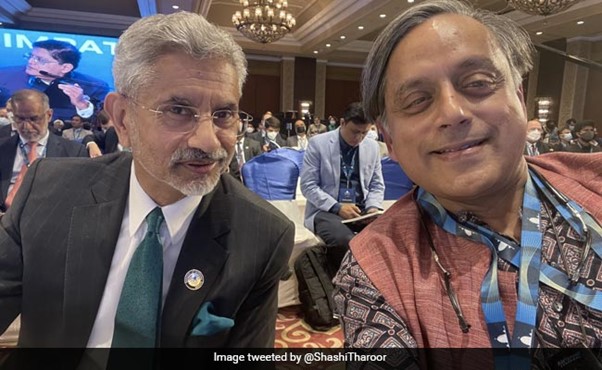
A selfie at the Raisina Dialogue for Tharoor and Jaishankar – endorsing “multi-alignment”

From the west we often hear business leaders say “India wants to be more western” – but does it? Or is there a different world view in India?

Three points stand out for me:

FIRST, PM Narendra Modi recently stated that, while many countries have strayed from spirituality and towards consumerism, India should not do so.

SECOND, laying the foundation for the World Health Organization’s (WHO) Global Centre for Traditional Medicine (GCTM) in Jamnagar, Gujarat, PM Modi stated that countries all over the world are focusing on traditional herbal systems to combat the COVID-19 pandemic, and that Yoga has helped people all around the world establish mental balance by reducing stress.

THIRD, in an increasingly divided world with an “us vs them” view, India is an exception. Senior Congress leader Shashi Tharoor on Tuesday thanked External Affairs Minister S Jaishankar for publicly giving him credit for the term “multi-alignment” and posted a selfie of them together at the ongoing Raisina Dialogue. There is a very conscious policy of engaging all the major powers simultaneously in a world. Who else is doing this?

What do you think?

Understanding India’s neutrality on Russia and Ukraine

Russia’s Putin meets with India’s Modi in 2018 – Russia has consistently supported India over Pakistan and China

India has taken a lot of criticism for not joining in global criticism of Russia over the invasion of Ukraine.

In the drama of conflict, few take time to think – but India perhaps deserves you taking a moment to reflect on why it has taken a neutral stance.

At the very centre of India’s position is that in face of border challenges with China, it needs its defence partnership with Russia to continue.

Interesting that almost all western leaders recognise this strategic dilemma.

India is an important part of the move to balance China in the Indo-Pacific, so it is vital to understand their position.

Few are aware that for all of its democratic and independent life, India has been very close to Russia. It is a long standing relationship.

India is now the only Quad country to have not called Russia out by its name let alone by imposing economic sanctions.

But the other three nations in the Quad know that India’s defence relationship with Russia could be described as its “most valued partnership”, as a recent Lowy Institute paper put it.

How important is Russia to India?  A whopping 86% of Indian military hardware is of Russian origin – and this hardware is central to India’s ability to stand up to China over longstanding territorial disputes.

In 2018, India signed a US$5 billion deal with Russia to buy the S-400 missile defence system. Trump warned India that it might impose sanctions – so far, no sanctions have arisen.

And don’t forget Russia has been the only country to support India over decades of problems with Pakistan. In 1971 when India and Pakistan fought for 13 days, Russia was the only country to help India – no western country provided support. The USA ignored Delhi’s please for help over East Pakistan as it then was.

You could see this as an “over reliance” on Russia, but don’t forget it has been close to Russia since the first Prime Minister Nehru took office – and it is only recently that it has become involved closely with countries like the USA, Japan and Australia.

India’s position on Russia and problems with China were somewhat challenged by the recent Russia-China joint statement, pledging that “there are no ‘forbidden’ areas of cooperation”. India is no doubt seeking to understand what this means – and in such a fast changing environment, is even more unlikely to call our Russia over Ukraine.

With the brutality and horror of the war on Ukraine now clearly visible, whether India will change its neutrality stance remains to be seen.

But hopefully the above information has helped you understand India’s position.