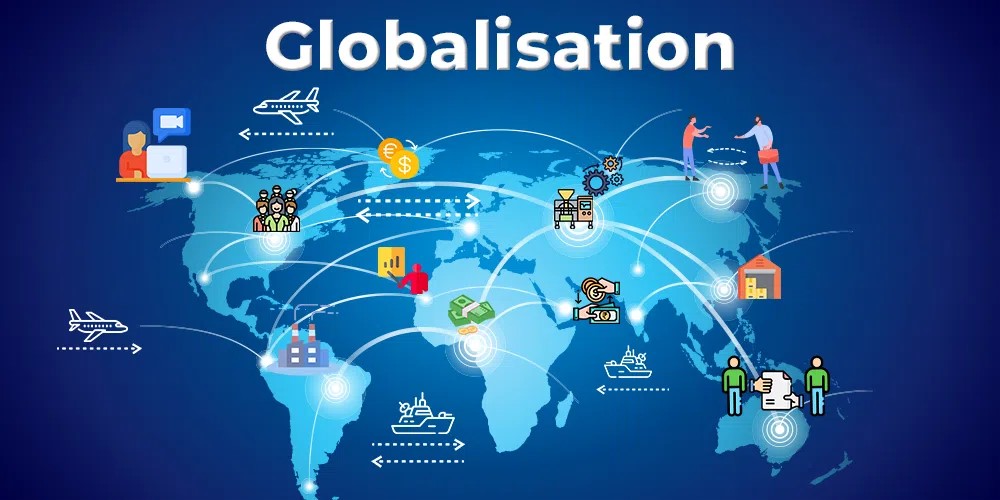
Does “trade detached” India have an edge in the trade wars?

Countries now turning to India

India should ride out the current global “trade wars” better than the world’s biggest exporting economies.

In fact, India’s “trade detached” economy now has new opportunities.

India can now fast-track trade agreements with the EU, UK, Australia and Canada, while deepening ties with China, Russia, Japan, South Korea, and Asean.

It also has much to gain from reforms, such as simplifying its own tariffs, making a smoother goods and services tax (GST), improving trade processes and applying fairer quality controls.

India is the world’s fifth-largest and fastest-growing major economy.

India’s vast domestic market (around 1.5 billion people) has fuelled its growth.

All of this means India has a lower exposure to global goods trade.

With export-driven economies slowing down under tariff pressure, and India continuing to grow at 6%, it looks well placed.

“Trade detachment” is turning into an advantage.

Critics have often described global trade systems as simply colonialism in disguise – partly accounting for why India does not focus too much on trade

But “trade detachment” has come at a cost – between 1951 and 1981, per capita income grew at a sluggish pace of just 1.5% a year.

1991 is celebrated in India as the turning point.

Between 2002–03 and 2011–12, India’s exports of goods and services surged six-fold, soaring from $75bn to over $400bn.

Consider how huge this is – per capita income grew more in the first 17 years of the 21st Century than it did throughout the entire 20th Century.

This is the miracle of modern India.

However, the “make in India” program has struggled, yet also had impact as global countries move to diversify from China.

Now the European Union is reaching out to India.

In the scramble for reliable trade partners, India is suddenly attractive.

How India can become the “next China”

Globalization worked so well for China, but is stressed today

It’s complicated.

Mainly because of the rise of protectionism worldwide.

The Chinese miracle rode on the wave of globalization that began around 1980 and lasted until the 2008 global financial market crisis.

Globalization has come under severe stress lately, according to Amit Kumar, a research analyst with the Takshashila Institution’s Indo-Pacific studies program.

Weaponizing trade has left nations increasingly wary of economic coercion.

Self-sufficiency in some form or other is back in fashion. PM Modi is super keen on self-sufficiency for India.

If globalisation is too restricted, India’s ambitions might be thwarted. India could well have shot itself in the foot here, with it’s own anti-globalism and scepticism on international trade deals.

Gains for India will however be derived from the ongoing de-risking and “China plus one” strategies.  

India – unlike China during its growth – faces tough competition from Vietnam, Thailand and Malaysia. India attracted 15% of European investment diversifying away from China, but it fell behind ASEAN, which attracted 21% of the rerouted investments.

India is also lagging on ease of doing business. INTO INDIA has praised India’s progress, but must admit that it is now too slow. Ease of doing business has to leap ahead.

India currently contributes 16% of the global economic growth, as opposed to China’s 34%. The IMF predicts India’s share to rise to 18% in the next five years.

As China witnesses a decline in its share owing to its economic slowdown, we are led to conclude that India should emerge as the leading engine of growth.

With one reservation – “Ease of doing business’ could be the key.

Perhaps India CAN become the ‘next China’ and drive global growth

India’s consumer base is rapidly growing – pic from a Delhi mall

Since INTO INDIA has been involved with India, the mantra from economists and diplomats has been that “India is not the next China “. Is that about to change?

It could be, according to Amit Kumar, a research analyst with the Takshashila Institution’s Indo-Pacific studies program.

China has been top of mind for good reason – contributing more than a quarter to global gross domestic product expansion between 1990 and 2020. In the period from 2013 to 2021, China contributed almost 39% of global GDP growth — 13% more than the G7 countries combined.

How could India become the next China?

India would need to sustain a near double-digit growth rate for nearly three decades.

It would need to integrate with the global manufacturing supply chain, transition into an export powerhouse and attract enormous foreign investment.

But 40 years ago, we would have said the same things about China.

China’s rise from the 1970’s was boosted because of the deepening U.S.-Soviet rivalry and the Sino-Soviet split, prompted the US and the West to open up to China in 1971.

This is happening now with India.

Due to the deepening strategic competition with China, Beijing’s expanding diplomatic and economic clout, its belligerent foreign policy and economic coercion, has sparked concerns of overdependence and strategic vulnerability in the West.

India is emerging (has emerged?) as the preferred partner for the West.

We should not forget that China’s growth was also driven by global businesses looking for cheaper manufacturing.

This is now happening with India. Global firms now see India as an alternative to China.

The Indian Government has already supported high-profile projects involving the manufacturing of iPhones and the assembly of semiconductors – sending an “invitation” to others.

China also had a rapidly growing consumer base. No other Asian country had such a base – until India.

India has the second-largest consumer base – defined as people spending above $12 a day – of over 500 million, second only to China’s 900 million. Estimates show that by 2030, India’s consumer base will expand to 773 million, trailing only China’s 1.062 billion.

The gap between China and India will only shrink from here on.

NEXT BLOG – What India has to do to become the next China.

Australia India two-way trade now over A$50 billion

Great news from Austrade – two-way trade between Australia and India has reached around AUD 50 billion!

INTO INDIA has been active in this space over 20 years, and for most of this time our trade remained stagnant.

This recent growth is a tribute to the folks at Austrade, as well as State Government offices and all the organisations promoting the relationship. And of course highest praise goes to the brave companies that are finding a way in the Indian growth market.

Healthcare is a good example of the opportunities ahead.

The recent Indian budget 2024 signals the Indian government’s resounding commitment to provide equitable healthcare services across socio-economic spectrum with special coverage of “missing” middle class.

The Indian government is scaling up their focus on digitalisation of the public healthcare system, tariff reductions on some critical pharmaceutical drugs and MedTech devices.

Good news across the board – the budget also involves notable reductions in corporate taxes for foreign companies.

As India continues to grow as a preferred commercial destination, connect with organisations such as the Australia India Chamber of Commerce, with Austrade and with State Government offices – they can all help with the pathway to India.

Why India is such a rare and attractive investment market

There is something about investing in India that most investors are not aware of. INTO INDIA is pleased to bring this important statistic to you.

India is a rare market that has delivered double digit annualised returns in USD terms consistently over a 5, 10, 15 and 20 year time frame.  Even the US has not done that, falling just short over the 20 year time horizon.

Why is this happening?

This startling fact was drawn to the attention of INTO INDIA by Anish Mathew, Chief Executive Officer & Chief Investment Officer, Sundaram Asset Management Singapore Pte Ltd.

Anish explains – “There are a couple of key reasons for this in my view.  India is a capital scarce country and hence cost of capital has always been high in India. 

“This has resulted in corporates being generally disciplined about their capital allocation decisions which in turn has benefited their shareholders over the longer term. 

“Secondly, the correlation between economic growth and corporate profits is the highest amongst its EM peers.  Studies have shown that over a 20 year period, it is around 0.62. 

“As the Indian economy has grown at an average of 6% since 1980, corporate profits have benefited, thereby underpinning the performance of the Indian market over the long term,” he said.

For those who love the stats:

The MSCI INDIA Net Total Return USD Index:

5 years – 11.92%

10 years – 10.06%

15 years – 10.42%

20 years – 11.04%

Makes INTO INDIA wonder – are we missing the India investment opportunity?

Jasmine Batra and AICC outlining a thoughtful way to enter the India market

Two organisations that advocate a “more thoughtful” way to enter the Indian market came together last week in a wonderful seminar providing some super advice.

First was the Australia India Chamber of Commerce (AICC) which hosted the event and their Chair, Chris Mooney, put the case for the chamber’s National Industry Groups doing well researched and sequenced steps to engage with India. Each group does research for a white paper, builds a community and knowledge group around it and leads to well prepared India missions.

Second was the keynote speaker, Jasmine Batra from Arrow Digital, who have a program called “The Big Leap” taking clients through a 12 month program of understanding and entering India. INTO INDIA has long advocated that slower market entry produces superior long term results – a strong alternative to the traditional Aussie hasty transactional approach. We love “The Big Leap” concept.

There are three major factors that make India today a very special market – first, the young population with an average age of 28; second, the rise of the tier 2 and 3 cities, including their specialisation, three, India’s global leadership in rolling out digital infrastructure that is transforming business and society.

Jasmine talked about importance of Food, Festivals and Family when thinking about India. “Family” includes what she called “the crazy rich” such as Tata, Ambani and many more. But it also goes right down to small community business families. Your journey will interact at all levels at some time.

Reducing risk is vital. There are three steps you can take. First, understand the cultural context. Second, do market research and find local partners. Third, network community and do due diligence.

In conclusion Jasmine Batra said you should get over there, get around and get partners. By research and regular visits, your more thoughtful engagement with India will produce results.

La Trobe University very kindly provided the venue.

CONTACT AICC

Contact Jasmine Batra

About Us

6 big changes in India – and 5 reasons growth will boom

Only 8% of Indian households own a car – so big growth is ahead

INTO INDIA has consistently said India is the growth story of this century.

Now Anish Mathew, CEO and CIO of the very successful Sundaram Asset Management Singapore Pte Ltd, has found a unique way to describe why India is indeed THE growth story.

6 big changes in India

  • The number of income tax filers has increased by 57.5% between FY15 and FY21.  This is obviously the impact of the growing use of Aadhar (biometric unique identity card) as the preferred KYC document and the implementation of GST, both of which is pushing up the tax compliance in the country.  
  • Indirect (GST) tax base stood at 14mn in November 2022, a 2.3x increase from mid 2017.   
  • Number of PAN cards (unique tax identity number issued by the Income Tax Department) allotted has increased by 2.5x in the last 7 years.
  • 80% of the railway tracks were electrified as of end FY22 as compared to 31% in FY11.
  • Road infrastructure measured in number of kilometres has increased by 36.6% in the last 11 years.
  • Major port capacity has nearly doubled in the last 8 years.

5 reasons growth will boom

  • Only 8% of the households owned a car, 24% an air conditioner and 38% a refrigerator.
  • Only 1% of Indians account for 45% of all flights.
  • Only 3% of Indians make up all unique card holders.
  • Only 2.6% of Indians invest in mutual funds.
  • The Indian diaspora remitted USD 100bn into the country in 2022, eclipsing the gross FDI flow during the same period. 

Mathew advises that the three big growth drivers for the next decade are consumption (driven by the Demographic Dividend and rising incomes); manufacturing, and; digitisation (which is the formalisation of the Indian economy)

He makes a powerful case for investment and trade with India.

India now the straight-forward long term story, not China, but go both!

“India much more straight-forward long term story than China” – Christopher Wood, Equities Analyst, Jefferies

For business and investment, India is now a more straightforward, long-term option than China.

But it is really smart to think BOTH India and China, not one or the other.

The equity strategists are saying it. All the trade commentators are saying get your product or service into India – now.

One equity analyst, Christopher Wood, the global head of equity strategy at Jefferies, said in the latest edition of his immensely popular newsletter to investors called ‘GREED & fear’: “India remains a much more straightforward long-term story than China, which is why GREED & fear has 39 percent of the Asia ex-Japan long-only portfolio, long-term in its focus invested in India and “only” 25 percent in China.”

INTO INDIA points to the incredibly high number of young Indians coming through – called the demographic dividend” – as the big reason to be there.

Time to begin or upgrade with an Indian investment and market entry strategy?

Great appointment for new Chair of the Centre for Australia-India Relations

INTO INDIA was super pleased to see that Australia’s Minister for Foreign Affairs, Senator Penny Wong, has appointed Ms Swati Dave as the inaugural Chair of the Advisory Board to the Centre for Australia-India Relations (CAIR).

By all talks, the CAIR is going to be the new epicentre of Australia’s broad relationship with India.

It can take things to a new level. Much needed.

CAIR will open some time this year and will serve as a national platform to further strengthen our relationship with India.

Why is this such a strong appointment?

Ms Dave is currently Deputy Chair of the Asia Society Australia and as a member of the National Foundation for Australia-China Relations’ Advisory Board. She is also an Investment Committee member for QIC Global Infrastructure. Ms Dave has more than 30 years’ of experience in finance and banking across a range of sectors in both domestic and international markets.

She is the right person to guide the relationship to a higher level.

We need much more guidance on business relations, cross-cultural understanding and a broader cultural engagement with India. INTO INDIA has long called for more Australian investment in India -investment is a powerful basis for future trade.

CAIR will apparently work closely with the Australia India Council (AIC) and the Australia India Institute (AII).

Australia and India – stepping up with CAIR to a new, stronger relationship.

2023 the year to engage with India as change speeds up in all sectors

Welcome to 2023 from INTO INDIA.

This has to be the year to engage more with India, be there more, make connections, launch products and services, expand into new areas and more.

Just one example stood out for me over the break – EV sales.

Electric Vehicle sales have become a symbol of how fast India is changing.

Delhi has recorded the nation’s largest electric vehicle (EV) sales in the country among all the states/Union Territories. A total of 7,046 EVs were registered in Delhi in December 2022, witnessing an annual growth of 86%.

Since the launch of the EV policy Delhi had recorded registration of a total of 93,329 electric vehicles out of which, two-wheelers contributed nearly 55% of the total EV sales in 2022. The December 2022 sales of EVs have resulted Delhi reaching one step closer to its mission of achieving two-thirds of its targets which can be attributed to the “i3” model of Incentivisation, Innovation and Inclusion.

The Transport Minister of India, Mr. Kailash Gahlot stated Delhi to be the country’s EV capital with 2,300+ charging stations and 200+ batteries swapping stations in operation across the city.

On August 7, 2020, EV policy was launched in Delhi by prioritising two-wheelers and three-wheelers segments, with an aim of rapid adoption of electric vehicles contributing to 25% of all new vehicle registrations by 2024.

A campaign launched by the Chief Minister of Delhi, Mr. Arvind Kejriwal, “Switch Delhi” focuses on spreading awareness about the benefits of such vehicles in making Delhi clean and pollution free. The government is spending more than US$ 183 million (Rs. 1,500 crores) on the electrification of 56 depots for housing more than 10,000 buses by 2025.