India’s YOUTH BOOM will reshape the world

These are the priorities of Indian Gen Z and Millennials.

Most of the world’s young people live in India.

And India next month becomes the most populous nation on earth, passing China.

India’s YOUTH BOOM looks like this:

440 million Millennials (born between 1981 and 1996)

375 million Gen Z (born between 1997 and 2012)

There are two things we need to know about these generations.

First, they are hard working and earning better than their elders. A high percentage of them have a second job.

Second, they are big spenders, so their capacity to shape and influence us all is enormous.

So, getting your product or service into India right now would make great business sense.

And countries, like Australia, are busy building closer political and strategic ties with India. Makes sense – it will be the economic (and therefore cultural etc) driver of the future.

Time for Australian business and education to find a way to increase trade with India

Dr Ashok Sharma has written about the increasingly close relations of India and Australia – for example, we are now the number 2 education market behind the USA and just ahead of the UK. Dr Sharma pointed to the Comprehensive Strategic Partnership and the New Education Policy which should “bring the current education partnership to the next level”.

But what about other areas of trade?

We know that the increasing activity in education has many spin offs – increased tourism, professional exchanges and more.

Education might be the “trade flagship” that drags other industries into the trade mix.

But we cannot be sure.

It is time for a new national conversation about Australia-India trade, with a close examination on what blockages might exist and what steps would increase two-way trade.

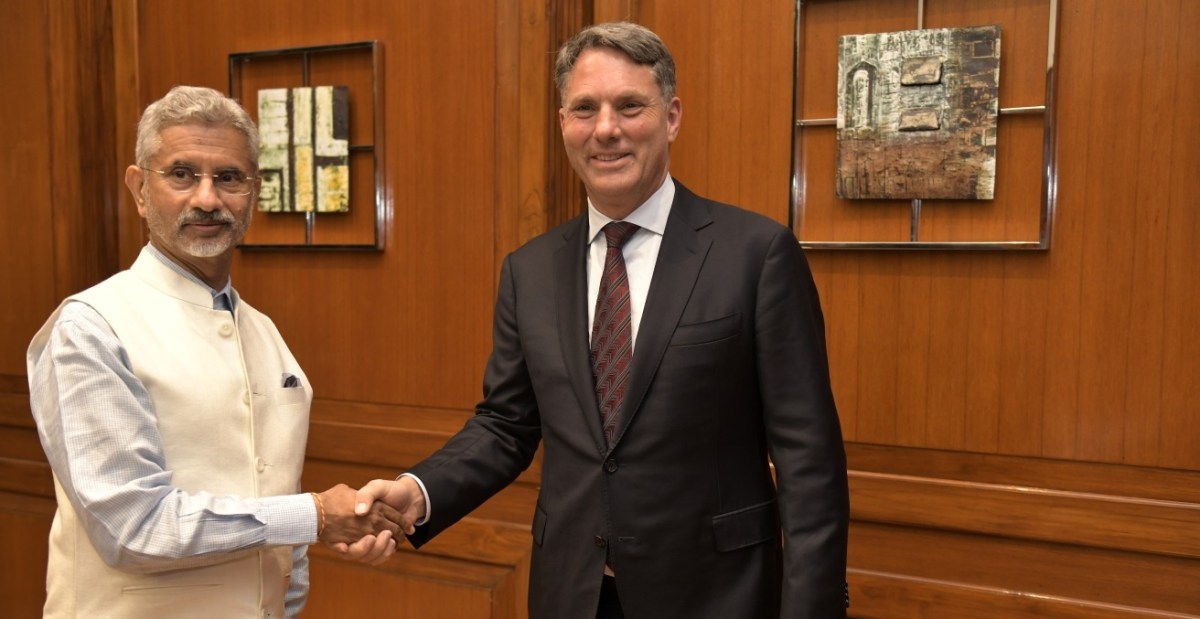
India’s External Affairs Minister Dr. S. Jaishankar (pictured with Acting Prime Minister Richard Marles) came to Australia in October for the annual Foreign Ministers’ Framework Dialogue – where these matters were discussed.

The two foreign ministers discussed “accelerating and deepening economic ties, including through our Economic Cooperation and Trade Agreement.”

Sounds good.

But what is next?

Can the Australian Trade Minister, the Hon Don Farrell, bring business and education at all levels together in a national dialogue?

Remember – India is not just the second most populous nation on earth, it is also the YOUNGEST – which makes it the global growth centre. We cannot afford to miss this opportunity.

We have to find a way.

DEAKIN UNIVERSITY HUBS – the new way in India

Deakin University set to lead in new education era for India – at JGU are Professor Iain Martin, VC, Deakin, and Ravneet Pahwa, VP and CEO South Asia

These “HUBS” are a great innovation by Deakin University – giving it a great advantage in the Indian era of the New Education Policy.

Deakin Vice-Chancellor Professor Iain Martin visiting New Delhi, India, announcing the launch of partner-institutions so that students can commence the first part of their studies in their home country.

“I am excited to be back in India and it couldn’t have been for a better occasion than the launch of the DEAKIN UNIVERSITY HUBS at OP Jindal Global University, Symbiosis International University and Chitkara University,” said Professor Martin.

Here is why this is a big idea!

Indian students can now commence the first part of their studies with a Deakin partner institution in India and then transfer to a Deakin campus in Australia for the second part of their educational journey.

But that’s just the early stage of the HUBS.

“These hubs will provide valuable opportunities for growth, student mobility and joint research. They will promote enhanced collaboration between Indian institutes and Deakin, leading to academic and research excellence that will be highly beneficial for both countries,” said Professor Martin.

It gets better!

Deakin has established similar hubs with corporates – Infosys, TCS and more.

Deakin was the first international university to establish its presence in India in 1994.

CONGRATULATIONS to Ravneet Pawha, Vice-President (Global Alliances) and CEO (South Asia) at Deakin and the whole Deakin team in India.

Deakin is a role model in how to do business in India:

  • Establish a presence for the long haul
  • Be visible in India
  • Develop relationships over time
  • As India further liberalises, build stronger engagement
  • Use Indians to head up your presence in India
  • Ensure your leadership (V-C) is a regular visitor to India

India and China – a simple comparison

The Indian economy is expected to grow by 7.3% in the current fiscal year, which ends in March.

China is expected to grow by 2%.

Population of China is 1.4 billion (approx), ageing and declining.

Population of India is 1.4 billion (approx), young and growing.

Indian economy is driven by supplying local demand as the youthful population and middle class growth increase demand.

Chinese economic growth has largely been driven by making and exporting.

India as a domestic demand-driven economy – is less sensitive to global downturns.

China is an export driven economy – highly sensitive to global downturns.

And we have not even got onto world’s largest democracy, innovative driven, attracting and welcoming western investment and more…

Compare the two – what do you think?

Indian consumers are optimistic, even during Covid – McKinsey

A McKinsey survey has found that nearly three-quarters of India’s consumers are optimistic about economic recovery, and net intent to spend is growing and positive across many categories.

Omnichannel usage continues across the majority of categories.

Social-media influence is high, especially for Gen Z and millennials. More than 90 percent are engaging in social media and entertainment platforms.

There is an upward trend for new technology, such as crypto and augmented reality/virtual reality, and consumers intend to continue digital activities as the COVID-19 crisis subsides.

About 40 percent of consumers are engaging in out-of-home activities, especially among the vaccinated segment.

Most consumers have tried new shopping behaviours’ such as new retail outlets and new brands.

https://www.mckinsey.com/business-functions/growth-marketing-and-sales/our-insights/survey-indian-consumer-sentiment-during-the-coronavirus-crisis

Find the right business partner in India

 One of the most frequent questions for INTO INDIA is how do we find the right business partner in India? Most case studies of Australian businesses succeeding in India reveal one key element – finding the right local partner.

What is the right local partner?

It is much more than someone who says “yes”. Too many have been frustrated in Indian market entry because they forged alliances with any and everyone who said “yes” – which means everyone they meet. India is a culture that cannot say no, so be wary of the yes answer.

The right partner is already active and successful in your field. They can show you their track record.

Your right partner will have connections among suppliers and customers, and will be keen to introduce you to them so you can form your own judgement.

In the collective culture of India, your right partner will be well connected in the various business chambers and will have good connections in government – central and state. This right partner will demonstrate these connections by organising meetings for you, rather than just saying “yes” we are connected.

Your right partner will be someone you double check with Austrade and with other reliable connections you have in India or Australia.

Your right partner could ultimately become an agent, a joint venture or more. They might just be a trusted individual who willingly offers to make connects for you – this freely opening doors does occur in India.

Your right partner might be a talented individual who you hire into your business. Or it might be a combination of external and internal. Patience will be your best friend as you make these choices.

Finally, your right partner will develop relationships for you – because in Indian culture relationships matter. Relationships first, business second is the path to long term business in India. Quick deals are just that – one transaction that might not lead to anything.

So, how are you going finding the right partner in India?
 

Online meetings present the challenge – how do I introduce myself?

Zoom, Teams and other online meetings are now part of our lives. In many of these meetings, you are called upon to introduce yourself. Maybe everyone is introducing themselves.

It can get the pulse raising and the mind in overdrive. What will I say? Where should I focus? Will they like me? Meanwhile, we are missing out on all the other interesting introductions happening.

The stress can be negative – or positive. Through practice, we can come to recognise stress when it arises and use it for good – ah, now, better concentration, sharper reflexes, and so on. In contrast, if we have a negative reaction to stress it can mess up our introduction – nervous, shaky voice, tongue-tied, rambling on….

So, what is the easiest way to introduce yourself?

Like all public communication, the secret is to keep it simple.

The simplest way to introduce yourself is in three parts (and this might mean just three sentences) – present, past and future. People love this approach – they recognise the structure, simplicity and like a note about the future.

A present-tense statement to introduce yourself: “Hi, I’m Stephen, and I’m a communication consultant and author. My current focus is mentoring and writing.”

Past tense might be just two or three points about your background and gives you credentials and credibility. An example: “My background is in corporate communication, and I have previously advised top 100 corporates and big four professional services firms.”

Future tense is all about projecting optimism and enthusiasm – two very likeable characteristics. In a meeting this should relate to the topic. “In the next 12 months I plan to do more writing towards a new book and meetings like this give me not only content, but the motivation to keep exploring”.

Simple? Present, past and future. Each can be as long or short as the occasion requires – but always err on the side of shorter. Trust me – you will gradually enjoy (and smile) while introducing yourself.

Is India the global centre of autodidacts?

Autodidacts.

People who love learning and take ongoing learning into their own hands.

How do you know if you’re an autodidact?

Autodidacts are busy, goal-oriented individuals who never run out of things to do. They are generally curious about things and believe in thinking outside the box. Their curiosity is effervescent, and they can easily talk about a subject they had no formal education in for hours together.

In my experiences of many visits and countless interactions, I have found India to be in love with ideas, open to exchange learning and in every way, it is the role model for would-be autodidacts.

Can Australia balance its Pacific Ocean strategy (USA) with an Indian Ocean strategy (India)? Seems it can.

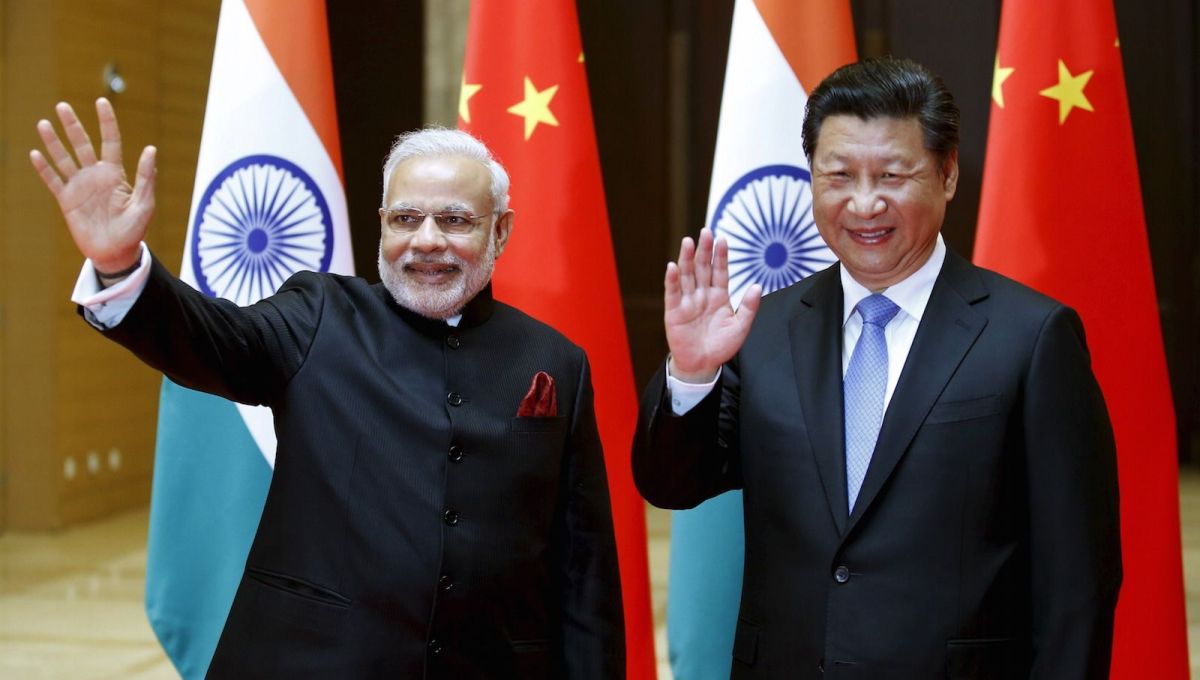
The four leaders of the QUAD – a new closeness transforming this region

There’s a big change happening and it is spearheaded by the new dynamic of the Australia-India trade and security relationship – this is growing to provide a balance for Australia’s historic close alliance with the USA.

INTO INDIA has long felt that Australia has “looked north east” for too long and now is looking more “north west”.

For a while our diplomats and politicians talked about “the Indo-Pacific” as a way to introduce the change. But it is not a sustainable concept and there is no such region.

Australia has a Pacific Ocean strategy (USA) and is now building an Indian Ocean strategy (India). These relationship shifts affect our defence and security, as well as our trade and investment.

Matching that change, it is more than symbolic that an organisation such as the Australia India Chamber of Commerce is focussing on the key industry areas of greatest potential under the deal – and moving away from the old “federal” and state based approaches. Great! Under the old structures, outcomes were often lost in rivalries and politics.

The AICC model has one national organisation – supported by National Industry Groups. This frees up resources to make a difference.

So far the NIG’s include Education, Power and Renewables, Critical Minerals, Defence and Security, and Technology and Innovation. Small steps, but steps they are!

One step at a time, one change at a time, at so many levels, Australia is looking “north west” and taking a role in the Indian Ocean region by a close relationship with the new regional and global power, India.

The new strength of the QUAD (India, Japan, USA and Australia) is also part of the change and the new world of moving alliances.

If the move keeps going, Australia will have strength in two main regions and close relations with two major powers – India and the USA.

Australia getting international students back – but a lot of work to do

The Department of Education has released year to date (YTD) April 2022 international student data. There were 456,811 international students on student visas for YTD April 2022, down 13 per cent or 67,301 on April 2021.

  • The student markets with the largest decreases were China (down 16 per cent decrease or 25,155 on April 2021) and India (down 18 per cent or 16,086 students on April 2021).
  • Overall, China and India contributed 61% of the total loss in students for YTD April 2022.
    • The number of students studying offshore decreased by 42 per cent from 152,888 to 89,082

There have been more students complete, discontinue, or defer than start studies. While YTD April 2022 commencements are up 6 per cent (or 8,584) to 150,834, enrolments fell 14 per cent (or 78,857) to 496,232.

Clearly Australia has to promote hard to win back – and grow – this market.