Jasmine Batra and AICC outlining a thoughtful way to enter the India market

Two organisations that advocate a “more thoughtful” way to enter the Indian market came together last week in a wonderful seminar providing some super advice.

First was the Australia India Chamber of Commerce (AICC) which hosted the event and their Chair, Chris Mooney, put the case for the chamber’s National Industry Groups doing well researched and sequenced steps to engage with India. Each group does research for a white paper, builds a community and knowledge group around it and leads to well prepared India missions.

Second was the keynote speaker, Jasmine Batra from Arrow Digital, who have a program called “The Big Leap” taking clients through a 12 month program of understanding and entering India. INTO INDIA has long advocated that slower market entry produces superior long term results – a strong alternative to the traditional Aussie hasty transactional approach. We love “The Big Leap” concept.

There are three major factors that make India today a very special market – first, the young population with an average age of 28; second, the rise of the tier 2 and 3 cities, including their specialisation, three, India’s global leadership in rolling out digital infrastructure that is transforming business and society.

Jasmine talked about importance of Food, Festivals and Family when thinking about India. “Family” includes what she called “the crazy rich” such as Tata, Ambani and many more. But it also goes right down to small community business families. Your journey will interact at all levels at some time.

Reducing risk is vital. There are three steps you can take. First, understand the cultural context. Second, do market research and find local partners. Third, network community and do due diligence.

In conclusion Jasmine Batra said you should get over there, get around and get partners. By research and regular visits, your more thoughtful engagement with India will produce results.

La Trobe University very kindly provided the venue.

CONTACT AICC

Contact Jasmine Batra

About Us

9 Rules for Thriving in India

Rules compiled from my personal experience – and with some reference to “Rules for Living” by the School of Life…

1. ACCEPTING IMPERFECTION

You will never be happy in India if you seek perfection. Hang on…maybe seeking perfection anywhere is a flawed idea. Is it possible we humans are inherently flawed and broken? Is perfection beyond us? Even the west with its “belief” in science has not stamped out stupidity and pain. Life will always include suffering – this is a big Indian idea. Accepting this makes everything so much better.

2. VULNERABILITY & COMPASSION MAKE LIFE SHINE

This follows from “Accepting Imperfection”. We are all in the same boat, and recognising that we all share weaknesses, fears and mistakes can make us feel generous towards others who are also imperfect – and feel compassion for ourselves.  I learnt in India that sharing your vulnerability, talking about it to people you have just met, can lead to amazing connections.

3. ALWAYS BE KIND

To be kind to others is a choice. Being kind is a form of respect in action. In India many people accept that what happen to us is mostly out of our control, so stop struggling and find a way to live. It also acknowledges that terrible things can happen anywhere, anytime to anyone – so we can be scared or even resentful, or we can just be kind instead. It feels good.

4. HAVE A GOOD LAUGH

I seem to smile and laugh more when in India. There is a kind of blanket acceptance that life is weird, and humans are pretty funny, so have a good laugh. Accepting all of this with good grace goes a long way to easing our frustrations at our own stupidity. Back home we often see acceptance as just doing nothing – but in India acceptance becomes the first step to boldly trying your best, knowing that any outcomes will not be perfect. Why would you expect a planet of 7.8 billion people just as foolish as you to run smoothly, why expect it to be better, why look for “it SHOULD be better”? Just have a chuckle.

5. WE ARE GOOD ENOUGH – AND NOT

I dropped my obsession with “perfection” on my first arrival in India. Sure, the luggage system looked a bit messy, but they never seemed to lose my luggage. I found that the alternative to perfection is not failure, This small thing (luggage) can lead to a greater idea – rough and flawed as we all are, we can make our peace with the idea that we are, each of us, ‘good enough’. We in the west are way too quick to call out “failure”, especially in ourselves. But being ordinary or not measuring up to someone’s standards is not failure – it is just how things are.

6. FINDING WHY ROMANTICISM IS A WASTE OF SPACE

I have learnt a lot from young Indians here in Melbourne and in India. In India there is much to learn about the gradual growth of friendship into love, as a more stable approach than “falling head over heels in love”. But even that is not perfect.  I learn that love grows out of friendship, and that compatibility grows out of love – while in the west we see it as a prerequisite for love. But I also learned that having said all of this, no one is ever wholly ‘right’ nor wholly wrong. We are just learners, or as Gandhi said, seekers.

7. ACCEPTANCE IS BETTER THAN CONSTANT STRUGGLE

When the great Indian philosopher Krishnamurti was on his death bed, he was asked how he maintained such a composted and happy mind. His reply was a teaching for me. He said: “I don’t mind what happens”. It made me realise that almost all of the time, with whatever is happening, my mind made up stories or created ideas – most of which were not helpful because they led to struggle or resistance to what was happening. Things might be bad, but we can still be cheerful. Don’t mind what happens.

8. CLEARLY SEE WHAT IS HAPPENING

Despite our seeming importance, we are not at the centre of the universe – probably not at the centre of anything. Seeing ourselves at the centre means we do not really see as it is, we see as we are. Back to the baggage at the first airport I visited in India – I did not see what was happening, I saw it as I was – impatient, not trusting, agitated and emotional. Putting myself at the centre, when I meet people, I meet them where I am at. With wisdom from India (“I am not the centre”) – I can meet people where they are at. It is a clearer vision.

9, YOU WILL FORGET ALL THIS

I can forget anything – and probably you can too. Our minds might be amazing but they also just – forget stuff. So, any big ideas need to be revisited, again and again, almost so they become a habit. Even if only one of these ideas works for you, go over it and keep it for your next visit to India.

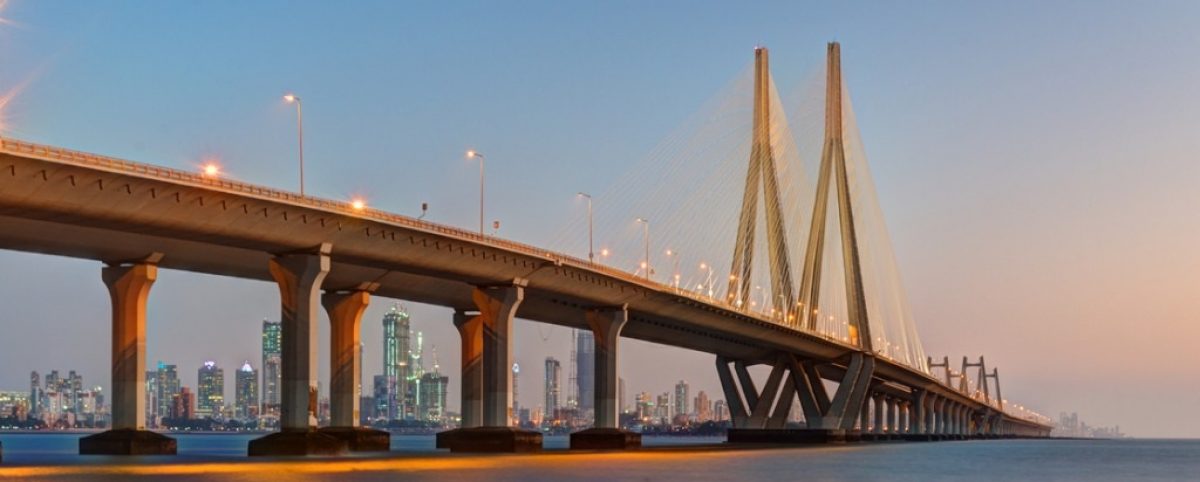
The bridge that is transforming Mumbai

The last time I went from south Mumbai to have dinner with friends in Navi Mumbai, the trip took three and a half hours – making us 90 minutes later than the expected two hour trip.

Today you can do this trip in 20 minutes.

Prime Minister Narendra Modi inaugurated the Mumbai Trans Harbour Link (MTHL), the country’s longest sea bridge, on Friday. The sea bridge connects South Mumbai to Navi Mumbai and will reduce the current two-hour journey to just around 15-20 minutes.

While inaugurating the bridge, PM Modi (who loves to paint the big picture) said, “This is proof of our resolve that for India’s development, we can take on even the ocean and break the waves.”

The 21.8-kilometre-long bridge will enhance connectivity to both Mumbai International Airport and Navi Mumbai International Airport, reducing travel time from Mumbai to Pune, Goa, and South India. Additionally, it will improve connectivity between Mumbai Port and Jawaharlal Nehru Port.

Things are changing fast in India – perhaps this is your year to find out what this might mean for you?

India’s “Look East” turning into railway and highway linkages

India first adopted “Look East” as a foreign policy in 1991 – but in true PM Narendra Modi form, he changed the name to “Act East” – and action there is. Two main projects show how change is coming.

As 2023 draws to a close, a decade-old Memorandum of Understanding (MoU) between India and Bangladesh, to set up the first Indo-Bangla international railway connectivity in India’s Northeast, has found fruition in the recently launched Akhaura-Agartala cross-border rail link.

Inaugurated digitally by Indian Prime Minister Narendra Modi and Bangladesh Prime Minister Sheikh Hasina, this railway connects, Agartala—the capital city of India’s Northeastern state, Tripura—with the Akhaura upazila in Bangladesh’s Bahmanbaria district. The connectivity through Bangladesh helps bypass the long, narrow, and congested Siliguri Corridor, also known as the ‘Chicken’s Neck’ which connects the Northeast to India’s mainland. In effect, this reduces the traveling distance from India’s Northeastern states such as Mizoram, and southern parts of Assam to Kolkata. For Tripura particularly, the distance to Kolkata by rail is reduced from 1,600 km to 500 km and the duration is reduced from 31 hours to 10 hours, approximately.

In another major “Act East” development, on the side-lines of the recently concluded 12th Mekong Ganga Cooperation (MGC) meeting in Bangkok on 16 July, Indian External Affairs Minister Dr. S. Jaishankar met with his Myanmar counterpart U Than Swe to discuss regional connectivity initiatives, with particular emphasis on expediting the India-Myanmar-Thailand Trilateral Highway (IMT-TH) project.

The IMT-TH project follows a proposed plan that starts from Bangkok and passes through cities like Sukhothai and Mae Sot in Thailand, and Yangon, Mandalay, Kalewa, and Tamu in Myanmar before reaching India. In India, it is likely to pass through Moreh, Kohima, Guwahati, Srirampur, Siliguri, and Kolkata, spanning over 2,800 km. The longest stretch of the highway will be in India, while the most minor road section will be in Thailand. Thailand’s Vice Minister of Foreign Affairs, Vijavat Isarabhakdi, stated in a recent interview that most of the project’s work in Thailand is over. The Indian counterpart also mentioned that around 70 percent of the work is complete. Upon being approached, Aung Naing Oo, Myanmar’s Trade Minister, revealed that most of the highway was constructed, spanning 1,512 km. The contractors will complete the remaining sections within three years.

“Act East” looks like building new connectivity between Southeast Asia and South Asia – and that strengthens the region.

How to Create an Effective Cross-Cultural Training Program

As Australia builds closer relations in Asia while India strides into the western world, it becomes more important than ever that employees have cross cultural knowledge.

My reading on cross cultural training programs is that the best focus on the assimilation of workers from a variety of cultures into a common corporate culture (sometimes called “cultural congruence”). The best also teach “cultural differentiation” – how to maintain your own culture while recognizing the value of others. That has been my mantra – stay true to your culture while adapting where you can.

This messaging has to start from the CEO and flow down, improving internal and external cross-cultural communications.

But beware – many existing programs are basically just etiquette training—such as whether you should bow or shake hands—and do not deal with the bigger issues.

Also beware of just training people in the basics such as Americans do this, Indian do that, Aussies do something else. Interesting and useful – but does not prepare your ream for behaving in cross culturally different situations. This takes many employees outside of their comfort zone.

Boeing: A Mixed Approach

At Boeing, the world’s largest aerospace company with 330,000 employees in 28 countries, leaders use a mix of approaches and tools—from online modules to afternoon seminars to one-on-one training—to help staff become more culturally aware. All employees are trained using GlobeSmart, an online resource developed by Portland-based Aperian Global. Workers and their families embarking on overseas assignments are given one-on-one sensitivity training and cultural orientation sessions.

The goal is to make sure employees are “not just landing in a country and getting introduced for the first time,” says Lisa-Marie Gustafson, SPHR, a talent manager for Boeing’s supplier management group.

Boeing also arranges “lunch and learn” cultural talks, employee rotation programs to allow overseas staff to work for nine to 18 months in the U.S., and diversity summits twice a year in U.S. locations.

Good training programs address subtle differences between people of different cultures. How is trust built differently in this culture? What is the most constructive way to provide criticism?

SAP: One Size Doesn’t Fit All

SAP is a software giant based in Walldorf, Germany, with locations in 130 countries. It has an elaborate diversity program, which includes cultural sensitivity training.  

Employees embarking on overseas business trips can access online cultural briefings. All SAP employees can take classroom-based training and receive interactive instruction. The company uses a mix of internal and external trainers and customizes its training depending on the location destination and employees’ needs.

Professor Andy Molinsky and “Global Dexterity”

I am a big fan and user of programs from Professor Andy Molinsky from Brandeis University – he claims the best training programs should also teach employees how to act in cultural situations that make them uncomfortable. That is, training would ideally teach employees “global dexterity”—which is also the title of Molinsky’s book.

In his programs, a student from Asia who may be culturally programmed to remain quiet unless she’s asked to speak, would practice speaking out at meetings without being prompted. Or an American who’s uncomfortable giving blunt feedback could practice that skill. Molinsky says the idea is for students to be put in realistic situations and to benefit from feedback and analysis in a supportive environment.

Making a start

Of course, for most corporations the first steps in building effective cross cultural training come from knowing your employees and assessing current attitudes.

You can choose to start with a simple program – creating a workplace committed to treating every employee, customer and client with respect. Of course, the program should define what that means—such as using no racial terms, jokes or language, even if such conduct is legally permissible in a particular country.

Tesla shows why India is the number one market right now and for many decades

The beauty of scale and economic dichotomy. 20% of Indians are growing their incomes and about to increase discretionary purchases – this 20% is a great market of 280 million people.

Mugunthan Siva, Co-Founder of India Avenue Investment Management gives some valuable insights into how this scale and dichotomy works.

The other 80% of the population of 1.4 billion is the “factory of India”, which allows companies like Tesla to manufacture more cheaply out of India. Plus of course the rural population with increasing productivity.

The real beauty of this – as employment and skilling in this segment increases, it will also start participating in more consumption.

A beautiful summary of why India today is the market of choice.

Read more detail here:

https://www.businesstoday.in/technology/news/story/tesla-to-set-up-factory-in-india-within-2-yrs-start-ev-imports-next-year-406499-2023-11-21

5 reasons to join a trade mission to India

Many people report having “gone it alone” to India, had wonderful experiences, came home with bundles of signed MOU’s – and then nothing happened. Wrong people? Wrong profile? Missed the market?

There are 5 main reasons a trade mission will work better for you:

With pre-mission briefings, backgrounders and just exchanging experience with others on the mission, you will know better than to sign up with the first person who says “yes” (did you know in India it is rare to say “no”?)

On a mission the Indian audience notices you – you will be connected with the government and business community (did you know that government and business are incredibly closely integrated in India?)

You will be able to work positively with others, leverage skills and knowledge of the way the market works in India – including expertise of Austrade and State Government Business Offices (did you know India is a “collective” culture and you need the right point of entry?)

Each day of a trade mission is learning – you will learn first hand from others and exchange your ideas with them (did you know most products and services need some form of adaptation to succeed in India?)

You will gain some valuable insights into the culture and history of this proud nation, so rather than filling your day with endless meetings you will be able to spend some time exploring India (did you know what a huge impact you can have simply by showing interest in the history and culture of India?)

As they say – If you can make it in India, you are ready for anywhere.

Take a look at this forthcoming mission from some experts:

https://www.linkedin.com/feed/update/urn:li:activity:7123800940507267072

A quick guide to doing business in India

THE “INTO INDIA” QUICK GUIDE TO INDIAN BUSINESS CULTURE

  • While India is one country, there are many Indias within India. India is a multilingual, multi-ethnic and pluralistic society, and vast cultural differences can be seen between North and South India.
  • You might need multiple “market entry strategies” to succeed with these “many Indias”.
  • But beware of generalisations and “expert” advice (including mine!) – it has been said that: “Whatever you can rightly say about India, the opposite is also true.”
  • English is the official language of business.
  • Be prepared for meetings to start and finish late and for interruptions to occur on a regular basis. If you can adapt to interruptions (in almost every activity) then you will have fun and enjoy India.
  • Learn the art of “going with the flow” – avoid filling your whole day with appointments, be flexible, be curious, take in the sights and sounds of this wonderful country and your hosts will be aware of how much you enjoy it.
  • You will no doubt be surprised by how formal and hierarchical is the relationship between managers and staff in India.
  • Indians place great value on relationships: take the time to develop contacts and relationships.
  • “Being there” is a big part of making it in India.
  • One last “generalisation” – India is young, confident, fast and energetic – you need to be all these things too!

Values like friendship and tolerance play a role in building cultural sensitivity and harmony

Australian Foreign Minister Penny Wong is a role model in cross-cultural adaptation

When Australian Foreign Ministers from Julie Bishop through to Penny Wong wear a headscarf or adapt in other ways to the culture they are visiting, they are an example to all of us of being a good guest, showing respect and acting with tolerance and friendship. Whether we travel as tourists, traders or diplomats, the old maxim of “when in Rome do as the Romans do” contains an underlying value of adapting to the local culture while staying true to our own.

We take our values with us – some of the values I would pack when going overseas would be the great Australian traditions of friendliness, flexibility, tolerance and a fair go.

The world is not “like us” – much of the world is religious rather than secular, where dress codes and traditions run deep. When you think about travel, part of the excitement comes from this difference and with an open mind we can explore difference in a way beneficial to both.

Organisations like Asialink, the Centre for Australia-India Relations and the Australia India Institute are helping prepare us to become “Asia ready” as we embark on this Asian century, and that readiness is going to involve doing things and wearing things which are not our normal experience. Again, this is adapting to others while being true to ourselves.

At business meetings in India there is frequently the lighting of the lamp, a Hindu tradition which westerners are generally invited to join. In Indian Hindu tradition, light is taken to symbolise knowledge, so it is an auspicious start to an exchange of views and ideas. Lighting of lamps is not something we do in Australia, but doing it when in countries where it matters is an act of tolerance and respect.

In Japan a greeting might include a respectful bow, while in India a welcome greeting might include placing the palms of the hands together in front of the chest while saying “Namaste” which literally means “I bow to you”. It is simply friendly and nice to reciprocate – even though our own way would be to just shake hands.

Throughout Asia, business meetings will often involve a large team of locals from the very senior to the junior – and while our egalitarianism makes us want to reach out and chat to juniors as well as seniors, the locals are at least confused and often offended by this action because in their culture all discussion is to the most senior person. Even the junior person engaged in conversation by the willing Aussie is generally flustered and embarrassed to receive this attention. Egalitarianism is a value that needs to be balanced by tolerance and adaptability – balanced, not “sold out”.

In Southeast Asia at many political and business functions the locals and guests will wear batik shirts – not to everyone’s taste, but adapting to this is not a betrayal of something sacred back home.

When a local business person generously offers to take me to their temple, I am often asked to wear the sari cloth skirt as a form of covering – and happily do so because this is what my host wants and I have never felt that I was selling out some Australian value.

In homes and buildings throughout Asia, guests might be asked to remove their shoes and it is simply respectful to do so.

Australia has embraced the indigenous “welcome to country” at national ceremonies and even sporting events, and I would like to see this performed at more international business meetings, trade missions and diplomatic gatherings.

Underlying this and other culturally sensitive activity is a value which would go a long way towards creating global harmony – the value of tolerance.

Good news you probably didn’t hear about – poverty reduction in India is the “most under-reported story of our time”

From our good friends at FUTURE CRUNCH who are determined to tell us stuff the media overlooks.

The decline of poverty in India is the most underreported story of our time.

Two weeks ago, the country’s biggest public policy think tank released a new report, and the numbers are mind-blowing. 135 million people were lifted out of multi-dimensional poverty between 2015-16 and 2019-2021, easily putting the world’s most populous nation (and fastest growing major economy) on course to achieve its SDG targets.