INTO INDIA has written about the extraordinary transformation that is happening in the “New India” – airports, roads, ports, urban renewal, smart cities, shopping malls, digitisation and online shopping.
But is is truly stunning to hear that India is right on the verge of being the biggest steel producer in the world.
On August 23, Minister of Civil Aviation and Steel, Mr. Jyotiraditya Scindia, stated that India would soon become the world’s top steel producer. The Minister was addressing an NMDC and FICCI-organized conference on the Indian minerals and metals business. After China, India is the second-largest producer of crude steel worldwide.
He believed that India had switched from being a net steel importer to an exporter of steel. According to him, India now consumes 78 kg of steel per person, up from 57.8 kg in 2013–14. By 2030, the government wants to produce 300 million tonnes (MT) of steel, according to Mr. Scindia.
In India take time out to look and learn – like me at India Gate in Delhi.
Myth one
Do everything their way and let your Indian host lead
Yes, always let your Indian host lead the conversation. But no, they might not want to. And no, you might have a simple offer or point to make. So – how to converse? I always let Indians know (and remind them) that as an Australian I am informal and friendly and direct – so please I hope that is OK with you (of course it is) – then make your point.
Myth two
Indian companies are family businesses
Yes, a lot of them are. No, many of them are not. And no, again, many are now a mixture as family businesses look for more innovation and more skills. And by the way, a high number of Australian and western companies are family businesses too – just find the way each company wants to do business.
Myth three
Always wear formal business clothes
In my almost two decades of engagement with India, this has changed. There are times for formal (less of them) and times for informal (lots more of them). Yes, Delhi is more formal. Yes, Mumbai is more informal. Most of your business or smart casual clothing will be fine over there.
Myth four
Always negotiate
True, India is a culture where negotiating over price and service is a constant – like a way of life. But business can be different. Indian companies know an enormous amount about western business preferences. More important than negotiating for the deal, be prepared for changes as you go along the relationship – Indians are flexible and accepting of change, so you should be too.
Myth five
Get to know your business partner first
This one has been my mantra for a long time – but I am also now seeing demand and hunger for products and services grow so fast in India that sometimes they are ready for business – now. Get to know them later. Be ready for anything – and where you can take time to build relationship.
Myth six
Be clear and direct in communication
I have tried this one and it rarely works for me. Communication takes two, right? If the other side is ready for clear and direct, then do it. But if not, you will fail in communication. One thing more important – be patient, the deal can always be done later, let things settle, exchange some emails, chat a bit – you will find a way. Again – whenever I feel direct communication is helpful, I always preface it with “You know that we Australians like to be very direct – especially on the cricket field”.
Myth seven
Make the most of your time in India by filling the day with appointments
This has never worked for me. Indians are proud of their country, the culture, history, architecture and more – so it seems to me it makes good sense to go see and learn about this. When you can talk to your Indian host about something you have seen, it enlivens everything. It’s much the same for us in Australia isn’t it? So, have some “free” time for looking around.
People who love learning and take ongoing learning into their own hands.
How do you know if you’re an autodidact?
Autodidacts are busy, goal-oriented individuals who never run out of things to do. They are generally curious about things and believe in thinking outside the box. Their curiosity is effervescent, and they can easily talk about a subject they had no formal education in for hours together.
In my experiences of many visits and countless interactions, I have found India to be in love with ideas, open to exchange learning and in every way, it is the role model for would-be autodidacts.
The four leaders of the QUAD – a new closeness transforming this region
There’s a big change happening and it is spearheaded by the new dynamic of the Australia-India trade and security relationship – this is growing to provide a balance for Australia’s historic close alliance with the USA.
INTO INDIA has long felt that Australia has “looked north east” for too long and now is looking more “north west”.
For a while our diplomats and politicians talked about “the Indo-Pacific” as a way to introduce the change. But it is not a sustainable concept and there is no such region.
Australia has a Pacific Ocean strategy (USA) and is now building an Indian Ocean strategy (India). These relationship shifts affect our defence and security, as well as our trade and investment.
Matching that change, it is more than symbolic that an organisation such as the Australia India Chamber of Commerce is focussing on the key industry areas of greatest potential under the deal – and moving away from the old “federal” and state based approaches. Great! Under the old structures, outcomes were often lost in rivalries and politics.
The AICC model has one national organisation – supported by National Industry Groups. This frees up resources to make a difference.
So far the NIG’s include Education, Power and Renewables, Critical Minerals, Defence and Security, and Technology and Innovation. Small steps, but steps they are!
One step at a time, one change at a time, at so many levels, Australia is looking “north west” and taking a role in the Indian Ocean region by a close relationship with the new regional and global power, India.
The new strength of the QUAD (India, Japan, USA and Australia) is also part of the change and the new world of moving alliances.
If the move keeps going, Australia will have strength in two main regions and close relations with two major powers – India and the USA.
The Department of Education has released year to date (YTD) April 2022 international student data. There were 456,811 international students on student visas for YTD April 2022, down 13 per cent or 67,301 on April 2021.
The student markets with the largest decreases were China (down 16 per cent decrease or 25,155 on April 2021) and India (down 18 per cent or 16,086 students on April 2021).
Overall, China and India contributed 61% of the total loss in students for YTD April 2022.
The number of students studying offshore decreased by 42 per cent from 152,888 to 89,082
There have been more students complete, discontinue, or defer than start studies. While YTD April 2022 commencements are up 6 per cent (or 8,584) to 150,834, enrolments fell 14 per cent (or 78,857) to 496,232.
Clearly Australia has to promote hard to win back – and grow – this market.
Pictured is Bengaluru (Bangalore) among the top Indian cities for sustainability
According to the Asia Pacific Sustainability Index 2021, the top 20 sustainable cities include four Indian cities: Bangalore, Delhi, Hyderabad, and Mumbai.
36 cities were ranked according to the APAC Sustainably Led Cities Index by global real estate firm Knight Frank based on urbanisation pressure, climate risk, carbon emissions, and government activities.
Singapore, Sydney, Wellington, Perth, and Melbourne were the top five green-rated cities in commercial real estate in the Asia-Pacific region.
Here’s a big generalisation – almost every product and service can find an eager market in India – the Indian economic growth story means demand for everything cannot be met – so that means opportunity for you.
But how to approach India?
First – think longer term than you normally do, but keep in mind modern India can be either fast or slow and there is no way of predicting.
Second – leave your ego behind. Pretty much every western company that has succeeded in India has done so on the support of a strong local Indian team across all levels. To do this, they have effectively left their ego behind.
Third – India wants your business, NOT your culture. You will struggle if you want to transfer your “culture” to India – putting your expat team in long-term charge of the local team is a risky approach.
Fourth – use your expat team wisely. Expats can come and go as needed – but your business needs longevity in India and that is what an Indian management team can provide.
Fifth – smart companies that go into India also ensure they hire Indians into the Head Office team, at the right level in HO guiding and advising the HO team.
Patrick Suckling presents the clearest short paper on climate change and what we urgently need to do
Patrick Suckling is a non-resident Senior Fellow of Asia Society Policy Institute and former Australian Ambassador for the Environment – and former Australian High Commissioner to India.
He has written one of the clearest – and briefest – papers on the importance of climate change and how we need to respond.
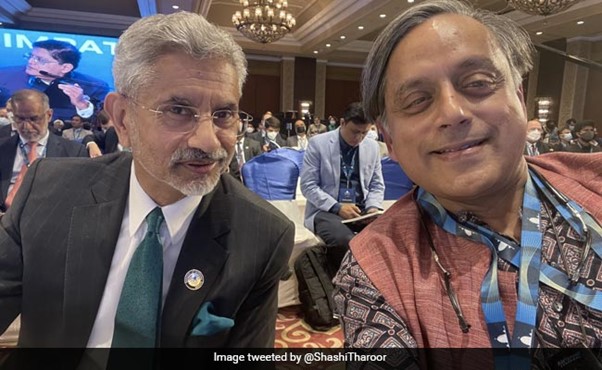
A selfie at the Raisina Dialogue for Tharoor and Jaishankar – endorsing “multi-alignment”
From the west we often hear business leaders say “India wants to be more western” – but does it? Or is there a different world view in India?
Three points stand out for me:
FIRST, PM Narendra Modi recently stated that, while many countries have strayed from spirituality and towards consumerism, India should not do so.
SECOND, laying the foundation for the World Health Organization’s (WHO) Global Centre for Traditional Medicine (GCTM) in Jamnagar, Gujarat, PM Modi stated that countries all over the world are focusing on traditional herbal systems to combat the COVID-19 pandemic, and that Yoga has helped people all around the world establish mental balance by reducing stress.
THIRD, in an increasingly divided world with an “us vs them” view, India is an exception. Senior Congress leader Shashi Tharoor on Tuesday thanked External Affairs Minister S Jaishankar for publicly giving him credit for the term “multi-alignment” and posted a selfie of them together at the ongoing Raisina Dialogue. There is a very conscious policy of engaging all the major powers simultaneously in a world. Who else is doing this?
Some of the best “corporate storytelling” is coming out of India
The most valuable companies in India include Tata Sons, Aditya Birla and Godrej. The most valuable in the world are Apple, Alphabet (Google), Amazon, Facebook and Microsoft (with the order changing every now and then). These companies cover a wide range of sectors but there is one common element. A consistent and strategic content narrative.
That’s an area well understood by Mumbai-based The Information Company (TIC) which is positioned as a “content, creative and digital agency preferred by India’s leading corporates”.
Corporate Storytellers. That’s how they like to be known.
The Information Company – Storytellers to India Inc
TIC started in 1999 and I have known them since 2004, when I connected with Founder Kiron Kasbekar, formerly Editor of The Economic Times (Bombay), Business Editor of The Times of India, and Managing Editor of Business India.
TIC has been ‘living and breathing’ content for more than 20 years, with its foundations built by top-notch journalists who brought their expertise in impactful storytelling to the game. Since then, TIC has added technologists, graphic designers, writers, videographers, and SEO specialists to the mix to execute great communication projects.
Their storytelling services are being used by the some of India’s largest, most influential, and best brands – Tata Sons, Aditya Birla Group, Godrej, Mahindra Group, Ambuja Cement, Hindalco, Fino, Cipla, Arcelor Mittal Nippon Steel, Capgemini, Weber Shandwick, and many more.
Storytelling for a purpose
TIC doesn’t just tell stories – the focus on storytelling towards a purpose, whether that is building digital brand identity, promoting business interests, creating perceptions, or reaching out to stakeholders.
Thought Leadership
One of the most unleveraged areas of communication is ‘thought leadership’, with much of it being overt promotion or semi-advertising. Here, TIC has been able to carve out a niche – crafting the voices of corporate brand and corporate leaders, and delivering good thought leadership content that is credible, engaging, accurate and consistent.
One of their unique skills is to write authored articles on behalf clients across industries such as automotive, aviation, chemical, consumer products, energy, engineering, IT, insurance, oil & gas, pharma, mining, manufacturing and infrastructure.
Blogs for Interaction
Blogs is another area where, for many organisations, things go wrong. The most common mistake is to come across as self-promoting. Or the organisation starts a blog but tires of it – so their latest blog is two or three years ago. Not a good look.
But the blog can be immensely valuable – it is the one platform for any company to connect with all its stakeholders, interact with them, connect like-minded enthusiasts and so on – through focused storytelling. No wonder then that TIC creates over 30 blogs every month.
Websites that just don’t sit there
Owned communication assets such as websites should not be static – they need to be information rich, and continually updated. They are the first stop for information that is used by investors, clients, media, prospective customers, prospective employees, regulatory bodies. The website is a critical and strategic asset to broadcast the corporate narrative.
Tata Chemicals, Tata Trusts, Rallis, Lupin, Hindalco, Ambuja Cement Foundation, and Suzlon are just some of TIC’s website clients. And this does not include the list of intranet clients!
Visual storytelling
Sometimes, a visual story tells more than a thousand words. Infographics are mostly data driven – the magic lies in crafting a coherent story around data.
By writing compelling text and presenting it in an efficient and visually pleasing manner, TIC ensures that an engaging story emerges from each Infographic. This form of content is its way, both art and science.
Campaigns – traction and reaction
Engaging with employees – especially in an age of WFH – has taken on a new significance. Companies often rely on emailer campaigns to connect. But how do we gain traction and reaction?
Whether the campaign is to showcase business achievements, announce a product launch or an event, highlight business achievement, connect with employees or other stakeholders, TIC partners several big corporates to put in the right words to their thoughts.
Social media campaigns take the need for creativity to another level. Here too TIC builds award-winning strategic campaigns for clients such as Godrej and Hindalco.
Video now “most effective”
If a picture is worth a thousand words, a video is worth 1.8 million – that is the view of TIC, and they see video as “the most effective way to narrate a story”. Be it explainer, animated, VFX, event, HR videos or corporate films, TIC creates videos for Aditya Birla Group, Sterling & Wilson, Asian Paints, and Hindalco.
Content Overload
Beware of stepping into ‘content overload’, a sign of our times. How do you ensure ‘thumb-stopping’, shareworthy content for your brand? One easy hack is to make sure the content is dynamic, visually rich and – most important – interactive! Adding a layer of interactivity to your content – blogs, posts, videos, graphics, podcasts, whatever – will add to brand recall and engagement. Even a simple quiz, for instance, becomes interactive content and can be a game changer for your brand. And that is what TIC delivers.
Awards tell the story
Recognition is the best sequel to creativity. TIC has won a slew of awards for its work – here is just a tiny fraction of the recent accolades won:
Double Platinum at the ‘AVA Digital Awards 2022’ for Tata Sons e-magazine and a video for Sterling & Wilson Renewable Energy Ltd
‘Mint Marketing Award 2021’ for Hindalco’s #WomenAtHindalco social media campaign
Gold for Hindalco’s internal newsletter at the ‘Afaqs! Digies 2021’
Bronze for Aditya Birla Group’s #HaathUthanaZarooriHai video at the ‘Velocity Awards’
Best Content agency at ‘The Great Indian Content Marketing Awards 2021’
Contact TIC
For more on how TIC can support your communication objectives, just drop a message on enquiry@ticworks.com. Or better still, call at +91 842 581 4016 / 17.














 Into India