
India relies on a friendly USA for progress and peace – but Trump is making this difficult

INTO INDIA last month asked this question – can the USA-India releationship survive President Trump?

This month the answer is even less certain.

New Delhi has some fears on this front – knowing that India’s growing economy and innovation needs a friendly USA. Even more so, the India-USA relationship is a key to ensuring an Asia NOT dominated by China.

India wants agreement with the USA.

Without some effort from Washington, India will just have to find new relationships to secure its position in Asia.

 If India and the United States become more distant to each other, both would have a weaker hand to play when it comes to China.

India is anxious to reduce its reliance on China as a source of supply and also its reliance on the USA as a source of demand.

Trump is softening his approach to China while he goes harder on India.

There are serious levels of concern in New Delhi about this.

First, the China border problem continues to fester.

Second, both the USA and China are moving closer to Pakistan = which is also a volatile border for India.

Corporate India seems to have made up its mind – several of India’s largest corporations are seeking a presence or partnerships in China.

But political India continues to look for new friends.

Beyond the Hype: My Take on Navigating AI with Clarity


This is INTO INDIA with a difference – in this blog I am handing over to my friend Vinay Sarawagi who has written the clearest summary of how you should proceed with AI. Vinay is the Founder, The Media GCC | Mindful Media l AI Trust and Safety and is a former Senior Vice President – Digital at The Times Group.

READ HIS REPORT ON “BEYOND THE HYPE”:

Artificial intelligence is the most transformative tech of the century. This doesn’t change another fact: we’re in a hype cycle. Snake oil is being sold in AI’s name.

The Big Tech Reality Check

Organizations and governments are overwhelmed by AI. Smart money sticks to first principles.

Watch what organisations like Apple and Google do. When they slow certain AI implementations, despite hundreds of billions in revenue at stake, it tells you something critical. The technology shows bright sparks. It’s not there yet.

This isn’t about legacy companies being outpaced by emerging tech. Google has done more AI research than most universities combined. These companies aren’t behind the curve. They’re mindful of the gap.

When an AI startup claims breakthrough capabilities that Apple, Google, or Microsoft can’t match, take it with a bucket of salt. These tech giants possess both the expertise and cash reserves, running into hundreds of billions, to acquire any capability they lack.

First Principles in an Age of Disruption

Stop panicking. Avoid emotional responses that swing between overwhelming fear and outright denial.

Two priorities matter: educate yourself your teams on AI’s capabilities and limitations. Stick to your business fundamentals.

Market Psychology and the Innovation Cycle

Markets behave like human psychology. A decade ago, predicting a tech that could replace half of all jobs within 2-3 decades would have seemed absurd. Most believed fundamental innovations were complete. Only incremental progress remained possible.

Then ChatGPT arrived. A public-facing tool that gave everyone a glimpse into generative AI’s power. BOOM! Gold rush mentality.

Markets respond with boom and bust cycles. This process rediscovers the new normal. The challenge: distinguishing hype from real potential while living through it.

This requires a multi-dimensional approach. Grounded, pragmatic, sharp, incisive, data-driven. Also lateral and far-reaching. Finding the sweet spot demands all these perspectives simultaneously.

Separating Signal from Noise

AI will redefine everything we know about our world. True statement.

Today, a lot of AI marketing is snake oil. Also true.

Develop filters. Differentiate real capability from hype. Know what’s right for your business adoption strategy. Always return to first principles.

Strategic Implementation Framework

One week of data can blind you. One month isn’t much better. Long-term data matters. Qualitative benchmarks matter too.

When trillion dollar tech giants proceed cautiously, pay attention. Their restraint reflects deep understanding of current boundaries, not innovation failure.

The future belongs to those who harness AI’s power while avoiding its pitfalls.

vinay@thegcc.media

Things are changing fast in this world as India rises

You could say it has truly become a “funny world”.

Now we hear that one of the world’s leading quality car makers – Japan – is in the top five export destinations for Made-in-India cars.

Key exporters include Suzuki Motor Corporation and Honda Motor Company’s local units, which are increasingly positioning India as a production hub.

According to commerce ministry data collated by the Society of Indian Automobile Manufacturers (SIAM), vehicle shipments to Japan rose to US$ 616.45 million in the first nine months of FY25.

Maruti Suzuki began exporting its Jimny Sport Utility Vehicle (SUV) to Japan in January, signaling an acceleration of this trend.

Honda Cars India exported 45,167 units of its Elevate SUV, mainly to Japan, more than double its domestic sales.

Maruti Suzuki’s Fronx and Jimny SUVs are also available in Japan, with the Jimny generating around 50,000 orders within four days of launch.

Yamaha plans to export premium motorcycles to Japan, leveraging India’s lower sourcing and labour costs.

While my thought was “funny world” – my considered reflection was “well done India for entering one of the world’s toughest and highest quality markets”.

Growth in “sports culture” part of India’s push of soft power and hopes of hosting the 2036 Olympics

Now Indian PM Modi is chasing an Olympic Games for India

Sport is on the mind of the Government of Indian Prime Minister Mr. Narendra Modi.

No doubt the next election he and the BJP face will have a big sports focus.

And words are being backed up by action – the Indian Government has a US$474 million sports budget this year.

PM Modi has always been ambitious for India – and his spending will create a sporting infrastructure boost to underpin the India push to host the 2036 Olympic Games.

A future Olympic Games could capture the minds and pride of Indians everywhere, including the large Indian diaspora here in Australia.

PM Modi recently stated that India’s soft power will grow with the development of a sports culture. Speaking at the inauguration of the Khelo India Youth Games, he highlighted the government’s focus on modernising sports infrastructure with the goal of hosting the 2036 Olympic Games.

A significant portion of the US$ 474 million sports budget for the year is being allocated to this purpose.

India has submitted a Letter of Intent to the International Olympic Committee to host the Games and is competing with countries such as Qatar, Saudi Arabia, Turkey, South Korea, Indonesia and Chile for the hosting rights.

The sports budget has increased more than threefold in the past decade, with over 1,000 Khelo India centres now operating across the country, including more than three dozen in Bihar.

Australia has been doing well via cricket – opening new training facilities and programs in India and chasing other collaborations.

PM Modi’s big sports spend shows the timing is good for all areas of sports in Australia to get over to India and actively participate in this growing sector.

India is available – but are WE capable?

Here is the paradox – Indian growth means there is demand for almost every product and service – but Australian business is not over there selling hard.

Perhaps we Aussies do not have an export mentality?

This was one possible reason canvassed today when I met with Leigh Howard, CEO of Asialink Business.

We agreed that there is still a need to sell the vision of exporting to India.

Asialink Business is really about building “Asia capability” and is keen to do more for the SME sector. You can sign up for an online “Doing Business with India” session this coming Wednesday here – https://asialink.unimelb.edu.au/business/course/academy-intro-india/

We also discussed how our universities could be paving the way for the rest of us to make it in India – their presence is now “bricks and mortar” and both Melbourne University and Deakin University are showing the way.

So, are you capable? Sign up now.

Australia sets impressive trade records which newsrooms refuse to report

Australians are not good at celebrating good news – and some of the good news they don’t even get to see on major media.

Trade performance is a good example.

Australia has an outstanding national trade body – Austrade – with talented people around the world promoting our products and services.

In many countries – including India – most of our states also have Government offices working hard to build trade and investment.

They have been incredibly successful.

Of the 35 advanced countries in the Organisation for Economic Cooperation and Development (OECD) who reported last year’s exports to the World Bank, only three increased exports relative to gross domestic product (GDP) over 2022.

Of these, Australia’s expansion was the strongest.

The World Bank also affirms Australia’s ascendancy.

The World Bank’s development indicators show export and import outcomes for 138 economies from 1974 to 2023.

The World Bank measured Australia’s 2023 exports at a record 26.7% of GDP.

The success story continues…

Of the 35 advanced OECD member economies for which the World Bank has recorded last year’s export volumes, 17 experienced a decline. These include normally robust economies Ireland, Germany, the United Kingdom, Netherlands and Belgium.

Only 18 increased their exports over the previous year. Just four managed an improvement of more than 5%. Australia ranked third with 6.5% behind Denmark and Costa Rica.

Well done all those Australian providers of quality export goods and services.

Well done, Aussie!

How India can become the “next China”

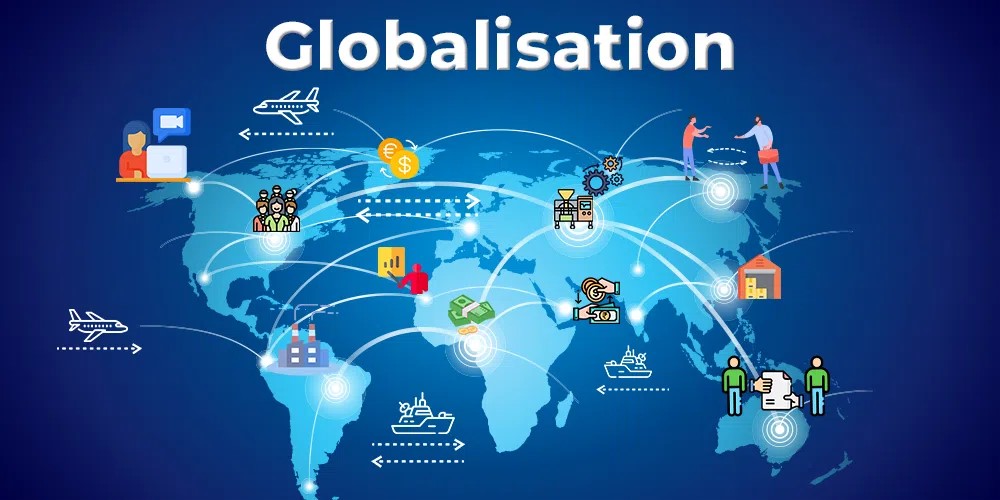
Globalization worked so well for China, but is stressed today

It’s complicated.

Mainly because of the rise of protectionism worldwide.

The Chinese miracle rode on the wave of globalization that began around 1980 and lasted until the 2008 global financial market crisis.

Globalization has come under severe stress lately, according to Amit Kumar, a research analyst with the Takshashila Institution’s Indo-Pacific studies program.

Weaponizing trade has left nations increasingly wary of economic coercion.

Self-sufficiency in some form or other is back in fashion. PM Modi is super keen on self-sufficiency for India.

If globalisation is too restricted, India’s ambitions might be thwarted. India could well have shot itself in the foot here, with it’s own anti-globalism and scepticism on international trade deals.

Gains for India will however be derived from the ongoing de-risking and “China plus one” strategies.  

India – unlike China during its growth – faces tough competition from Vietnam, Thailand and Malaysia. India attracted 15% of European investment diversifying away from China, but it fell behind ASEAN, which attracted 21% of the rerouted investments.

India is also lagging on ease of doing business. INTO INDIA has praised India’s progress, but must admit that it is now too slow. Ease of doing business has to leap ahead.

India currently contributes 16% of the global economic growth, as opposed to China’s 34%. The IMF predicts India’s share to rise to 18% in the next five years.

As China witnesses a decline in its share owing to its economic slowdown, we are led to conclude that India should emerge as the leading engine of growth.

With one reservation – “Ease of doing business’ could be the key.

Perhaps India CAN become the ‘next China’ and drive global growth

India’s consumer base is rapidly growing – pic from a Delhi mall

Since INTO INDIA has been involved with India, the mantra from economists and diplomats has been that “India is not the next China “. Is that about to change?

It could be, according to Amit Kumar, a research analyst with the Takshashila Institution’s Indo-Pacific studies program.

China has been top of mind for good reason – contributing more than a quarter to global gross domestic product expansion between 1990 and 2020. In the period from 2013 to 2021, China contributed almost 39% of global GDP growth — 13% more than the G7 countries combined.

How could India become the next China?

India would need to sustain a near double-digit growth rate for nearly three decades.

It would need to integrate with the global manufacturing supply chain, transition into an export powerhouse and attract enormous foreign investment.

But 40 years ago, we would have said the same things about China.

China’s rise from the 1970’s was boosted because of the deepening U.S.-Soviet rivalry and the Sino-Soviet split, prompted the US and the West to open up to China in 1971.

This is happening now with India.

Due to the deepening strategic competition with China, Beijing’s expanding diplomatic and economic clout, its belligerent foreign policy and economic coercion, has sparked concerns of overdependence and strategic vulnerability in the West.

India is emerging (has emerged?) as the preferred partner for the West.

We should not forget that China’s growth was also driven by global businesses looking for cheaper manufacturing.

This is now happening with India. Global firms now see India as an alternative to China.

The Indian Government has already supported high-profile projects involving the manufacturing of iPhones and the assembly of semiconductors – sending an “invitation” to others.

China also had a rapidly growing consumer base. No other Asian country had such a base – until India.

India has the second-largest consumer base – defined as people spending above $12 a day – of over 500 million, second only to China’s 900 million. Estimates show that by 2030, India’s consumer base will expand to 773 million, trailing only China’s 1.062 billion.

The gap between China and India will only shrink from here on.

NEXT BLOG – What India has to do to become the next China.

Just quietly, the “gig economy” is changing how we work and India is a good example

India’s gig economy is rapidly expanding, with predictions that the workforce will grow from 7 million in 2021 to 23.5 million by 2030.

This growth is stunning and signals a major shift in how we work.

INTO INDIA sees the gig economy as offering flexibility for both sides, remote working and other opportunities.

But the reality of being self employed is that you can also be “self unemployed”.

You can see why employers are so keen on this – providing access to a diverse talent pool while cutting costs. As companies embrace gig work, sectors like pharmaceuticals and technology are increasingly relying on freelance experts to meet their needs.

The gig workforce is growing – but it is still a tiny percentage of the total workforce – in India expecting to go from 1.5% in 2021-22 to 4.1% by the 2029-2030 financial year.

The pandemic is responsible for most recent changes in everything – and this is no exception.

Globally, the gig economy is expected to reach a gross volume of $455 billion by 2023, up from $368 billion in 2021. In India, there is a noticeable increase in organized sector gig work compared to a decline in the unorganized sector, reflecting a growing trend towards investing in gig workers.

Source: NITI Aayog Report

INTO INDIA notes that trust between gig workers and employers is improving, with longer project durations becoming more common. Kapil Joshi, Deputy CEO of Ques Corp, observes that the average tenure for freelance projects has increased from 9 months to over a year since the pandemic, indicating growing trust in freelance coders for larger projects.

Historically, “flexibility” has meant flexibility for employers at the expense of employees. But this one might be different, because employees (some) are demanding gig work in preference to full time jobs.

We’ll see how this one goes over time.

Australia India two-way trade now over A$50 billion

Great news from Austrade – two-way trade between Australia and India has reached around AUD 50 billion!

INTO INDIA has been active in this space over 20 years, and for most of this time our trade remained stagnant.

This recent growth is a tribute to the folks at Austrade, as well as State Government offices and all the organisations promoting the relationship. And of course highest praise goes to the brave companies that are finding a way in the Indian growth market.

Healthcare is a good example of the opportunities ahead.

The recent Indian budget 2024 signals the Indian government’s resounding commitment to provide equitable healthcare services across socio-economic spectrum with special coverage of “missing” middle class.

The Indian government is scaling up their focus on digitalisation of the public healthcare system, tariff reductions on some critical pharmaceutical drugs and MedTech devices.

Good news across the board – the budget also involves notable reductions in corporate taxes for foreign companies.

As India continues to grow as a preferred commercial destination, connect with organisations such as the Australia India Chamber of Commerce, with Austrade and with State Government offices – they can all help with the pathway to India.