Just watch India’s TCS and Accenture dominate the future world of IT

Tata Consultancy Services Ltd (TCS) is set to surpass DXC Technology Co. to become the world’s third-largest software services provider in fiscal 2018-19 – behind IBM and Accenture.

TCS grew 9.6%, or added $1.82 billion in new business, to end with $20.91 billion in revenue in the year ended 31 March.

TCS’s strong performance over the two years has seen a change of guard at the top. In 2017, TCS entrusted Rajesh Gopinathan, who was then chief financial officer, to take over as chief executive and succeed N. Chandrasekaran, who was named the chairman of Tata Sons Ltd. Still, the company managed to retain all its senior executives and improved its growth and profitability, with the consensus view that this was one of the smoothest management transitions at an Indian corporate entity.

Experts predict the fight for world dominance will be between TCS and Accenture.

But when it comes to profitability, TCS is already way in front – TCS ended last year with a 25.6% operating margin, while Accenture and DXC had 14.8% and 14% profitability, respectively.

New era for India-Australia as Ms Petula Thomas becomes Director of Indo-Australia Chamber of Commerce

Exciting news for the India-Australia relationship – Ms Petula Thomas has been appointed the new Director of the Indo-Australian Chamber of Commerce.

Petula worked with the British Deputy High Commission (BDHC), Australian Trade Commission (Austrade) and British Airways in Chennai over the past 15 years and brings a wealth of experience in strategic leadership, international relations, marketing and business development.

Petula is a passionate innovator and supporter of Women in Leadership, so I feel she will make a big positive difference in this role.

PetulaThomas

She is also a strong communicator.

We need strong and effective communication to enhance the India-Australia role and to make it easier for business of both countries to get together.

I hope the IACC can pioneer more exchange of people, more two-way missions, great education, more collaboration, improved cross-cultural understanding and positive steps to ensure that business in both countries know best what works in each country.

By the way – Petula has an amazing track record, winning four global and regional performance awards from the Foreign & Commonwealth Office in London, when she headed Consular Operations for South India, leading on Customer Engagement for the MENASA region (Middle East North Africa and South Asia) and Communications/Digital strategy for India.

Petula has worked with Austrade, Australian Government, where she received commendation from the Deputy CEO Austrade for successfully delivering on multi-city Industry events in India & Australia. During her career with British Airways Plc. she received a Regional CASAMEA award (Central Asia South Asia Middle East & Africa) for Revenue Development/Sales from British Airways Plc.

Petula has a First class Masters Degree in Science and recent qualifications in Project Management and Customer Relationship Management (including Sales, Marketing and E-commerce).

We wish her every success and happiness in the important new role.

Let’s give credit where due – India and China are greening the planet!

Congrats to India and China – these two are doing heaps to green the planet.

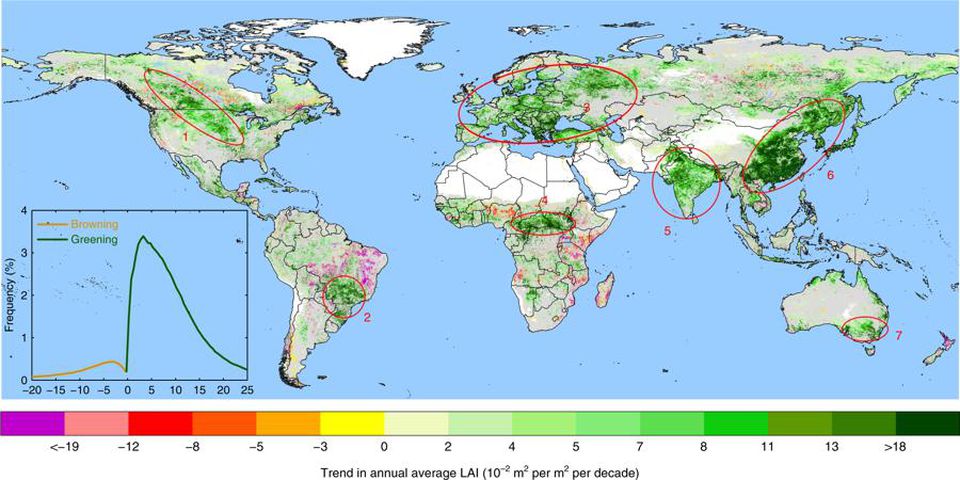
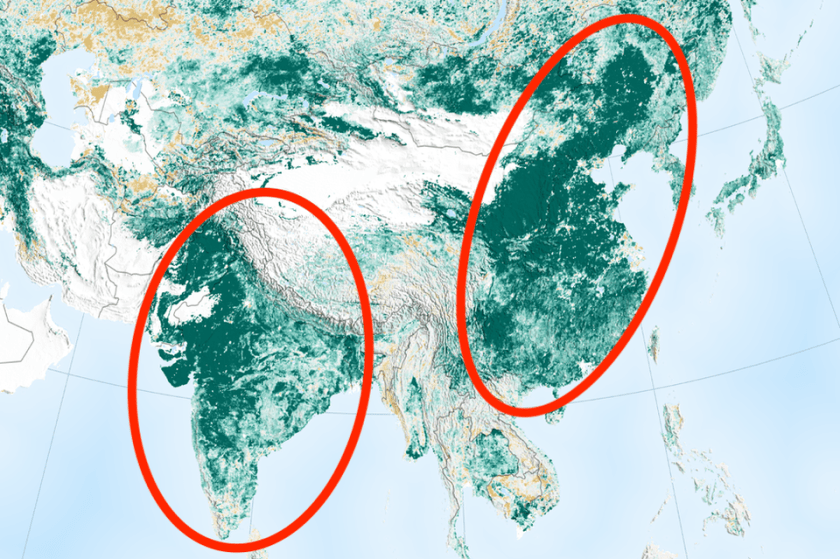
NASA discovered the good news – the world is a greener place today than it was 20 years ago. What prompted the change? Well, it appears China and India can take the majority of the credit.

The countries are responsible for the largest greening of the planet in the past two decades. The two most populous countries have implemented ambitious tree planting programs and scaled up their implementation and technology around agriculture.

India continues to break world records in tree planting, with 800,000 Indians planting 50 million trees in just 24 hours.

So – let’s give praise where it is due.

Green2

Are you ready for the facts on how much India has changed?

(Based on an article by Monika Halan, consulting editor at Mint and writer on household finance, policy and regulation)

Indian elections have just opened – so, how long does it take to find out if your name is on the Indian electoral role? Go to the Election Commission site, it asks you to SMS to check if your name is on the list—thirty seconds later, you will get a confirmation that your name is or is not there. Things move fast in modern India.

As Monika Halan writes – “Most people get their Provident Fund (PF) balance on SMS too. Also, the passport and visa processes are mostly all automated and keeps us well-informed about the progress of the process.”

So, what else works fast and well in India?

The metro network where it exists, in cities like Delhi and Kochi, is superb.

trains2

Getting or renewing a passport used to be a total nightmare a decade back. Enter private sector plus technology and the average time it takes for the passport application process is 30 minutes to under 4 hours. The passport reaches home by courier in a couple of days. At every stage, you get an SMS informing you what will happen next.

What about getting a driving licence? At least in Delhi, the process is mostly painless—online form filling, and 30 minutes to three hours of time in the local office. The licence reaches home in just a few days – according to Monika Halan.

Property registration used to be a nightmare. But Halan says “That again is a breeze. Again, a mix of technology and processes has reduced transaction time and pain hugely.”

Payments is the other huge success story of modern India. Forgetting your wallet at home is no big deal anymore. The money is in the phone. In a wallet, on an app or available through mobile banking. Riding on the backbone built by the National Payments Corp. of India (NPCI), transaction options and ease are both world-class.

payment

So how long does it take you to get a Wi-fi connection? How long does it take you to open a bank account? At least in the big metros, a Wi-fi connection happens within a day. Opening a bank account takes lesser time. The average time for these services in most developed countries is much longer. In most of Europe, for instance, it takes at least a month to get both these services.

Modern India is fast. Click on “buy” at 11pm and hear the doorbell ring at 9am the next morning.

A huge shift has happened in India and even Indians have failed to notice. The mix of technology, competition and cheap labour – plus reformist governments – means modern India has some of the simplest and fastest processes in the world.

All of this in just over a decade.

Time to catch up with what is really happening in modern India?

Australian media – especially Fairfax – misrepresent modern India

India is not understood in Australia – China continues to hold our national imagination. Our myopia on India is a problem because within ten years India is tipped to become the third largest economy in the world.

Multiple cliched views of India dominate – slums (despite millions lifted out of poverty), public sector corruption (despite serious advances through use of IT) and the so-called Hindu fundamentalism of Indian Prime Minister Narendra Modi (despite four years of relative communal stability).

How does Australia get India so wrong? Our media influences our national perspective on India, and recent coverage of developments in the holy city of Varanasi (The sacred as strategy, The Age, 9 April) shows how we focus on cliché and miss the big picture. The article branded development in this city as Modi’s move to “insert religion into the centre of the political debate”.

So, what is happening in India and why should Australia care?

Four things are important for Australia – India’s investment growth, rising local consumption, over a decade of around 7% economic growth per year and governments (central and 29 states) awash with money due to the GST.

As a result, every part of this country is being transformed and demand is rising for products and services of the type Australia is good at. By contrast, our trade with India is stagnant – if not for rising numbers of Indian students, trade would be in decline. Clearly, we are missing something.

What is the real picture in Varanasi? Sure, as reported a major new promenade is being built – as much as anything to enhance the tourism appeal of this great city. Branding it as driven by a religious view is as silly as claiming tourist development around Uluru is “divisively pro-indigenous”.

But the bigger picture is far more interesting. Varanasi is just one of one hundred “smart cities” being developed across India, with new roads, freeways, cleanliness, sewage treatment, trade and convention centre, traffic management and more upgraded within five years. Located on the banks of the River Ganges, the city will also become a multi-modal river and road transport hub, supporting local industry.

Varanasi is preparing for a 25 per cent growth in tourist numbers, fuelled by a combination of India’s middle class and international visitors.

To see this as promoting “a distinctly Hindu state” displays a stubborn refusal to see the bigger picture in India. What is happening here is happening across India.

Just look at tourist numbers for the Taj Mahal, India’s best-known symbol of Muslim India rule – located in Agra, another city having infrastructure upgrades as part of the Modi Government’s Smart City program. In the last year there were approximately five million tourists, of which 4.5 million were Indians of all beliefs. This weight of numbers demands infrastructure upgrade, and the Taj Mahal and Varanasi are examples of many across the country.

Indians are becoming more interested in their own history and they can afford travel. It makes no sense to link this to some divisive religious plot.

International yoga day is another example of Indians promoting and being confident about their heritage – celebrated in countries around the world with many millions in the west now more interested in yoga. That yoga grew within Hindu India is incidental.

Australia should know how much India is changed – we have just taken our first delivery of railway carriages made in India for Sydney’s public transport upgrade. Modi’s “Make in India” program is working.

Health is improving – a new study shows that the lives of 50,000 Indian children have been saved through a measles vaccination campaign run between 2010 and 2013.

We know a lot about the generosity of Bill Gates, but Indian tech billionaire Azim Premji has just given away US$21 billion to philanthropy, becoming the biggest endowment in Asia – our region.

At a BDO “Improving Business with India” seminar last month I tongue-in-cheek explained rapid change in India by launching my “India Shopping Mall Index”. Here goes – there were 3 shopping malls in India in 1999 – just 20 years later there are over 350 malls and another 85 in the pipeline.

The Indian Finance Minister has estimated India will have a middle class of around 600 million by 2030 when it becomes number three economy in the world.

All of this is exciting news for Australia – we would know about these great changes and opportunities if we avoided the old cliched views of India. If we continue to view India though a prejudiced lens, we will see only what we look for – such as Modi and Hindu nationalism or the poverty of slums – and we will miss the great changes that offer real possibilities for us.

Within our volatile and changing region, India could become our most important friend – but right now we are looking at India with blinkers on.

Stephen Manallack is a blogger at IntoIndia.blog and former President, Australia India Business Council (Victoria)

The above article was submitted to The Age on Tuesday 9 April – not yet published.

Asia Society showing the way on “global competence” for students

We are facing massive and fast change. Industrial 4.0 (the Fourth Industrial Revolution) is beginning to impact – the technology a current student will use in their first job has probably not been invented yet. And where we work is becoming irrelevant – we will all be global.

It is therefore good to see the Asia Society and its Centre for Global Education taking such a lead on the idea of global competence – articulating the knowledge and skills students need in the 21st century.

Our universities need to move fast on this. 

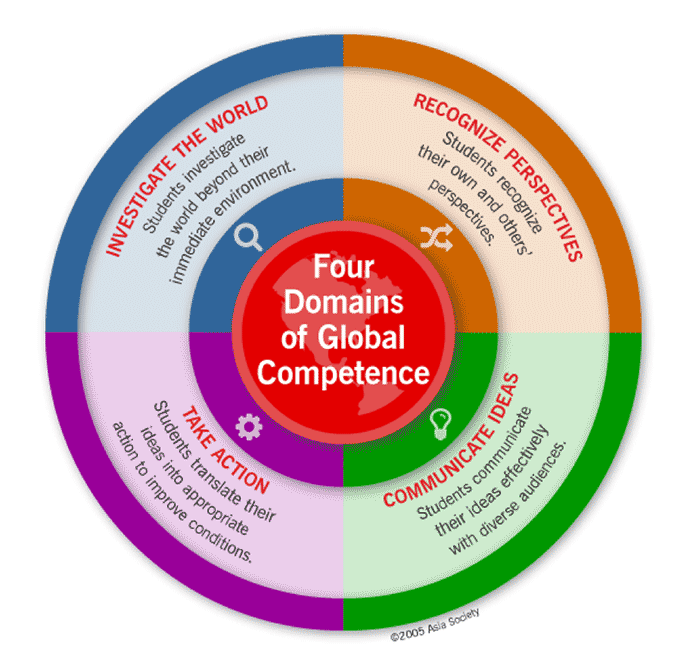
According to the Asia Society, globally competent students have the knowledge and skills to:

Investigate the World

Globally competent students are aware, curious, and interested in learning about the world and how it works. MY COMMENT – curiosity is the basis for cross-cultural success, it embraces difference, is tolerant and generous.

Recognize Perspectives

Globally competent students recognize that they have a particular perspective, and that others may or may not share it. MY COMMENT – we still hear frustrated business leaders asking “why can’t they be more like us”. Recognising perspectives is the basis of acceptance – which is a reality based way to deal with difference.

Communicate Ideas

Globally competent students can effectively communicate, verbally and non-verbally, with diverse audiences. MY COMMENT – there is a huge job to train and motivate students from Asian cultures to speak up and have confidence in their ideas – once they do speak up, we will quickly learn how much value they add.

Take Action

Globally competent students have the skills and knowledge to not just learn about the world, but also to make a difference in the world. MY COMMENT – my guess is that in Industrial 4.0 many of the jobs of the future will be ones we create for ourselves – individually or in teams. This used to be called entrepreneurship but might morph into a new form.

Please share your perspectives…

Mark Mobius (investment guru) calls for reform of FDI in India

The Economic Times recently spoke to Mark Mobius, emerging markets guru and Founder of Mobius Capital Partners:

What are your thoughts on Indian economy currently?

I think the (economic) growth is still going to be higher than China. We will probably see around 7 per cent, and that itself is a tremendous accomplishment. I know unemployment is a real issue, and this is something that whoever comes to power in the next election, is going to have to address very forcefully. They will have to think how to make it work, and that means making it easier for foreign investors to come in.  ..

PM Modi an achiever for India – whether he wins or loses this week

Prime Minister Narendra Modi swept into power in 2014 with the first single-party majority government in over three decades – thus holding out the promise that “things would happen”. With results to come in this week for Indian elections, it is time to ask: Have things happened?

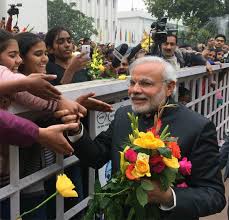
PM Modi has been an achiever for India and his legacy will continue whether he wins or loses this week – with higher expectations from governments, more revenue for governments, increasing digitisation and anti-corruption – and an expectation that India is a global player and needs global political leaders like Modi.

Modi

There are four achievements of Modi that have changed and are changing India forever – and for the better.

The first was to show he was serious about ending corruption – his Demonetisation move shocked many, hurt the economy short term but sent a clear signal. Indians had been used to governments paying lip service on corruption – Modi took action. Increasing digitisation of government means less opportunity for corruption.

Second, the world’s biggest tax reform was his Goods and Services Tax (GST), long talked about in Indian politics but it took the skills of Modi to make it happen. Modi was outstanding in gaining state government support, essential to the process. Government revenue is now getting to where it should be. As a result, governments in India are awash with money and can now do things.

Third, Modi knew that the key to improving India’s attractiveness to global investors and businesses was reform of the Bankruptcy law. Since Modi, business leaders who had run their businesses into the ground would be called to order and stripped of control. He was also a global sales person for India – vital in the global economy.

Fourth, Modi has also activated the 29 state governments by financing and introducing competition. Indices, which rank states on the ease of doing business, health, education and water, already creating energy and activity in every state capital.

I am not saying each of these were done flawlessly but given the history of India it is amazing that they were done at all. Yes, there is a lot to be done. But against the odds and expectations, Modi has made significant change to India that will last for decades or more. Win or lose, he has earned his place in history.

IndependenceDay


“We need to build skills, not walls.” – Telstra Boss

The need for Australian companies to source ICT talent from overseas is stronger than ever, with the local pipeline continuing to fall short.

That was the message from Telstra CEO Andy Penn, who delivered a strongly-worded address at the Committee for Economic Development Australia in Melbourne on Wednesday.

andy penn

“We need to build new skills and capabilities in new areas,” he said.

“We need these capabilities now, but the fact is we cannot find in Australia enough of the skills that we need on the scale that we need them, such as software engineers.

“Why? There simply are not enough of them. The pipeline is too small.”

In anticipation of the impending local ICT talent shortfall – which Penn said he expects to be 60,000 skilled workers short in the next five years – Telstra will this year open a new ‘Innovation and Capability Centre’ in Bangalore, India.

Labelling Bangalore as “India’s ‘Silicon Valley’”, Penn said the move would consolidate Telstra’s presence in India, where it has been operating since 2011.

Immigration negativity

Penn also called for a cease to the “negative commentary around immigration”.

“We need to build skills, not walls.”

He pointed to the associated benefits that come with “a well-targeted skilled migration policy”, arguing this would create – not take away – jobs.

“Skilled migrants also add to Australia’s wealth,” he explained.

“Research by the International Monetary Fund estimated Australia’s migration program would add up to 1% to annual average GDP growth from 2020 to 2050 because it focused on skilled migrants of working age and would limit the economic impact of Australia’s ageing population.”

PM Modi leads India to 6th largest economy in the world with high growth

Things are happening fast under the leadership of the Prime Minister,  Shri Narendra Modi – India is having its best phase of macro-economic stability, becoming the sixth largest economy in the world from being the 11th in the World in 2013-14.

Presenting the Interim Budget for the year 2019-20 in Parliament this week, the Union Minister for Finance, Corporate Affairs, Railways & Coal, Shri  Piyush Goyal said “India is the fastest growing major economy in the world” with an average GDP growth  of 7.3% per annum, the highest ever achieved by any Government since economic reforms began in 1991.

Shri Goyal said  under the leadership of Prime Minister, Shri Narendra Modi, a clean, decisive and stable Government reversed the policy paralysis, laid the foundation for sustainable growth  and restored the image of the country.

New India by 2022

Shri Goyal said that a New India would celebrate its 75th Independence year in 2022 when every family would have a house with access to water, electricity and toilets; farmers income would have doubled; and the country would be free from terrorism, communalism, corruption and nepotism.

This is clearly an ambitious government, and the track record so far proves that Modi does get things done.

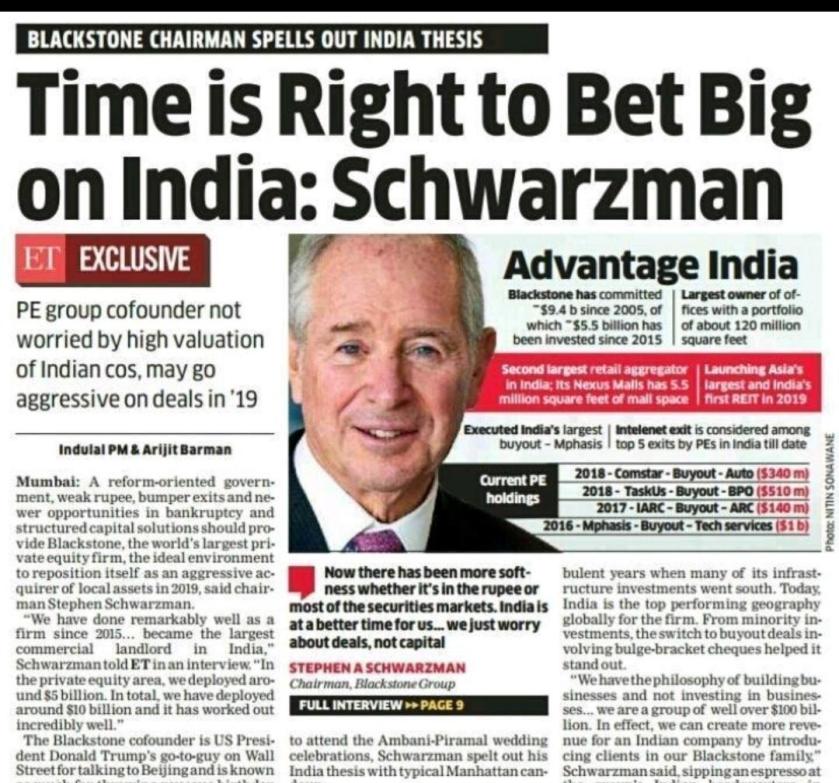
blackstone