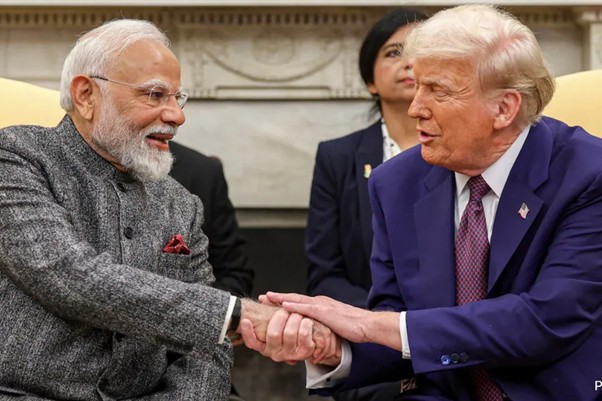
Can the India-USA relationship survive President Trump?

We have just had 25 years of India and the USA gradually getting closer together.

But claims from US commentators that the two countries have “shared values” and “shared interests” have shown that they miss the point about India.

In the last 25 years India has been engaging with “the world” and has seen the USA as just one among many – it is today, for example, much closer than ever to countries like China, Japan and Russia.

When India joined the “Quad” (USA, Japan, India and Australia) it was celebrated in the USA (and to some extent Australia) as if India had “changed sides”. It had done no such thing.

In fact, within one week of attending a recent Quad meeting, Indian PM Narendra Modi was also high profile at the Shanghai Cooperative Organisation – the world’s largest regional organisation in terms of geographic scope and population, covering approximately 24% of the world’s total area and 42% of the world population.

At heart, this misunderstanding arises from the dramatic differences in world view of the USA and India. The USA and many of its partners see you as being on their side or against them. India, by contrast, takes a more universal view and sees many polarities, many arrangements and alternatives.

In addition, India is not generally evangelical on “democracy” and certainly does not see its mission as imposing democracy on others. It tends to accept others as they are.

Today India faces a 50% tariff from the USA, imposed, it is said, because India continues to buy oil from Russia, which is at war with Ukraine.

On this and other issues with the USA, India takes a quiet non-confronting line – understanding that anger is unlikely to work where reason has failed.

India’s favored policy of “Mult alignment”—seeking friends everywhere while refusing to forge clear single country alliances – is aggravating and confusing to Washington but is an obvious outcome of the Indian world view.

INTO INDIA predicts that the Indian response to Trump’s tariffs and rough tactics will lead to India seeking more diverse trade relationships and to be even more active in building multi alignments.

It’s just a matter of how you see the world.

What do you think?

Is India the new China?

The stunning economic rise of India is causing a re- think – in 2023, India’s GDP was US$14.54 trillion, the world’s fourth largest economy, behind the United States, China and the European Union.

But what is prompting a rethink by many countries is India’s annual GDP growth of 7.6% – now outstripping all those other countries. India could match China’s 2023 GDP of $34.64 trillion in 14 years. On top of the growth rate advantage, India’s population overtook China’s in 2023, and the “demographic dividend” is kicking in.

This growth comes with an interesting twist, no doubt occupying minds in Washington and Beijing.

India’s military expenditure is now third behind the US and China.

When it comes to regional security in the Indo-Pacific region, India now counts as a major player. In addition to defence spending, location of this large landmass (the world’s seventh largest) means India is pivotal to trade routes crossing the Indian Ocean, as well as being close to China, the preeminent trading nation at the heart of the Indo-Pacific region.

Someone who is well aware of the growing power of India is of course Prime Minister Narendra Modi, a strong leader who stands as an equal with Chinese President Xi Jinping and soon-to-be President of the USA, Donald Trump.

The big question for countries like Australia and New Zealand is where do we fit in with this new scenario, who is listening to us, what does emerging “multi-lateralism” (championed by India) mean for us and how can future trade be assured?

Our diplomats and trade people are well placed and respected in New Delhi – but as the position of India becomes stronger, the diplomatic skills of both Australia and New Zealand will be needed to define our place in what is a new order.

Thanks to Chris Ogden, Associate Professor in Global Studies, University of Auckland, Waipapa Taumata Rau, for some of the above data.

Perhaps India CAN become the ‘next China’ and drive global growth

India’s consumer base is rapidly growing – pic from a Delhi mall

Since INTO INDIA has been involved with India, the mantra from economists and diplomats has been that “India is not the next China “. Is that about to change?

It could be, according to Amit Kumar, a research analyst with the Takshashila Institution’s Indo-Pacific studies program.

China has been top of mind for good reason – contributing more than a quarter to global gross domestic product expansion between 1990 and 2020. In the period from 2013 to 2021, China contributed almost 39% of global GDP growth — 13% more than the G7 countries combined.

How could India become the next China?

India would need to sustain a near double-digit growth rate for nearly three decades.

It would need to integrate with the global manufacturing supply chain, transition into an export powerhouse and attract enormous foreign investment.

But 40 years ago, we would have said the same things about China.

China’s rise from the 1970’s was boosted because of the deepening U.S.-Soviet rivalry and the Sino-Soviet split, prompted the US and the West to open up to China in 1971.

This is happening now with India.

Due to the deepening strategic competition with China, Beijing’s expanding diplomatic and economic clout, its belligerent foreign policy and economic coercion, has sparked concerns of overdependence and strategic vulnerability in the West.

India is emerging (has emerged?) as the preferred partner for the West.

We should not forget that China’s growth was also driven by global businesses looking for cheaper manufacturing.

This is now happening with India. Global firms now see India as an alternative to China.

The Indian Government has already supported high-profile projects involving the manufacturing of iPhones and the assembly of semiconductors – sending an “invitation” to others.

China also had a rapidly growing consumer base. No other Asian country had such a base – until India.

India has the second-largest consumer base – defined as people spending above $12 a day – of over 500 million, second only to China’s 900 million. Estimates show that by 2030, India’s consumer base will expand to 773 million, trailing only China’s 1.062 billion.

The gap between China and India will only shrink from here on.

NEXT BLOG – What India has to do to become the next China.

Jasmine Batra and AICC outlining a thoughtful way to enter the India market

Two organisations that advocate a “more thoughtful” way to enter the Indian market came together last week in a wonderful seminar providing some super advice.

First was the Australia India Chamber of Commerce (AICC) which hosted the event and their Chair, Chris Mooney, put the case for the chamber’s National Industry Groups doing well researched and sequenced steps to engage with India. Each group does research for a white paper, builds a community and knowledge group around it and leads to well prepared India missions.

Second was the keynote speaker, Jasmine Batra from Arrow Digital, who have a program called “The Big Leap” taking clients through a 12 month program of understanding and entering India. INTO INDIA has long advocated that slower market entry produces superior long term results – a strong alternative to the traditional Aussie hasty transactional approach. We love “The Big Leap” concept.

There are three major factors that make India today a very special market – first, the young population with an average age of 28; second, the rise of the tier 2 and 3 cities, including their specialisation, three, India’s global leadership in rolling out digital infrastructure that is transforming business and society.

Jasmine talked about importance of Food, Festivals and Family when thinking about India. “Family” includes what she called “the crazy rich” such as Tata, Ambani and many more. But it also goes right down to small community business families. Your journey will interact at all levels at some time.

Reducing risk is vital. There are three steps you can take. First, understand the cultural context. Second, do market research and find local partners. Third, network community and do due diligence.

In conclusion Jasmine Batra said you should get over there, get around and get partners. By research and regular visits, your more thoughtful engagement with India will produce results.

La Trobe University very kindly provided the venue.

CONTACT AICC

Contact Jasmine Batra

About Us

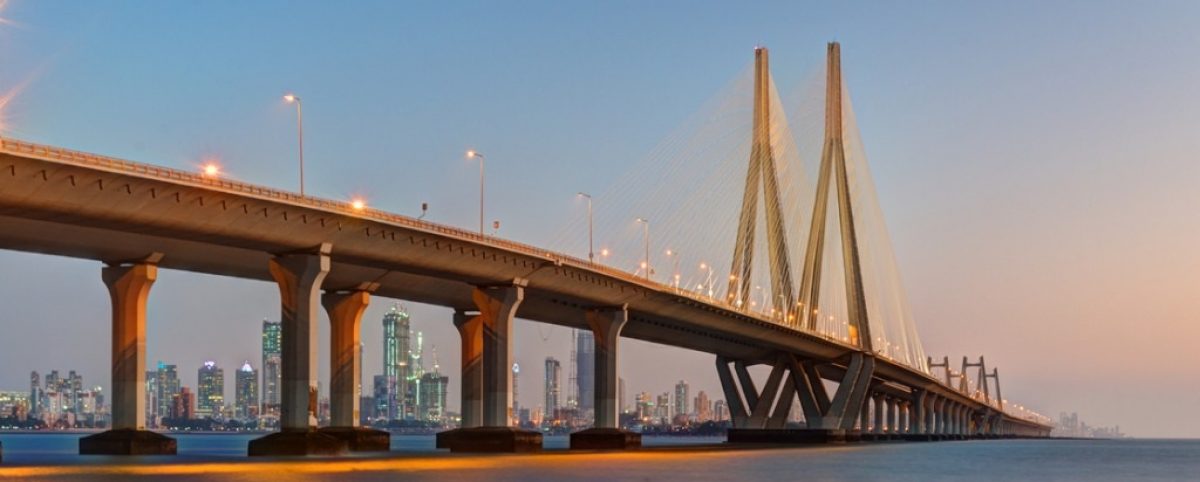
The bridge that is transforming Mumbai

The last time I went from south Mumbai to have dinner with friends in Navi Mumbai, the trip took three and a half hours – making us 90 minutes later than the expected two hour trip.

Today you can do this trip in 20 minutes.

Prime Minister Narendra Modi inaugurated the Mumbai Trans Harbour Link (MTHL), the country’s longest sea bridge, on Friday. The sea bridge connects South Mumbai to Navi Mumbai and will reduce the current two-hour journey to just around 15-20 minutes.

While inaugurating the bridge, PM Modi (who loves to paint the big picture) said, “This is proof of our resolve that for India’s development, we can take on even the ocean and break the waves.”

The 21.8-kilometre-long bridge will enhance connectivity to both Mumbai International Airport and Navi Mumbai International Airport, reducing travel time from Mumbai to Pune, Goa, and South India. Additionally, it will improve connectivity between Mumbai Port and Jawaharlal Nehru Port.

Things are changing fast in India – perhaps this is your year to find out what this might mean for you?

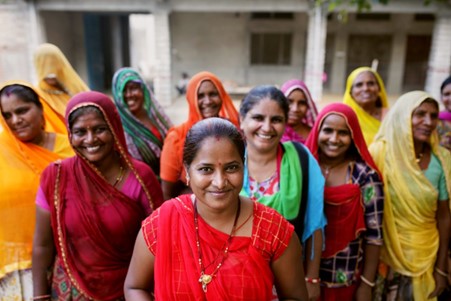
Women, the Global South and inclusive development clear winners of India leading the G20

In the sense that the G20 is mainly about global conversations and agendas, India succeeded in directing those conversations and setting out an agenda which will be picked up by the next G20 presidency country – Brazil.

India’s G20 presidency was focused on sustainable and inclusive growth, including women-led development initiatives.

India also shifted the G20 somewhat from a fundamental economic platform, to addressing the challenges of climate change, disasters, growing water and energy insecurity, democratic backsliding and gender inequality.

India was also successful in building consensus – something which has been a challenge over the years. It welcomed the African Union as the newest member and signalled the need for great inclusion of countries, including the Global South.

Drawing women-led development into the mainstream was a priority of India’s presidency, resulting in the G20 announcing the creation of a new Working Group on Empowerment of Women to support the G20 Women’s Ministerial that will start during Brazil’s term.

Indians embraced and celebrated the G20 – and India as president clearly made a positive difference.

Can kinder communication restore respect and civility?

Something has changed in how we communicate with each other. Like the pandemic, it has infected Australia and might have spread to India.

Just for ease, some commentators call this change “Trumpification” of our public conversations. Of course, it is not just Trump, it is also an outcome of spiteful and hateful social media. We have forgotten how to be respectful and kind.

It is too easy to blame America for our own problems, but we have seen over there that trading in hate and fear – combined with deliberate misinformation – creates divisions that might be hard to heal.

Social media has encouraged and built extremism, has destroyed much of our civility and is weakening respect, integrity, trust and social cohesion.

It is a stretch to blame Trump for all of this – much as he has deliberately practised anger and misinformation – and we must acknowledge that what we are seeing publicly now is what has laid dormant in our cultures probably for all time. Extremism and hatred are now empowered and public.

Long term, it will be difficult to turn around the negativity unleashed mainly by social media. It is hard to stop the toxic infection of how we treat each other. But it is worth having a go.

Mallika Bajaj and her company, Little Yellow Beetle, based in New Delhi, is helping clients create kinder content. It is one step in the right direction and might just restore respect, thoughtfulness and caring to our public discourse. I hope so.

https://www.littleyellowbeetle.com/

Here is an earlier discussion I had with Mallika Bajaj.

Values like friendship and tolerance play a role in building cultural sensitivity and harmony

Australian Foreign Minister Penny Wong is a role model in cross-cultural adaptation

When Australian Foreign Ministers from Julie Bishop through to Penny Wong wear a headscarf or adapt in other ways to the culture they are visiting, they are an example to all of us of being a good guest, showing respect and acting with tolerance and friendship. Whether we travel as tourists, traders or diplomats, the old maxim of “when in Rome do as the Romans do” contains an underlying value of adapting to the local culture while staying true to our own.

We take our values with us – some of the values I would pack when going overseas would be the great Australian traditions of friendliness, flexibility, tolerance and a fair go.

The world is not “like us” – much of the world is religious rather than secular, where dress codes and traditions run deep. When you think about travel, part of the excitement comes from this difference and with an open mind we can explore difference in a way beneficial to both.

Organisations like Asialink, the Centre for Australia-India Relations and the Australia India Institute are helping prepare us to become “Asia ready” as we embark on this Asian century, and that readiness is going to involve doing things and wearing things which are not our normal experience. Again, this is adapting to others while being true to ourselves.

At business meetings in India there is frequently the lighting of the lamp, a Hindu tradition which westerners are generally invited to join. In Indian Hindu tradition, light is taken to symbolise knowledge, so it is an auspicious start to an exchange of views and ideas. Lighting of lamps is not something we do in Australia, but doing it when in countries where it matters is an act of tolerance and respect.

In Japan a greeting might include a respectful bow, while in India a welcome greeting might include placing the palms of the hands together in front of the chest while saying “Namaste” which literally means “I bow to you”. It is simply friendly and nice to reciprocate – even though our own way would be to just shake hands.

Throughout Asia, business meetings will often involve a large team of locals from the very senior to the junior – and while our egalitarianism makes us want to reach out and chat to juniors as well as seniors, the locals are at least confused and often offended by this action because in their culture all discussion is to the most senior person. Even the junior person engaged in conversation by the willing Aussie is generally flustered and embarrassed to receive this attention. Egalitarianism is a value that needs to be balanced by tolerance and adaptability – balanced, not “sold out”.

In Southeast Asia at many political and business functions the locals and guests will wear batik shirts – not to everyone’s taste, but adapting to this is not a betrayal of something sacred back home.

When a local business person generously offers to take me to their temple, I am often asked to wear the sari cloth skirt as a form of covering – and happily do so because this is what my host wants and I have never felt that I was selling out some Australian value.

In homes and buildings throughout Asia, guests might be asked to remove their shoes and it is simply respectful to do so.

Australia has embraced the indigenous “welcome to country” at national ceremonies and even sporting events, and I would like to see this performed at more international business meetings, trade missions and diplomatic gatherings.

Underlying this and other culturally sensitive activity is a value which would go a long way towards creating global harmony – the value of tolerance.

Good news you probably didn’t hear about – poverty reduction in India is the “most under-reported story of our time”

From our good friends at FUTURE CRUNCH who are determined to tell us stuff the media overlooks.

The decline of poverty in India is the most underreported story of our time.

Two weeks ago, the country’s biggest public policy think tank released a new report, and the numbers are mind-blowing. 135 million people were lifted out of multi-dimensional poverty between 2015-16 and 2019-2021, easily putting the world’s most populous nation (and fastest growing major economy) on course to achieve its SDG targets.

India and Australia? The best analysis you can read

Former Australian diplomat, John McCarthy AO, continues to be by far our best analyst and writer on relations with India.

John is a Vice Chancellor’s Fellow at the University of Melbourne, an Adviser to the Asialink Board and a former High Commissioner to India.

It is worth revisiting an Asialink Insight he wrote in May of this year.

The Insight is titled “The Strategic Illusion of India” and in two short paragraphs he makes the case for closer diplomatic ties with India:

“Over the past two decades Australia has rightly recognized the rise of India. Its population at 1.4 billion exceeds China’s. It is the world’s third biggest economy in purchasing power parity terms and it should soon be third in nominal terms.

“We now have four diplomatic offices on the ground in India. It is our biggest source of immigrants. It is our fourth biggest export destination. Education links are burgeoning. All to the good.”

But John McCarthy’s enthusiasm for India comes with warnings.

His first was “India does not share our world view.”

His second was: “It does not expect others to come to its aid and it will not join someone else’s war.”

So, he recommends we build the relationship with patience and realism.

Great analysis. Top advice. Read more…

https://asialink.unimelb.edu.au/insights/the-strategic-illusion-of-india