
The Belt and Road Initiative and the Geopolitics of the Indo-Pacific Region

David Morris is a former Australian diplomat and current expert/advisor on regional issues, risk and international relations. He recently wrote on “The Belt and Road Initiative and the Geopolitics of the Pacific Region” published in Research on Pacific Island Countries, Social Sciences Academic Press (China), 2019.

The Belt and Road Initiative has become associated with a geopolitical “China threat” discourse in the South Pacific, he writes.

Are China and Australia, the dominant regional player in the South Pacific, driven by geopolitical imperatives to compete for power? Or do their different geopolitical needs provide opportunity for cooperation that is mutually beneficial and manages risks in the region?

As a commentator on India and the Indian Ocean, I can see much of what David Morris writes could be applied to the Indian Ocean rim countries.

Morris analyses supposed Chinese “threats” as well as risks to China, including fears of a military base in Vanuatu, Chinese debt-funded projects in Tonga and closer economic cooperation with Papua New Guinea.

He concludes that it is feasible for Australia to meet its geopolitical imperatives if its regional security leadership can be maintained.

A geopolitical analysis of China in the South Pacific concludes that China is unlikely to seek regional security leadership if it can ensure access to trade routes and markets.

If Australia could move beyond geopolitical rhetoric, it should therefore be possible for Australia to partner with China to support sustainable development, mitigate risks and ensure broader stability of the South Pacific region, he writes.

With large doses of common sense, Morris writes that Australian activity could be complementary to China’s BRI, and that while there are political risks, the two countries could cooperate to reduce risk and ensure projects are sustainable.

This would be great – but my view is a big barrier to anything Australia does in our region is always its world view of “goodies and baddies” with the USA as the major “goody” and China the current “baddy”.

It would be great if influential countries like India, Australia and China could create a new collaborative model that brings real development to those poor communities in our region.

Is this possible?
ModiMorrisonSmile2

India launches Artificial Intelligence knowledge centre for NSE

India’s National Stock Exchange (NSE) has launched a Knowledge Hub in New Delhi, an Artificial Intelligence (AI) powered learning ecosystem that will assist the banking, financial services and insurance (BFSI) sector.

India has two major stock exchanges – the NSE and the Bombay Stock Exchange.

nse6

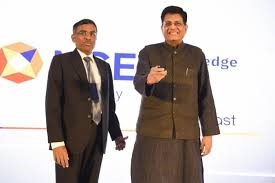
Speaking on this occasion Commerce & Industry Minister Mr Piyush Goyal (pictured above right) said that although India has developed as the second largest fintech hub in the world, a lot of work still needs to be done in the BFSI sector. He hoped that the Knowledge Hub created by NSE will fill in these gaps and help the financial sector to move into the future.

The NSE Knowledge Hub will enhance skills and help academic institutions in preparing future-ready talent for the financial service industry. It is also available on mobile and attempts to bring together world class content and learners through this state-of-the-art and future-ready platform.

The use of AI will ensure that the skill upgrade is affordable and accessible. Piyush Goyal said AI and Machine Learning will contribute US$ 1 trillion to the Indian economy by 2035.

Industry4.0 2

Is India really growing? Hyatt Hotels think so, adding 11 new hotels in 2020

Hyatt Hotels is bullish on India and plans to open 11 new hotels across India by the end of 2020.

Hyatt now has 32 hotels across 20 destinations under its eight brands in India – I recently stayed at Hyatt Regency in Chandigarh and it was an outstanding hotel – well located, good food and beverage service and everything went smoothly.

The hotels at Thrissur, Kochi, Jaipur, Dehradun, Trivandrum and Udaipur will be under the Hyatt Regency brand.

India is a very important market for Hyatt. It is one of the top three global growth markets for the company after the US and China and there is a huge scope of growth as the demand still exceeds the supply.

So, for Hyatt, in 2020 India is a growth story.

Anil Wadhwa could be reviving Australia-India trade relations – Lowy Institute – but health, agri and sport could be the key

So good to read on the Lowy Institute daily publication “The Interpreter” that India is doing something unusual in response to Australia’s Peter Varghese report – it is responding with an Australian Economic Strategy (AES). By the way, well done Lowy Institute for powering this and other national discussions.

The AES is led by former Ambassador and Secretary (East) in the Ministry of External Affairs in India, Anil Wadhwa (pictured).

Let’s not get bogged down on the failed Free Trade Agreement with India – let’s not wait forever, and, by the way, trade is progressing without it. We would prefer to have one, but we can make mutual gains without it.

The key is that the AES from India means for the first time we will have a blueprint for economic engagement with another nation – this is the view of Mukund Narayanamurthy and Danielle Rajendram writing for Lowy Institute. Well done to you both!

They point out that unlike India’s engagement with the US, Canada, UK, and Japan, our relative size means that it is highly unlikely that Australia will have a similar scale of engagement with India. So, they say the crux of the relationship, certainly from a materiality perspective for both sides, will lie in mining, energy, infrastructure, education, and tourism.

This where I differ. They see healthcare, agribusiness, and sport having relevance but “may not be as material in absolute dollar terms” – my view is that these could be the areas that unlock the “India code” and get Australia into the big game with India.

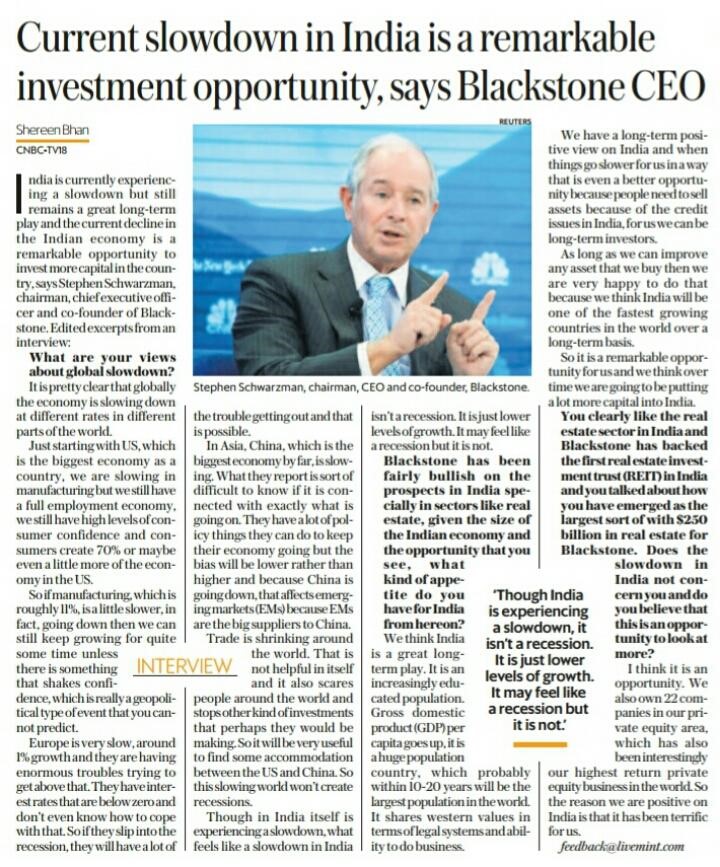
The “India growth story” is a long-term one for investors and business

India remains a compelling long-term investment and business story – despite a lot of negative talk about the Indian economy (mostly politically motivated but also buoyed by a slow down in growth).

blackstone5

Most commentators expect the slowing to be temporary.

Take a look at the MSCI India index which has comfortably outperformed the MSCI Emerging Markets index (697.7 per cent vs. 485.1 per cent). Not too bad.

Favourable demographics is another driver with India having the world’s largest population of millennials – those aged between 21 and 38 – India has 450 million and these people will transform India. What it eats, drinks, how and where it travels, fashion, what it watches and listens to – life will change fundamentally.

More than 50 per cent of the population is under 25 years of age – a total of 600 million – with 1 million new people entering the workforce each month. Contrast this with China, which is ageing faster than any other country, with the over 60’s expected to account for 35 per cent of the population by 2050. Europe, the US and Japan face similar demographic challenges.

Urbanisation is another driver of growth – a third (34 per cent) of India’s population is urban, but it’s rising fast. Compare this to China (58 per cent) and Japan (92 per cent) – you can see the long-term growth story of India.

Then there is structural and economic change, with pro-business Prime Minister Narendra Modi – let’s steer clear of short-term politics but acknowledge that change has happened, and more is to come.

Visitors to India notice rapid improvement in infrastructure – road construction, plus 27 km of railway built per day, while India’s metro system is growing again, new airports and more.

Investors and businesses should be finding a way to participate in and benefit from the long-term India growth story.

Macquarie on a winner with toll road investments in India

In March 2018, an Australian institutional investor walked away with some prized toll-road assets in India – on the Golden Quadrilateral in the first auction for toll-operate-transfer (TOT) bundles.

MIRA – Macquarie Infrastructure and Real Assets – had bid aggressively, almost 55% over the base price, and many thought it was a flawed decision. But not anymore.

MIRA’s portfolio is relied on by more than 100 million people every day. Their team of over 800 people invests in businesses that underpin economies and communities – aiming to add real and lasting value for our clients and the people these assets serve. MIRA manages $US129 billion in assets, including: 155 portfolio businesses, approximately 600 properties and 4.7 million hectares of farmland.

MIRA is part of Macquarie Asset Management (MAM) – the asset management arm of Macquarie Group.  As at 31 March 2019, MAM had more than $US385 billion of assets under management.

It may just have picked up some of National Highways Authority of India’s best assets. Toll collections are likely to exceed expectations, reveals an analysis of FY19 figures.

In India, MIRA has found a way to participate in the “growth story”.

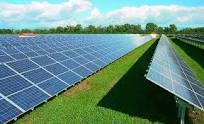
Solar is getting really interesting as Australia to build world’s biggest solar farm – energy for Asian neighbours

Plans to build a giant solar power and battery facility in central Australia to supply electricity to Singapore will go ahead thanks to backing from tech and mining billionaires Mike Cannon-Brookes and Andrew ‘Twiggy’ Forrest.

The duo are co-leads on an investment round for Singapore-based Sun Cable‘s $22 billion proposal for a 10-gigawatt (GW) solar farm and 22GWh battery storage near Tennant Creek, in the Northern Territory.

asiamap8circle

Solar is stepping up while the Australian Government continues to step back – locked into an ideological stance of opposing any alternative to coal and denying any impact on the climate. Sad to see this continue.

Singapore gets 95% of its electricity from imported LNG and Sun Cable hopes running a 4500km high voltage direct current cable from the 15,000 hectare site – around a quarter of the size of Singapore itself – via Darwin to the island state will supply up to one-fifth of the city’s power needs. It will be the world’s largest solar farm and also supply the NT capital.

The 10GW plant is nearly double the 5,500 megawatts Snowy Hydro scheme, which generates around 4500GWh anually. The Australia-Singapore Power Link (APSL) plant’s generation capacity is four times more than Australia’s largest coal-fired power station.

Central to the project is Sydney solar energy startup 5B, founded by Chris McGrath and Eden Tehan in 2013.

The business developed new technology for portable, prefabricated solar arrays, re-engineering the supply chain and simplifying how solar projects are delivered, using fewer materials, rapid deployment and streamlined logistics.

If Australia makes this happen, we can become the biggest energy supplier to the Asian region – Indonesia, Malaysia and more.

The project is expected to take six to seven years to complete.

Big Battery gets bigger too

News of Sun Cable’s progress comes in the same week that South Australia’s Hornsdale Power Reserve, dubbed the Tesla Big Battery, announced plans to expand the world’s largest battery by 50% by mid 2020.

The 50 MW/64.5 MWh expansion, supported by Tesla, will be the first grid-scale battery in Australia to provide inertia benefits to the National Electricity Market (NEM), which is critical to grid stability and the future integration of renewable energy.

Solar looks set to change history – for the better.

solar2

Ambani leaps into the online retail space as he transforms Reliance Industries Ltd

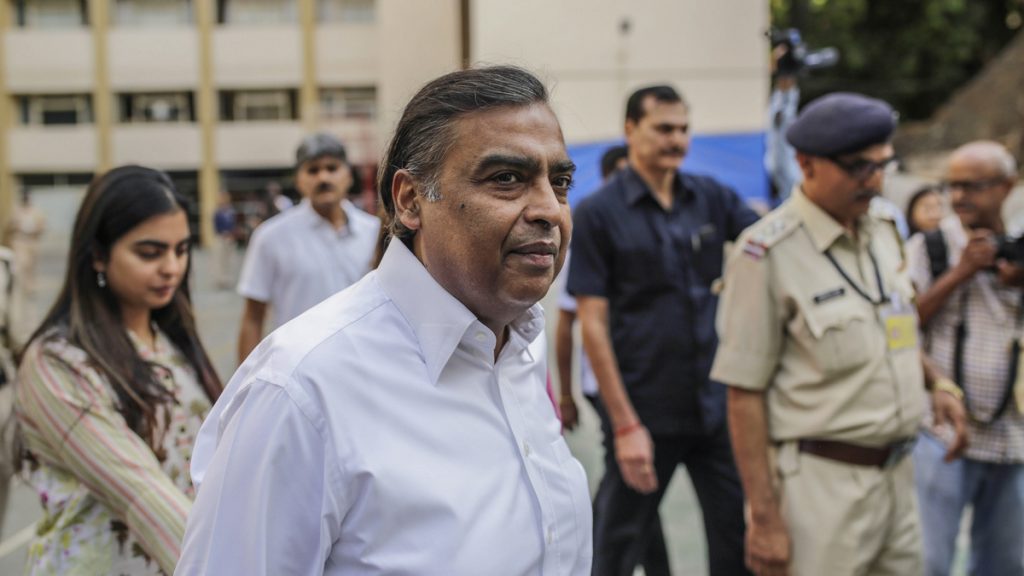
Indian billionaire Mukesh Ambani (pictured) moved a step closer to creating an e-commerce giant for India, unveiling plans to set up a $24 billion digital services holding company that would become the main vehicle in his ambition to dominate the country’s internet shopping space.

This is really hotting up as Ambani takes on Amazon and Flipkart (owned by Walmart).

The board of Ambani’s Reliance Industries Ltd. approved a proposal to place $15 billion into the fully owned subsidiary, which will in turn invest that amount in Reliance Jio Infocomm Ltd., the conglomerate’s telecommunications venture.

The move by Asia’s richest man is the latest sign of the oil-to-petrochemicals group’s pivot toward data and digital services for future growth. Ambani, 62, told shareholders in August that the new businesses, including retail, are likely to contribute half of Reliance’s earnings in a few years, versus about 32% now.

While former English teacher Jack Ma started Alibaba in 1999 from scratch, Ambani is using the heft of his empire to build something similar for India by connecting retailers and consumers.

Shares of Reliance Industries have rallied 28% this year, compared with an 8.8% gain in the benchmark S&P BSE Sensex index.

The tycoon, whose net worth is about $56 billion as per the Bloomberg Billionaires Index, has also revealed a plan to sell 20% of Reliance’s oil and chemicals business to Saudi Arabian Oil Co. at an enterprise value of $75 billion – he’s cleaning up the balance sheet and heading for a “debt free” target soon.

Watch this space!

Now India launches the worlds’ most expensive chocolate

I do love chocolate – but maybe not this much!

India’s ITC group has launched worlds’ most expensive chocolate that is priced at US$6152 per kg under its Fabelle brand name.

‘Trinity – Truffles Extraordinaire’, a limited-edition range of chocolate, that was introduced by ITC’s luxury chocolate brand Fabelle entered into Guinness World Records to become the world’s most expensive chocolate.

The chocolate is co-curated by France’s Michelin Star Chef Philippe Conticini and Fabelle’s Master Chocolatier.

fabelle3

ITC Chief Operating Officer – Chocolates, Confectionary, Coffee and New Categories – Food Division, Mr. Anuj Rustagi said, “We at Fabelle are extremely happy for setting new benchmarks not just in the Indian luxury chocolate market but also now in the world with achieving the Guinness World Records feat.”

The chocolates will be offered in a hand made wooden box that will contain 15 truffles, each weighing around 15 grams. The made-to-order box will be made available at an indulgent price of US$ 1,431 inclusive of taxes.

Place your order now!

fabelle1