Why is the west being so jittery about the rise of Asia?

Trade war on China. Military action here and there.

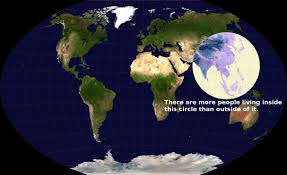
The west is jittery. Yet all we have is the return to the normal state of affairs – until exactly 200 years ago China and India were major global economies. Now they are again.

So, why is the west so jittery about the rise of Asia?

First, the west “won” the cold war against Russia without firing a single shot. Great victory – but the pride of that has become hubris and shows in a belief that only western liberal democratic countries can succeed. And here comes China. Not western, not liberal and not democratic. Jittery.

russia2

Second, 9/11 was a shocking event that dominated the mind of the west then – and now.

Wile we focused on 9/11, two things happened – rising China joined the World Trade Organisation and the lowest earners in the USA were hit by a 50% decline in income.

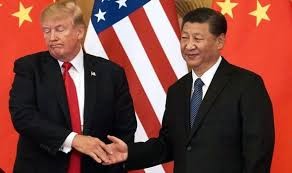
Hence – Trump. And hence, lots of jittery decisions being made throughout the west.

Can the west get back to rational, calm and innovative leadership? I hope so.

Thanks to Kishore Mahbubani for inspiring some of the above.

 

What is the “fourth industrial revolution” and why is India important?

The First Industrial Revolution introduced the use of steam power to mechanize production.

The Second Industrial Revolution saw a number of groundbreaking inventions in transport, telecommunications and manufacturing, including the use of electric power to generate mass production.

The Third Industrial Revolution brought the internet and other technological innovations, which have ushered society into the digital era.

Today, society is challenged by a Fourth Industrial Revolution, an age in which scientific and technological breakthroughs are disrupting industries, blurring geographical boundaries, challenging existing regulatory frameworks, and even redefining what it means to be human.

Emerging technologies such as artificial intelligence (AI), blockchain, drones and precision medicine are swiftly changing lives and transforming businesses and societies, inevitably posing new risks and raising ethical concerns. How can society ensure that its policies, norms and standards are able to keep up with these rapidly evolving technologies?

The World Economic Forum has chosen India as the base for its Centre for the Fourth Industrial Revolution – India is the world’s largest democracy having the second highest number of scientists and engineers – shaping the future.

Modi oath

India and Australia to be key players in world’s largest free trade deal

Australia and India are poised to be key players in the world’s largest free trade deal – the Regional Comprehensive Economic Partnership which should be signed by mid 2020.

There are 15 countries in RCEP excluding the USA. Major players are China, Japan, Indonesia, India and Australia.

RCEP will have a market of over 3.5 billion people and almost 33% of the world’s GDP.

As we have noted before – Trumps’s trade war with China has given some urgency to RCEP negotiations and the 15 countries are set to complete the deal.

ModiMorrisonSmile2

Pictured the two Prime Ministers excited about RCEP – Australia’s PM Morrison (left) and India’s PM Modi

India – have a go! Some “quick tips” for those thinking of doing business with India

Have a go! India is already a large market and growing fast – with a massive young population driving future demand. Interest is growing in “all things western” and demand in many sectors (IT, education, resources) is just so big it cannot be satisfied locally.

Do your homework! Failures are many and most can be traced back to lack of research or inability to adapt to the local market. Factors such as cultural differences, consumer trends and what the market wants have to be identified.

ModiMorrisonSmile2

Above Australian PM Morrison and Indian PM Modi hit it off at a recent meeting

Use our reputation! Australia is generally well thought of in India – those who come here are amazed at the quality of our cities. Use this for brand advantage and to open doors.

cotton5

Choose the right channel. Distribution, e-commerce choices and so on will be make or break for you if consumers are your target. Aussie firm COTTON ON recently set up and online sales entry into India, the first step towards a physical presence.

India is a “relationship” culture – meaning they want to get to know you first. It might take several visits for you to create the connection. Otherwise you get a short term transaction this year that might not be there next.

Indians can help you! Finding local Indian talent has been a big success factor for so many global companies, large and small. If you cannot afford to establish a local team then perhaps you cannot afford to do business there.

Adapt to culture – get some training to understand how to behave and how your Indian counterpart might think. We are different! If you are culturally adaptive you can succeed and enjoy the difference.

Have both short term and long-term goals – and long term with India means committing to this venture for at least three years.

But above all – have a go!

Australian firm MoooFarm wins award for work in India

MoooFarm, co-founded by Australian Indian impact entrepreneur Param Singh (pictured below) has been awarded a winning prize of $30,000 for their breakthrough technology of ‘Facial Recognition of Cattle’ in the Agriculture Insuretech Innovation Challenge organised by the World Bank Global Index Insurance Facility.

param3

MoooFarm is an award-winning initiative that aims to increase income of 75 million small dairy farmers through capacity building, last mile extension and transfer of technology. Through its unique approach, MoooFarm addresses United Nation’s Sustainable Development Goals toward Gender Equality, Poverty and Responsible Production and Consumption.

MoooFarm, bagged a winning price of USD 30,000 by The World Bank Group in Data Analytics category for their unique solution of ’Facial Recognition of cattle’.

With an accuracy of 95.7%, MoooFarm was able to test the facial recognition model using deep learning technology. In the coming weeks, this breakthrough technology will reach each and every small-holder farmer via MoooFarm’s mobile based application and its network of Village level Entrepreneurs.

According to The World Bank Group, the Global Index Insurance Facility (GIIF), “helps smallholder farmers and micro-entrepreneurs gain better access to finance, manage financial losses, and protect their livelihoods against more frequent and more severe weather events…since 2009 it has facilitated more than 4.6 million contracts, covering over 23 million beneficiaries and $730 million in agricultural investments insured in more than 30 developing countries.”

Indian budget signals some shifts in education and skills training

The Indian Budget this month signalled continued commitment to free (free-er) market economy and was interesting in terms of education, skill development and related sectors.

The New Education Policy (NEP) is at the centre of reforms, set to bring major changes in school and higher education.

YoungIndians 2

Research is being given a big thrust with the National Research Foundation. Also, approx. US$60 million has been allocated to world-class institutions, signalling the continued thrust on excellence in higher education.

PM Modi is personally committed to having high ranking universities in India and some future deregulation is expected to allow greater global involvement – but nothing on this in the budget.

The finance minister also highlighted the ambitious Study in India programme, which has the potential to make India the hub of learning (again).

The National Sports Education Board is a much-needed initiative to promote sports amongst children who want to pursue that as a career.

We do hope the much-awaited Higher Education Commission of India (HECI) takes shape this financial year – still waiting on that one.

Indian budget to be presented today showing the way for Modi 2.0

The India Budget 2019 is due to be presented today by Finance Minister Nirmala Sitharaman (pictured).

This will be one of the most crucial Budgets for Modi 2.0 as it will become a guide for upcoming reforms and policies in the next five years of his government.

Modi2Promo

Come and learn more at our FREE Melbourne seminar (copy this and paste into your browser):

https://www.eventbrite.com/e/modi-20-journey-towards-greater-india-tickets-64489650280

India-Australia trade relations set to grow at critical time

Many of us have championed closer economic ties between Australia and India. It is now more important than ever to get closer to India.

As Austrade expresses it – “With trade wars, powerful neighbours, and the odds on a recession narrowing within the next two years, considering Indian market entry has never been more mission-critical for Australian business.”

AusIndiaFlags

Some key statistics:

•In 2018, Australia’s total exports to India grew 10% to A$22.3 billion. India ranked number five in Australia’s export destinations.

•Two-way trade increased by a similar percentage to A$30.4 billion, making India Australia’s sixth largest two-way trade partner.1

•Australian investment in India increased almost 12% to A$15.6 billion, slightly ahead of India’s investment in Australia at A$15.1 billion.

However – and here is why Australia needs to balance trade – according to the Australian Bureau of Statistics, in 2016–17 (the latest year for which there is data), only 2,087 exporters engaged with India, compared to 7,214 for China.

Time to think India.

RMIT University is changing the India-Australia education relationship

After decades where Australian universities have often been accused of taking the money for Indian students but not giving back – innovative ways of “giving back” have emerged from Melbourne’s RMIT University.

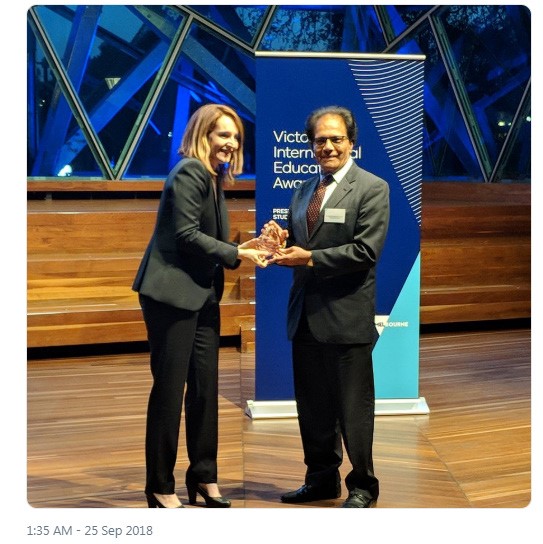
These efforts have been led by Professor Suresh Bhargava, Associate Pro Vice-Chancellor India, who received a Victorian Government “Victorian International Education Award for Excellence in Innovation in Partnership and International Engagement” for its work in India. (Pictured above)

What has RMIT University done?

It seems to me they have created a unique blend of Government, research, industry and universities across India to form an amazingly extensive network of relationships – as shown in this diagram.

rmit

The RMIT-AcSIR Program has at least eight leading Indian research centres and laboratories involved in a program which will target 100 PhD students.

As Dr Alan Finkel AO, Australia’s Chief Scientist, said: “Very few of us have the opportunity to do something that is first in the world and worthwhile. One without the other is common. Both together is ground-breaking.”

Dr Megan Clark, Head of the Australian Space Agency, also commented: “This is a wonderful achievement and will make such a difference for the future.”

Difference – RMIT University is setting out the groundwork for a new collaboration which will bring India and Australia closer together.

With the Modi Government poised to shake up Indian higher education and global relationships, now is a good time for all of our universities to build on this leadership from RMIT University.

Modi 2.0 – What will Modi do in 7 major policy areas?

Health

Telemedicine and diagnostic laboratories

More medical colleges

National immunisation programs

Modernisation

50 cities to have metros

Toilets for all Indians

State road network expansion

Inclusion

Banking access for all

Pension for small shop keepers

Poverty reduced to single digit

Economy

Grow to $5 trillion by 2025 and $10 trillion by 2032

Infrastructure spend

Credit scheme for MSME’s

Governance

Simultaneous elections

Time-bound delivery of public services

Upgrade governance standards

Education

Indian institutions to rate in top 500 in world

Medical and specialist doctors

Foreign Policy

Increase diaspora interaction

Multilateral cooperation on terrorism and corruption

Increase diplomatic corp

PLUS since this is PM Modi, expect the unexpected in this new 5 year term as Indian Prime Minister.