India retains world fastest growing economy, while Apple to boost manufacture in Tamil Nadu

As Apple struggles for impact in India, one of their key contract manufacturers, Foxconn, will invest in new production lines to manufacture certain iPhone models in its factory in Sriperumbudur near Chennai, Tamil Nadu, according to the Economic Times.

TN5

Apple refused to comment on the development while Foxconn India officials were unavailable for comment. Lack of local manufacture is holding back the traditional “single store” marketing push of Apple, so this move is a timely one.

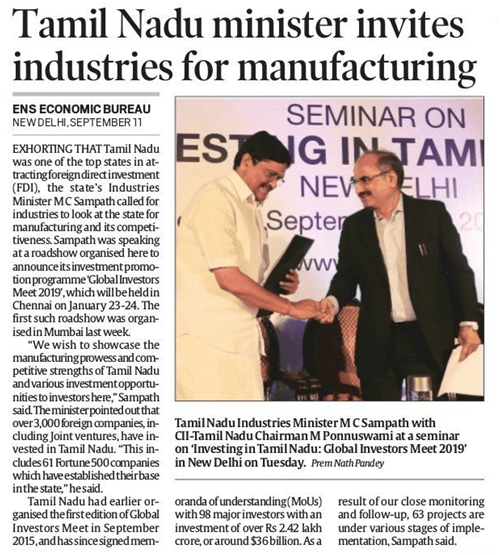
The move certainly reinforces the status of Tamil Nadu as a specialist manufacturing state, with cars, phones and IT on the list.

TN1

It was also announced in January that India remained ahead of China to retain the tag world’s fastest growing large economy withstanding several ups and downs, spike in oil prices and global trade war like situation during 2018.

According to Niti Aayog (national economic planning body) Vice-Chairman Rajiv Kumar, the focus of the government in 2019 will be to expedite reforms with a view to accelerate growth.

India will grow at around 7.8 per cent in the next calendar year and investment cycle that has already started picking-up will gather further strength and we will see more private investments,” Kumar said.

Looks like a good year to review your India engagement strategies, and put some energy into the Indian market.

indiagate

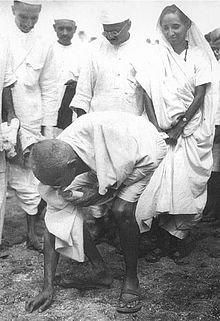
The Jamnalal Bajaj Awards promote the values of the great Mahatma Gandhi

Many things amaze me in India and one that both amazes and inspires is the Jamnalal Bajaj Awards – for the “unsung heroes” who inspire many through selfless effort in the tradition of Gandhian values.

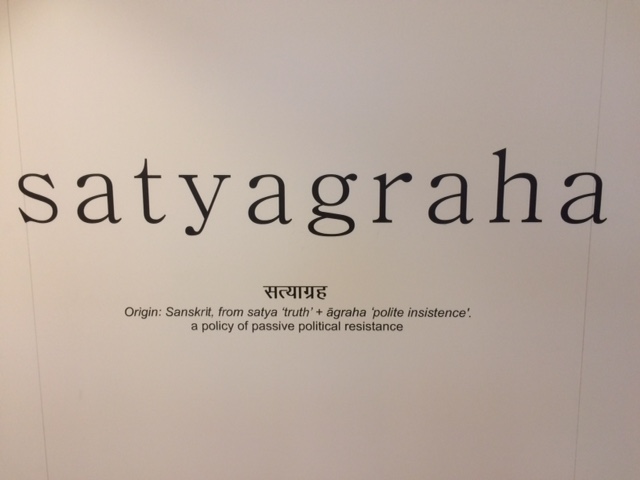
gandhisatyagraha

My good friend eminent scientist and regular visitor to Australia, Dr R A Mashelkar, is Chairman of the Selection Committee of the Award for Application of Science and Technology for Rural Development and a Member of the Council of Advisors for the whole scheme.

Dr Mashelkar said: “The fundamental issue is about Gandhian values and creating an inclusive society by dismantling inequalities.”

ATT00012_

The Nobel Laureate Kailash Satyarthi is one of the trustees of the Jamnalal Bajaj Foundation and a jury member for the Awards: “Changemakers firstly need to understand the trend of the change and then change the direction to positivity, righteousness, justice, equality and humanity.”

My country – Australia – has seen a decline in the reputation of major institutions and corporate Australia is in the firing line as the Banking and Finance Commission finds unethical behaviour is rife. Beyond the so-called ethic of “building shareholder returns”, no Australian business leader has had anything constructive to say on corporate ethics. Very disappointing. We could learn much from this foundation and the great Mahatma Gandhi.

More information about this wonderful foundation and the awards is at http://www.jamnalalbajajfoundation.org/

Gandhi Salt

Blackstone is “betting big” on India

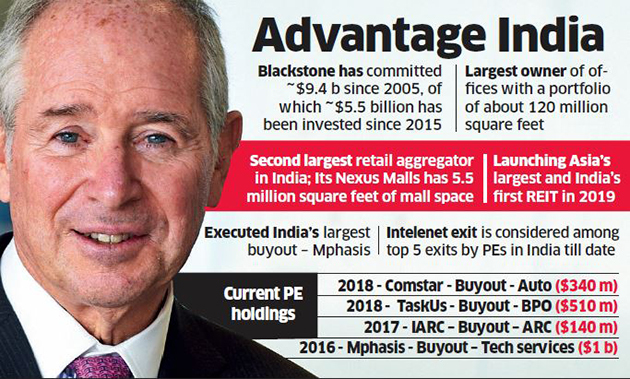
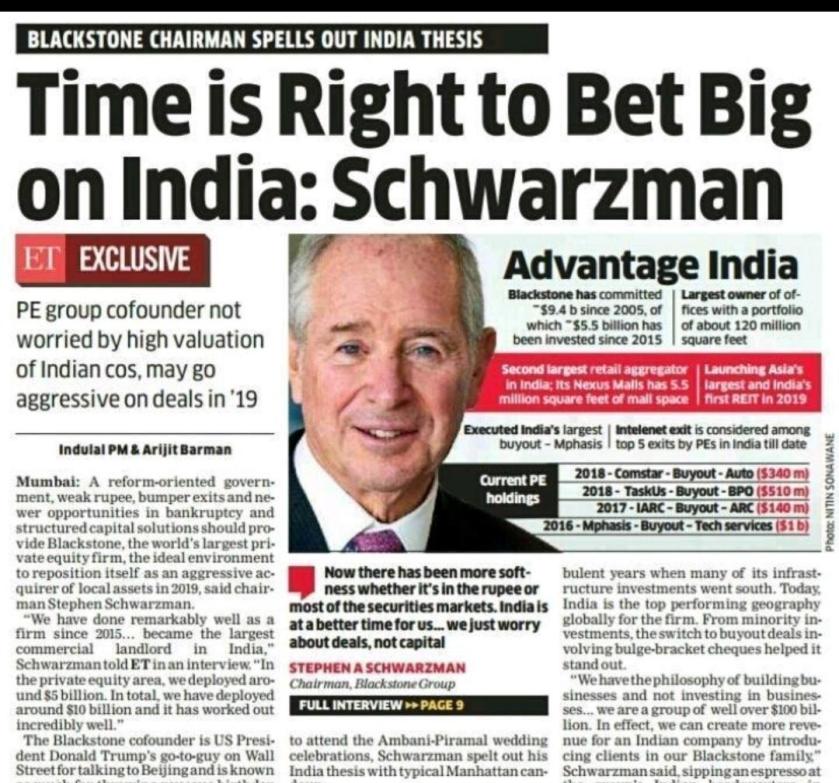
A reform-oriented government, weak rupee, bumper exits and newer opportunities in bankruptcy and structured capital solutions should provide Blackstone, the world’s largest private equity firm, the ideal environment to re-position itself as an aggressive acquirer of local assets in 2019, said chairman Stephen Schwarzman, in a recent interview with the Economic Times.

“We have done remarkably well as a firm since 2015… became the largest commercial landlord in India,” Schwarzman told ET in an interview.

Blackstone, which globally manages about $457 billion, changed its strategy after the initial turbulent years when many of its infrastructure investments went south. Today, India is the top performing geography globally for the firm.

From minority investments, the switch to buyout deals helped it stand out.  The firm has the philosophy of building businesses and not investing in businesses.

Beyond technology or other export-oriented sectors that earn in foreign currencies, the focus is on domestic consumption – financial services and consumer companies.

https://economictimes.indiatimes.com/markets/stocks/news/time-is-right-to-bet-big-on-india-stephen-schwarzman-chairman-blackstone/articleshow/67085650.cms?from=mdr

blackstone

Modi Government to do more on “ease of doing business”

Watch out for more improvements in India on “ease of doing business”.  India’s rise in the World Bank “Doing Business” rankings from 142 to 77, over the last four years, was stunning – but the government wants more.

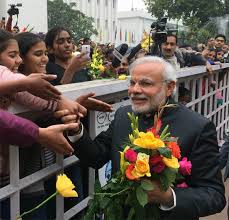
The Prime Minister, Shri Narendra Modi, recently chaired a high-level meeting to review progress with regard to “Ease of Doing Business.”

modiyoung

The meeting was attended by senior Union Ministers related to economic matters; Maharashtra Chief Minister Shri Devendra Fadnavis; Lieutenant Governor of Delhi Shri Anil Baijal; and senior officials from the Union Government, Maharashtra Government and Delhi Government.

Subjects such as construction permits, enforcement of contracts, registering property, starting a business, getting electricity, getting credit, and resolving insolvency came up for discussion.

The Prime Minister stressed the need to improve last mile delivery, and focus on streamlining procedures, which would  improve not just the “Doing Business” rankings, but also increase the “Ease of Living” for small businesses and the common man.

He said this is extremely important for India, as an emerging and vibrant economy. He also spoke of the tremendous global interest about the rise in India’s “Doing Business” rankings.

So – in 2019 there should be more news on ease in doing business with India.

indiagate

India attracting major MNC research and technology centres

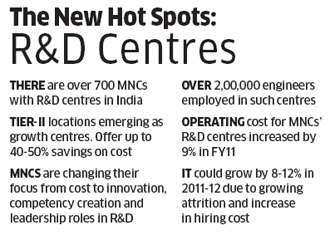
Today, multinational companies (MNCs) from the USA, Europe as well as the Asia Pacific region are setting up their research and technology centers in India. These centers are mainly focused on research & development (R&D), Business Process Management (BPM) and information technology (IT).

These centers are commonly known as Global In-house Centers (GICs). The primary reason for moving their core operations to India are no longer just cost. “It is digital technology that is bringing companies here”, opines K S Viswanathan, Vice President, Industry Initiatives at India’s leading IT industry association NASSCOM.

India has clearly moved away from cheap outsourcing work to digital-technology areas such as big data, analytics, mobility, artificial intelligence, machine learning, IoT (Internet of Things), blockchain as well as robotics.

India today has more than 1500 GICs, being operated by MNCs like Target, JCPenney, AB (Anheuser-Busch) Inbev, Saks Fifth Avenue, Grant Thornton, Adobe, Fiat Chrysler, GM, Volkswagen, Hyundai, Texas Instruments, GE, Honeywell, Airbus, Boeing, Shell, AON Hewitt, Intel, Qualcomm, Tesco, Petrofac, Novartis and Mercedes Benz.

chennai 3

6 trends to watch for India in 2019

1. Politics to dominate

Internal politics will dominate India with a general election due in May 2019. The Modi Government won in 2014 with a slogan of “good days are coming” but higher inflation, declining rural incomes and lack of jobs are all hitting government prospects, while the big unknown is the huge number of “first time” voters – India has 20 million young people turning 18 each year which means there will be around 100 million first time voters.

modiyoung

Modi has so far appealed strongly to young voters. However, state elections show that the Indian voter is now harder to predict. Most predict Modi will be returned but with a reduced majority. But when the world’s biggest democracy votes, politics becomes the theme of the year.

2. Trade deals point to stronger region

India has a growing number of trade deals that place it at a point of influence in the Indo-Pacific Region and there is a growing prospect of countries such as India, Indonesia and Australia leading a stronger Indian Ocean grouping. Of significance is the Regional Comprehensive Economic Partnership or RCEP (a trade alliance currently in negotiation among 16 countries in Asia and Oceania) which India could join in 2019 – perhaps a long shot but one to watch.

3. Fashion, weddings and pride

fashion

National pride has been growing (some call it Hindu pride, but it seems broader) and so we can expect Indian fashion, traditions and weddings to be bigger than ever – the wedding planning industry will be booming but fashion and festivals not far behind. The trend in India is to combine modernity with preservation of the past – a great balancing act. Another result is that well placed local brands – if marketed well – will attract huge consumer interest. And any year now the west will become very interested in “all things Indian” which is good news for Indian fashion, music, films and dance.

4. Economy and shares to grow

nifty50

Despite trade and currency wars slowing global growth, Moody’s and others predict continuing Indian economic growth and shares to remain buoyant for 2019. However, keep in mind shares have been booming – the Nifty 50 Index (the largest 50 stocks in India) rose from 7000 points at the end of 2015 to 11,750 points in September 2018. That is a growth of 57% in the market in just three years. It seems the psychological touch point is 10,500 for the Nifty – above that and shareholders will have a good year. Below that and watch out.

5. Business opportunities abound

health4

Healthcare for India has got to be one of the world’s biggest business opportunities with massive growth prospects for healthcare clinics and online service delivery. When you consider 60% of the people are rural but 80% of healthcare is urban (and not meeting demand there) so there will be a big rural boost. Agribusiness is strong with specific areas to watch – dairy, butter/ghee, strawberries, button mushrooms, salad supplies and alternative production such as hydroponics on urban fringes. But really, growth opportunities are everywhere as domestic demand soars – tourism (domestic and global) and education (including western immersion tours for Indian uni students) are top growth areas.

6. Energy up

India is a global leader in investment in alternative energy and this will gain ground with solar, wind and biomass to surge ahead. All of which makes the proposed and controversial Adani coal mine in Australia more of a mystery.

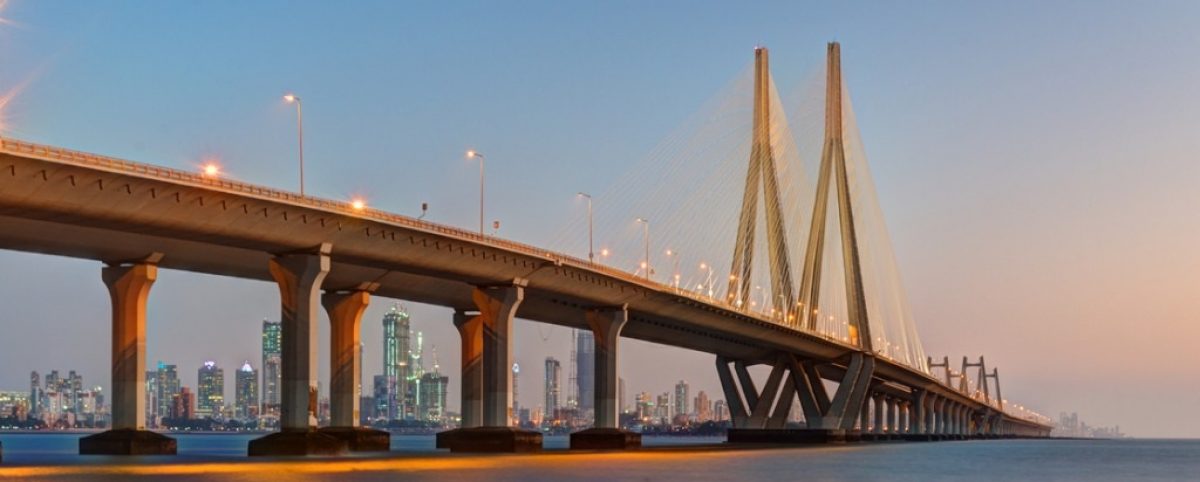
mumbaitrain

To know culture deeply you need to ask the right questions – not just “how are we different?”

To do business we need to have some idea how people will behave. That is why operating globally and across borders requires a high level of cultural awareness.

But if all we do is gain a general idea of the culture and how they differ from us, we are likely to be unprepared.

We are amazed when the person we are dealing with does not fit the culture picture. The American we are trying to impress is in fact quiet and retiring, not brash and out there as we thought. Or the Indian we expected to be incredibly polite and reticent turns out to be brash and in your face.

Why do we get this wrong?

We have only asked one question instead of digging deeper. We have asked “What culture do they have and how does it differ from ours” – it is an important question but this is only the beginning of being prepared.

molinsky

What questions should we ask in addition to the big “culture difference” one? For this I turn to a global leader in understanding culture, Andy Molinsky,Professor of Organizational Behavior at the Brandeis International Business School. He’s the author of Global Dexterity and Reach. Here are his three questions:

Question 1: What do you know about the region? Just as it is useful to learn something about culture norms when diagnosing your situation, it is good to learn something about region norms. For example, if you were doing business in the United States and assumed that people from the Northeast would be quite similar to people from the South or from the Midwest, you might find yourself surprised. Similarly, you’d be misguided if you assumed that Southern and Northern Italy are identical or that people from rural and urban areas of China tend to act in similar ways.

For India, there are at least four major regional differences (north, south, east and west) but a country with 26 major languages has multiple regional differences.

Question 2: What do you know about the company or industry? Like countries and regions, companies and industries also have distinctive cultures. How you would interact with a boss at Google is quite different from how you would interact with a boss at Microsoft or Intel.

In India, the boss of an established company like Tata Sons is going to be very different from the CEO of the latest startup or the new telco.

Norms for behavior in the advertising industry are quite different from norms for behavior in the agricultural industry, and so on.

Question 3: What do you know about the people? Finally, ask yourself what you know, or what you might be able to find out, about the people you are interacting with. Are you communicating with a 60-year-old senior executive or a 20-something manager?

In India age differences matter enormously – there is a real generation chasm between the under 40’s and the over 40’s. People who are older are often more likely to reflect the norms of the overall society.

It would also be useful to know if the people you are interacting with are locals, born and raised in that particular setting and without extensive travel experience, or if they are cosmopolitans, with extensive travel background. Locals are much more likely to reflect the norms of the immediate region you are in, whereas cosmopolitans are likely to be open to a wider range of potential behaviors.

In many East Asian and Southeast Asian cultures, such as India, China, and Korea, relatively indirect forms of communication are used, especially from a subordinate to a superior — whereas superiors in these cultures are often quite direct with their subordinates.

Finding the answers to these questions before you cross cultures can be tricky, but it is possible. Books and articles will often give you some insight into these nuances, but one of the best ways to anticipate what you’ll encounter is by talking with expats: people similar to you who have studied, lived, or worked in the country in question.

Doing your homework before entering a new culture is one of the keys for success. But unless you ask the right questions, you might end up mistakenly overlooking the real differences that matter.

For India – keep digging, asking, researching – and persevere.

gateway3


Adapting to India’s combination of “direct and indirect” culture

Most cross-cultural trainers will tell you India is an “indirect” culture, meaning it does not say things bluntly, goes around the topic rather than directly to the heart of the matter.

This is one of those generalisations that is only partly right – and if you rely on it you will be in for surprises in India.

The reality is that India combines direct and indirect communication.

direct

At the point of meeting you, Indians can be very direct – “are you married, why is your husband/wife not here with you, what do you earn, can you find me a job, will you distribute my product”. For most westerners this is confronting, because our style of meeting and networking is very gradual.

But at the point of issues arising, this is where Indians can be very indirect.

If there is a problem with what you are wanting or what India promised for you, the communication becomes more obscure. India’s indirect communication can be hard to spot, even for India trade veterans. Some tell-tale signs are when the India side says “we will try to meet your deadline” – this generally is leading to the heart of the problem which is that they cannot deliver.

This indirect communication is not motivated to deceive or make your life difficult. in fact, it is based on the value India places on its relationship with you and a desire to keep that relation intact. This is why Indians rarely use the word “no” – the relationship is more important than the truth.

Chennai now a hot spot for startups and entrepreneurs

Chennai has a well educated population, skilled technical talent and is now emerging as a competitor to Bengaluru for startup and entrepreneurial activity.

Who would have thought? “Conservative and slow” was how Chennai was first described to me. Now it has changed.

chennai 3

Active angel investors operating in the region, are boosting the change.

But Chennai is not a city to boast or shout – it will let success do the talking for it.

chennai4

The region’s economy was earlier more dependent on the automobile industry but has shifted towards information technology sector.

Here are some of the startups – Freshdesk, OrangeSpace, Bharatmatrimony, Zoho and CaratLane – all doing exceptionally well.

Why Chennai?

Chennai is a home to many investors with deep pockets willing to invest in startups with innovative ideas. Good governance and integrity further make Chennai the preferred city for business leaders.

Add to that good roads, ports, railways and airports as positive factors.

chennai5

Chennai is among the top Indian cities with a maximum number of engineering and medical colleges in the region.

Another reality is that the former home of these new ventures – Bengaluru – just cannot accommodate all the new entrepreneurs, so many turn to Chennai.

Growth

Chennai has hosted a number of entrepreneurial events to attract emerging startups and one to watch coming up soon is Pudu Chennai, 2018.


10 reasons every business can find a market in India

To understand what a great long-term opportunity India is, consider these facts:

  1. The numbers are on your side:  564 million below the age of 20
  2. The middle class is growing: 600 million growing middle-class, saving rates have tripled in last 12 years
  3. The mindset is right:  adaptability, competitive, entrepreneurial, believes in “learning, earning and spending”
  4. Challenges lead to opportunity:  mainly in areas such as transport and agricultural infrastructure, medical, power generation & distribution, education, healthcare
  5. Eating and drinking is changing: food & Beverages: food processing, food packaging, food warehouse and transport, health drinks
  6. Homes are stylish: home decor products, kitchenware essentials, bed and bath
  7. Paying for Healthcare: diagnostics and testing, medical equipment, health supplements, clean air and water products
  8. Consultancy Services are flat out: engineering, business development, product development, security analysis, accounting
  9. Infrastructure is big ticket: waste management, solar and wind technologies, temperature-controlled warehouses, air and noise pollution control technologies, towing trucks, and automated parking lot equipment.
  10. “Franchising” is popular: Top sectors with franchising opportunities are Education and Healthcare due to a huge mismatch between supply and demand now and in the coming years

Time to find your niche in India?

indiagate