Does Australia need to have a public holiday for Diwali?

As the Indian diaspora continues to grow in Australia, you can see Indian culture such as Diwali having a big impact in communities across the nation.

Australia is home to a rapidly expanding Indian community.

According to an MEA report, approximately 1 million Overseas Indians live in Australia. The Indian diaspora is the second-largest and fastest-growing in Australia. As of September 2023, there are 122,391 Indian students, making them the second-largest group of foreign-born students in the nation.

Meanwhile, in California, Governor Gavin Newsom has signed Assembly Bill 268 into law, putting Diwali on the list of 12 state holidays. The new law, which will go into effect next year, allows community colleges and public schools to close on Diwali, and state government employees can choose to take the day off.

Diwali is such a charming and engaging event – and celebrates the triumph of light over dark, good over evil – it is an uplifting message for our times.

INTO INDIA would love to hear from you – do we need a public holiday for Diwali?

Indians shaping as the big thing in Aussie tourism

Indian tourists to Australia on the rise, spending more and trending to younger

Australia is now the second highest in India for awareness, consideration and active planning for touring Australia, just below Dubai and surrounds. The “big three” for Indians are Dubai, USA and Australia.

What is exciting about the Indian traveller market is that there is an attitudinal shift – from saving to spending.

Arrivals from India for the year 2023 were at 396,000; which were on par with 2019 levels.

Indian travellers are spending more – spending A$2.2 bn on their Australia trips (an increase of 20% when compared with 2019).

In addition to the shift to spending, there is a generational shift: Indians are travelling at a much younger age.

In my home state of Victoria and the city of Melbourne, India was Victoria’s second largest tourism market by value in 2019 and is the fastest growing international visitor market to return to Victoria following the reopening of Australia’s international borders.

Factors of greatest importance to Indian travellers are safety/ security, beautiful natural environments and value for money.

Seven in ten Indian travellers are aware of Australia as a holiday destination, with half considering travelling to Australia within the next four years and one in five who are actively planning their holiday.

Australia is strongly associated by Indians with world class beaches/ coastlines/ marine wildlife, having different and interesting wildlife, having a good range of accommodation, being family friendly and having good infrastructure.

That’s why our tourism organisations, Austrade and State Government trade offices are placing such focus on promoting Australian tourism.

It’s and exciting future for Australia.

Just quietly, the “gig economy” is changing how we work and India is a good example

India’s gig economy is rapidly expanding, with predictions that the workforce will grow from 7 million in 2021 to 23.5 million by 2030.

This growth is stunning and signals a major shift in how we work.

INTO INDIA sees the gig economy as offering flexibility for both sides, remote working and other opportunities.

But the reality of being self employed is that you can also be “self unemployed”.

You can see why employers are so keen on this – providing access to a diverse talent pool while cutting costs. As companies embrace gig work, sectors like pharmaceuticals and technology are increasingly relying on freelance experts to meet their needs.

The gig workforce is growing – but it is still a tiny percentage of the total workforce – in India expecting to go from 1.5% in 2021-22 to 4.1% by the 2029-2030 financial year.

The pandemic is responsible for most recent changes in everything – and this is no exception.

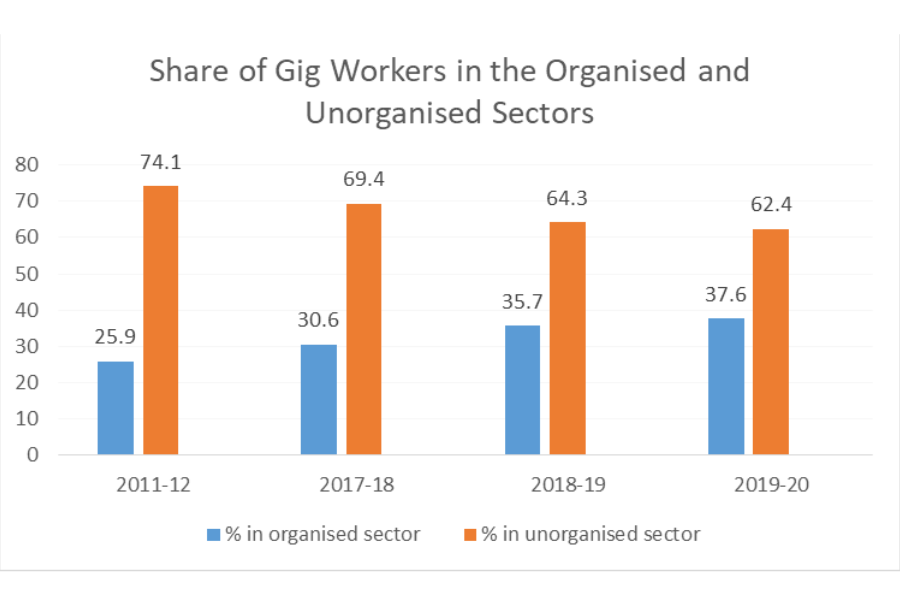
Globally, the gig economy is expected to reach a gross volume of $455 billion by 2023, up from $368 billion in 2021. In India, there is a noticeable increase in organized sector gig work compared to a decline in the unorganized sector, reflecting a growing trend towards investing in gig workers.

Source: NITI Aayog Report

INTO INDIA notes that trust between gig workers and employers is improving, with longer project durations becoming more common. Kapil Joshi, Deputy CEO of Ques Corp, observes that the average tenure for freelance projects has increased from 9 months to over a year since the pandemic, indicating growing trust in freelance coders for larger projects.

Historically, “flexibility” has meant flexibility for employers at the expense of employees. But this one might be different, because employees (some) are demanding gig work in preference to full time jobs.

We’ll see how this one goes over time.

Xentrix Studios Australia Animated Cricket Series ‘Snick and Willow’ to add real spin to our India relations

Xentrix Studios Australia has created a brilliant animated cricket series which will score big runs in both India and Australia – bringing us closer together on our favourite topic, cricket.

Don’t read what I say – watch this and be impressed…

The whole project is championed by famous cricketer Lord Ian Botham and was developed in collaboration with parent company, Xentrix Studios India.

Ken Cantrill, Head of Creative of Xentrix Studios Australia and Co-Creator of Snick and Willow. “The series is destined to be a massive success.”

Lord Ian Botham
Lord Ian Botham

This series is more than cricket, bridging cultures and inspiring young audiences worldwide. That is why INTO INDIA is so excited.

It educates about teamwork, courage, and the spirit of sportsmanship.

Can’t wait for it to come out – rumour is it will be launched during the Australia vs India Boxing Day Test this summer in Melbourne.

Want to know more about Xentrix?

https://www.xentrixstudios.com/

Australia India two-way trade now over A$50 billion

Great news from Austrade – two-way trade between Australia and India has reached around AUD 50 billion!

INTO INDIA has been active in this space over 20 years, and for most of this time our trade remained stagnant.

This recent growth is a tribute to the folks at Austrade, as well as State Government offices and all the organisations promoting the relationship. And of course highest praise goes to the brave companies that are finding a way in the Indian growth market.

Healthcare is a good example of the opportunities ahead.

The recent Indian budget 2024 signals the Indian government’s resounding commitment to provide equitable healthcare services across socio-economic spectrum with special coverage of “missing” middle class.

The Indian government is scaling up their focus on digitalisation of the public healthcare system, tariff reductions on some critical pharmaceutical drugs and MedTech devices.

Good news across the board – the budget also involves notable reductions in corporate taxes for foreign companies.

As India continues to grow as a preferred commercial destination, connect with organisations such as the Australia India Chamber of Commerce, with Austrade and with State Government offices – they can all help with the pathway to India.

Learning a lot about networking within different countries

Andy Molinsky is a professor of organizational behaviour at Brandeis University’s International Business School. He regularly writes for the Harvard Business Review, and his work has been featured in the Economist, Fast Company, Fortune, the Financial Times, the Boston Globe, NPR, and the Voice of America. 

He recently did some simple research which put a spotlight on how networking varies across cultures.

– Kanya is an MBA student in the United States who grew up in Thailand. She works in the construction industry and is 26 years old.

– Sandeep is an IT professional from India with an MBA degree from the United States. He is 28 years old.

– Mohamed is a security professional from Egypt pursuing an MBA degree in the United States. He is 24 years old.

Here are their answers:

1. Is networking common in your culture?

Kanya (Thailand): “No – it’s not common at all in Thailand. I have never been to networking events in my country before, other than a specific career fair. We don’t have any organizations that set up networking events.”

Sandeep (India): “Yes, it’s somewhat common, but only in certain situations. Indian culture is opening up to the idea of socializing and partaking in networking activities. As there is an influence of the western culture and the emergence of multinational companies is becoming evident, more and more Indian students and employees are making themselves available for networking events.”

Mohamed (Egypt): “The Arab culture is one that is more personal. You typically do business with those you know personally or have at least met. This makes networking vital in the Arab world. Networking is done in both business and non-business settings much like the West.”

2. Where does networking happen in your culture?

Kanya (Thailand): “Only career fairs provide us with the chance to meet with employers.”

Sandeep (India): “It can happen in many different places – career fairs, conferences, and even at unexpected places like parties or other informal get-together. Social parties, charities, functions are hot spots for youngsters and experienced employees alike to mingle with representatives from companies. I saw it happening in my workplace!”

Mohamed (Egypt): “There are both formal and informal settings to network. I have personally found that connections made through informal networking are more beneficial than those made in a career fair. This could be at a social outing or the informal portion of a conference.”

3. In your culture, what matters most: your resume and skills, the way you present yourself during a networking conversation, or both?

Kanya (Thailand): “When we meet employers at a career fair, they are not usually interested in our resumes. They want to talk with us about our experiences.”

Sandeep (India): “A lot of companies pay special interest to the resume of an individual, encompassing all the skills and expertise he or she has in his or her previous assignments. But at the same time, a lot of companies also look at how an individual carries himself or herself. Confidence is a big positive sign for many employers who are looking forward to hiring someone who can meet expectations without breaking a sweat; a fast learner perhaps.”

Mohamed (Egypt): “Both are crucial, but I believe the way you present yourself is more important. The personal presentation isn’t just a foot in the door; it’s a first interview. Your resume and skills are the second round interviews.”

4. If you are talking with a potential employer at a networking situation in your culture, how appropriate is it to talk about yourself and your background?

Kanya (Thailand): “It is not wrong to talk about yourself at career fair because that is why you are there. But it’s different than in the United States. In the US, you promote yourself and talk about your positive qualities. In Thailand, we’re not used to that. We don’t promote ourselves like in the United States. Instead, we just share our experiences and provide additional details if the employer asks about it.”

Sandeep (India): “You can mention something about your background, even if the employer doesn’t ask, as long as you do not sound too conceited. In the contemporary work environment in India, employees are becoming smart and impromptu in their demeanor. They like to boast, if I can say, a bit about their past jobs, their skills sets. But some overconfident employees and students blow it!”

Mohamed (Egypt): “This depends on the context. Given the right employer, job, and situation you can talk about yourself. I think it is more common for those coworkers to discuss personal matters amongst one another than with your supervisor.”

INTO INDIA comment – Networking varies across cultures – everything about communicating and doing business varies across cultures. It pays to be ready!

https://www.andymolinsky.com/

Australian banker says “this is India’s century”

This is the best, strongest vote of confidence in India from one of Australia’s leading corporations.

Mark Whelan, Group Executive at ANZ: “The time is very much appropriate to grow here. If you look at the basics of the Indian economy and where its place is in the world, this is India’s century”.

Rufus Pinto, Country Head, India, Australia and New Zealand Banking Group, outlined the rapid recent growth of ANZ in India: “ANZ India started our Institutional Banking operations in 2011. 13 years of existence across three branches today with over 80 bankers supporting the top Financial Institutions; Local Large Corporates and MNC’s working together with our home markets of Australia and New Zealand, and ~30 markets in our global network providing our clients a seamless agile offering.

“ANZ in India today house almost 20% of our global workforce, with our Global Capability Centre in Bengaluru,” he said.

This is change on a grand scale for a leading Aussie company.

Yes, this is India’s century.

Time to get on board?

Australia’s sister-city relationships with India and the diaspora here – asleep but huge potential

The growing Indian diaspora in Australia could add real energy to our relations with India – and the sister-city program could be an ideal vehicle.

My desk research suggests that only Brisbane and Ipswich have formal sister-city relations, both with Hyderabad. I also believe Perth has begun searching for an Indian sister-city.

This is pathetically small when compared to our large numbers with Japan, USA, Canada and China. It is time to catch up with India.

Global sister-city relationships, also known as city twinning, started after World War 2 with the ideal of fostering international cooperation, cultural exchange, economic development and disaster preparedness.

Worldwide sister-city relationships right now have almost stalled, yet offer immense potential.

There is a growing need for comprehensive research to assess the effectiveness of existing collaborations, identify challenges, and formulate evidence-based policies that can enhance the outcomes of these bonds.

We should reinvent sister-city relations with India and focus on helping with challenges such as climate change and pandemics, along with development and economic links. The Indian diaspora in Australia is well placed to lead this.

Modern technology makes sister-cities highly attractive via the improved and cheap communication channels. Knowledge exchange is now easier than ever. Economic collaboration and trade between twin cities can go through the roof if the local diaspora is heavily involved.

People to people connection is the sleeping giant of Australia-India relations and it can wake up and energise via the Australian Indian diaspora.

How can we apply digital platforms, data analytics and smart city technologies to create highly effective sister cities with India? We need answers in order for sister cities to be a wise investment of time and money.

Successful sister-city relationships must be characterised by a commitment to mutual understanding, effective communication, and a focus on shared goals.

Anusha Kesarkar Gavankar, a Senior Fellow at the Observer Research Foundation, recently wrote: “Policymakers could focus on enhancing communication channels between sister cities by utilising modern technology, establishing regular forums, and promoting language exchange programmes. Developing dedicated online platforms and mobile applications can facilitate real-time communication, allowing cities to share experiences, best practices, and innovative solutions to shared challenges.

“Furthermore, establishing annual forums or conferences where representatives from sister cities can meet and discuss collaborative opportunities can strengthen ties and foster a sense of community.”

In addition to the economic potential, I would love to see sister-city scholarships for Indian students to study in Australia, as well as cultural events that showcase the rich diversity and indigenous knowledge of each city can strengthen the bond between communities.

Many of our universities now have formal links and presence in Indian cities, so it would make sense for sister city deals to focus on this groundwork.

I would also like our sister city deals with India to include “great challenges” so the two come together for problem solving and common goals. This adds real energy to the relationship.

The Indian diaspora in Australia can provide the real energy to make this work. We already know External Affairs Minister Dr S Jaishankar is a big fan.

Read more from Observer Research Foundation here:

https://www.orfonline.org/expert-speak/the-twin-connection-revitalising-sister-city-relationships

Jasmine Batra and AICC outlining a thoughtful way to enter the India market

Two organisations that advocate a “more thoughtful” way to enter the Indian market came together last week in a wonderful seminar providing some super advice.

First was the Australia India Chamber of Commerce (AICC) which hosted the event and their Chair, Chris Mooney, put the case for the chamber’s National Industry Groups doing well researched and sequenced steps to engage with India. Each group does research for a white paper, builds a community and knowledge group around it and leads to well prepared India missions.

Second was the keynote speaker, Jasmine Batra from Arrow Digital, who have a program called “The Big Leap” taking clients through a 12 month program of understanding and entering India. INTO INDIA has long advocated that slower market entry produces superior long term results – a strong alternative to the traditional Aussie hasty transactional approach. We love “The Big Leap” concept.

There are three major factors that make India today a very special market – first, the young population with an average age of 28; second, the rise of the tier 2 and 3 cities, including their specialisation, three, India’s global leadership in rolling out digital infrastructure that is transforming business and society.

Jasmine talked about importance of Food, Festivals and Family when thinking about India. “Family” includes what she called “the crazy rich” such as Tata, Ambani and many more. But it also goes right down to small community business families. Your journey will interact at all levels at some time.

Reducing risk is vital. There are three steps you can take. First, understand the cultural context. Second, do market research and find local partners. Third, network community and do due diligence.

In conclusion Jasmine Batra said you should get over there, get around and get partners. By research and regular visits, your more thoughtful engagement with India will produce results.

La Trobe University very kindly provided the venue.

CONTACT AICC

Contact Jasmine Batra

About Us

9 Rules for Thriving in India

Rules compiled from my personal experience – and with some reference to “Rules for Living” by the School of Life…

1. ACCEPTING IMPERFECTION

You will never be happy in India if you seek perfection. Hang on…maybe seeking perfection anywhere is a flawed idea. Is it possible we humans are inherently flawed and broken? Is perfection beyond us? Even the west with its “belief” in science has not stamped out stupidity and pain. Life will always include suffering – this is a big Indian idea. Accepting this makes everything so much better.

2. VULNERABILITY & COMPASSION MAKE LIFE SHINE

This follows from “Accepting Imperfection”. We are all in the same boat, and recognising that we all share weaknesses, fears and mistakes can make us feel generous towards others who are also imperfect – and feel compassion for ourselves.  I learnt in India that sharing your vulnerability, talking about it to people you have just met, can lead to amazing connections.

3. ALWAYS BE KIND

To be kind to others is a choice. Being kind is a form of respect in action. In India many people accept that what happen to us is mostly out of our control, so stop struggling and find a way to live. It also acknowledges that terrible things can happen anywhere, anytime to anyone – so we can be scared or even resentful, or we can just be kind instead. It feels good.

4. HAVE A GOOD LAUGH

I seem to smile and laugh more when in India. There is a kind of blanket acceptance that life is weird, and humans are pretty funny, so have a good laugh. Accepting all of this with good grace goes a long way to easing our frustrations at our own stupidity. Back home we often see acceptance as just doing nothing – but in India acceptance becomes the first step to boldly trying your best, knowing that any outcomes will not be perfect. Why would you expect a planet of 7.8 billion people just as foolish as you to run smoothly, why expect it to be better, why look for “it SHOULD be better”? Just have a chuckle.

5. WE ARE GOOD ENOUGH – AND NOT

I dropped my obsession with “perfection” on my first arrival in India. Sure, the luggage system looked a bit messy, but they never seemed to lose my luggage. I found that the alternative to perfection is not failure, This small thing (luggage) can lead to a greater idea – rough and flawed as we all are, we can make our peace with the idea that we are, each of us, ‘good enough’. We in the west are way too quick to call out “failure”, especially in ourselves. But being ordinary or not measuring up to someone’s standards is not failure – it is just how things are.

6. FINDING WHY ROMANTICISM IS A WASTE OF SPACE

I have learnt a lot from young Indians here in Melbourne and in India. In India there is much to learn about the gradual growth of friendship into love, as a more stable approach than “falling head over heels in love”. But even that is not perfect.  I learn that love grows out of friendship, and that compatibility grows out of love – while in the west we see it as a prerequisite for love. But I also learned that having said all of this, no one is ever wholly ‘right’ nor wholly wrong. We are just learners, or as Gandhi said, seekers.

7. ACCEPTANCE IS BETTER THAN CONSTANT STRUGGLE

When the great Indian philosopher Krishnamurti was on his death bed, he was asked how he maintained such a composted and happy mind. His reply was a teaching for me. He said: “I don’t mind what happens”. It made me realise that almost all of the time, with whatever is happening, my mind made up stories or created ideas – most of which were not helpful because they led to struggle or resistance to what was happening. Things might be bad, but we can still be cheerful. Don’t mind what happens.

8. CLEARLY SEE WHAT IS HAPPENING

Despite our seeming importance, we are not at the centre of the universe – probably not at the centre of anything. Seeing ourselves at the centre means we do not really see as it is, we see as we are. Back to the baggage at the first airport I visited in India – I did not see what was happening, I saw it as I was – impatient, not trusting, agitated and emotional. Putting myself at the centre, when I meet people, I meet them where I am at. With wisdom from India (“I am not the centre”) – I can meet people where they are at. It is a clearer vision.

9, YOU WILL FORGET ALL THIS

I can forget anything – and probably you can too. Our minds might be amazing but they also just – forget stuff. So, any big ideas need to be revisited, again and again, almost so they become a habit. Even if only one of these ideas works for you, go over it and keep it for your next visit to India.