Might change your life – or you might just have fun. Gurudev coming to Australia in October

“An Evening with Gurudev Sri Sri Ravi Shankar” is coming to Melbourne, Sydney and Perth in October.

I love this Art of Living program.

If you can get tickets – go! For Melbourne:

For me, it involves breathing techniques that lead to such a relaxed state of bliss. And attendees are fun people to be around.

At second level of what I like, Gurudev does not ever complicate things – he provides simple wisdom.

A Life Changed – think about this quote:

In my 20s, I was consumed by depression and everything felt hopeless. One day, my sister told me about a nearby event featuring a talk and meditation session with Sri Sri Ravi Shankar. As soon as I walked in, I felt something shift inside me. His words seemed to answer the questions in my mind, and I was filled with peace I had never known before.

After the session, meeting Gurudev in person was an experience beyond words. It was as if a heavy burden had been lifted off my shoulders. The bliss and boundless energy I experienced stayed with me for months. When this initially faded, I began addressing my depression, but this time with a much calmer and more peaceful approach. Because I learnt the SKY breathing practice with the Art of Living, it has changed my life for the better. I have accomplished things I once thought impossible and have found inner peace.

https://www.artofliving.org/au-en

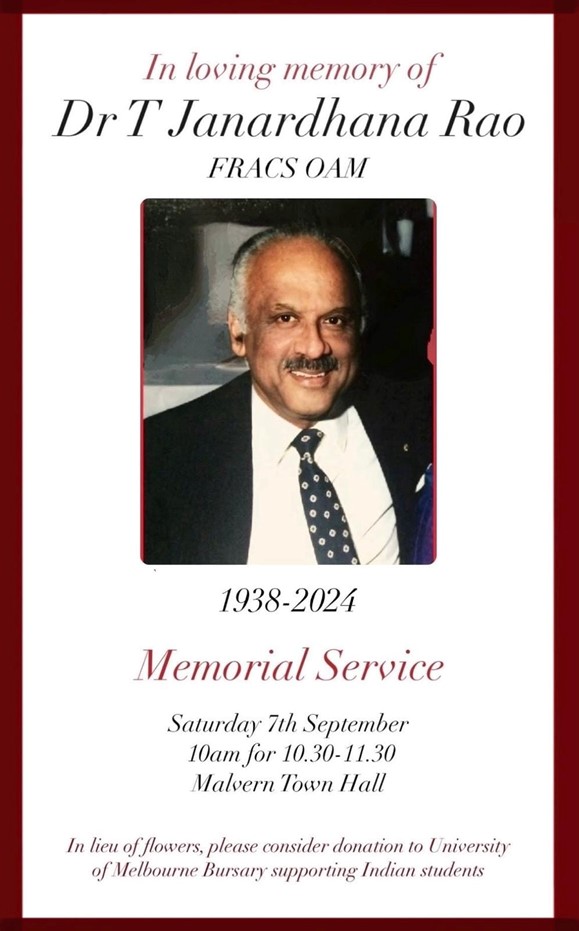
Reflecting on the life of T Janardhana Rao – a great India-Australian – 1938-2024

Dr T Janardhana Rao MBBS, MS, FRACS, FACS, OAM has passed away. This leaves a huge gap in Melbourne – and in those who love India and Australia.

He was an outstanding surgeon and honorary Indian Consul for so many decades that he has left his imprint across the Indian-Australian and broader community.

My abiding memory of Jana is the way he was always respectful, kind, seeking cooperation and building relationships. Quietly spoken and very considered in his comments, he was a strong believer that the two countries would benefit from much closer ties across politics, trade, culture and the arts.

Jana taught me so much about the Indian way of thinking and of concepts such as acceptance and patience. When staying with Jana and Vimila in their Chennai home, the highlight for me was the morning walk with Jana prior to breakfast. It was “walk and talk”.

Jana was a role model for all who want to change things – do so with respect and patience, bringing all with you rather than dividing.

His charitable legacy and foundation will leave a lasting impact, but it is his and his family story as a migrant family that shows us what can be done and how we can achieve better together.

A Memorial Service will be held at Malvern Town Hall, Saturday 7 September, 10am for 10.30 commencement. All are welcome.

How India can become the “next China”

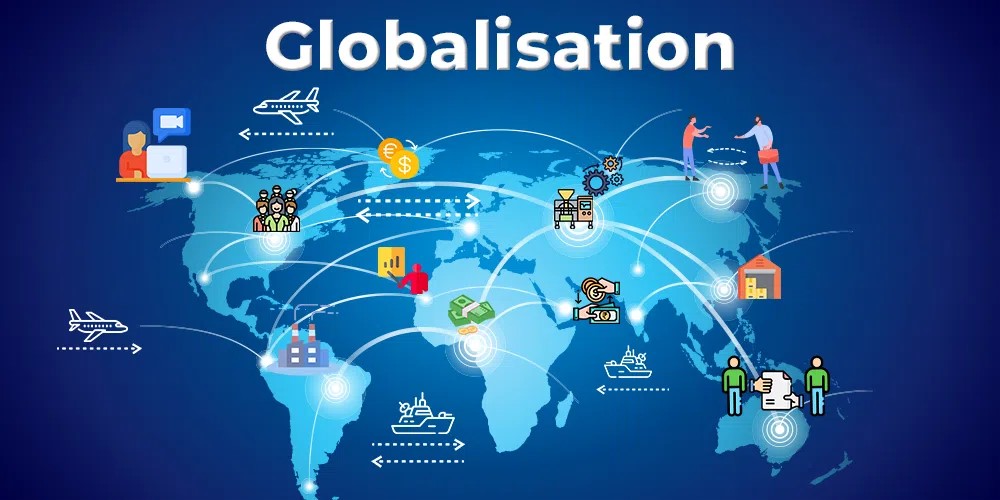
Globalization worked so well for China, but is stressed today

It’s complicated.

Mainly because of the rise of protectionism worldwide.

The Chinese miracle rode on the wave of globalization that began around 1980 and lasted until the 2008 global financial market crisis.

Globalization has come under severe stress lately, according to Amit Kumar, a research analyst with the Takshashila Institution’s Indo-Pacific studies program.

Weaponizing trade has left nations increasingly wary of economic coercion.

Self-sufficiency in some form or other is back in fashion. PM Modi is super keen on self-sufficiency for India.

If globalisation is too restricted, India’s ambitions might be thwarted. India could well have shot itself in the foot here, with it’s own anti-globalism and scepticism on international trade deals.

Gains for India will however be derived from the ongoing de-risking and “China plus one” strategies.  

India – unlike China during its growth – faces tough competition from Vietnam, Thailand and Malaysia. India attracted 15% of European investment diversifying away from China, but it fell behind ASEAN, which attracted 21% of the rerouted investments.

India is also lagging on ease of doing business. INTO INDIA has praised India’s progress, but must admit that it is now too slow. Ease of doing business has to leap ahead.

India currently contributes 16% of the global economic growth, as opposed to China’s 34%. The IMF predicts India’s share to rise to 18% in the next five years.

As China witnesses a decline in its share owing to its economic slowdown, we are led to conclude that India should emerge as the leading engine of growth.

With one reservation – “Ease of doing business’ could be the key.

Perhaps India CAN become the ‘next China’ and drive global growth

India’s consumer base is rapidly growing – pic from a Delhi mall

Since INTO INDIA has been involved with India, the mantra from economists and diplomats has been that “India is not the next China “. Is that about to change?

It could be, according to Amit Kumar, a research analyst with the Takshashila Institution’s Indo-Pacific studies program.

China has been top of mind for good reason – contributing more than a quarter to global gross domestic product expansion between 1990 and 2020. In the period from 2013 to 2021, China contributed almost 39% of global GDP growth — 13% more than the G7 countries combined.

How could India become the next China?

India would need to sustain a near double-digit growth rate for nearly three decades.

It would need to integrate with the global manufacturing supply chain, transition into an export powerhouse and attract enormous foreign investment.

But 40 years ago, we would have said the same things about China.

China’s rise from the 1970’s was boosted because of the deepening U.S.-Soviet rivalry and the Sino-Soviet split, prompted the US and the West to open up to China in 1971.

This is happening now with India.

Due to the deepening strategic competition with China, Beijing’s expanding diplomatic and economic clout, its belligerent foreign policy and economic coercion, has sparked concerns of overdependence and strategic vulnerability in the West.

India is emerging (has emerged?) as the preferred partner for the West.

We should not forget that China’s growth was also driven by global businesses looking for cheaper manufacturing.

This is now happening with India. Global firms now see India as an alternative to China.

The Indian Government has already supported high-profile projects involving the manufacturing of iPhones and the assembly of semiconductors – sending an “invitation” to others.

China also had a rapidly growing consumer base. No other Asian country had such a base – until India.

India has the second-largest consumer base – defined as people spending above $12 a day – of over 500 million, second only to China’s 900 million. Estimates show that by 2030, India’s consumer base will expand to 773 million, trailing only China’s 1.062 billion.

The gap between China and India will only shrink from here on.

NEXT BLOG – What India has to do to become the next China.

Just quietly, the “gig economy” is changing how we work and India is a good example

India’s gig economy is rapidly expanding, with predictions that the workforce will grow from 7 million in 2021 to 23.5 million by 2030.

This growth is stunning and signals a major shift in how we work.

INTO INDIA sees the gig economy as offering flexibility for both sides, remote working and other opportunities.

But the reality of being self employed is that you can also be “self unemployed”.

You can see why employers are so keen on this – providing access to a diverse talent pool while cutting costs. As companies embrace gig work, sectors like pharmaceuticals and technology are increasingly relying on freelance experts to meet their needs.

The gig workforce is growing – but it is still a tiny percentage of the total workforce – in India expecting to go from 1.5% in 2021-22 to 4.1% by the 2029-2030 financial year.

The pandemic is responsible for most recent changes in everything – and this is no exception.

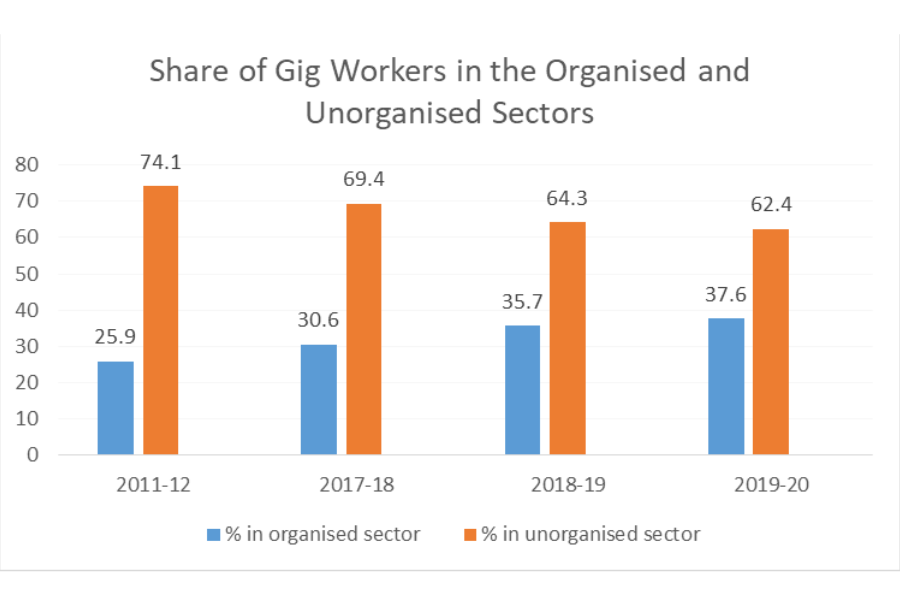
Globally, the gig economy is expected to reach a gross volume of $455 billion by 2023, up from $368 billion in 2021. In India, there is a noticeable increase in organized sector gig work compared to a decline in the unorganized sector, reflecting a growing trend towards investing in gig workers.

Source: NITI Aayog Report

INTO INDIA notes that trust between gig workers and employers is improving, with longer project durations becoming more common. Kapil Joshi, Deputy CEO of Ques Corp, observes that the average tenure for freelance projects has increased from 9 months to over a year since the pandemic, indicating growing trust in freelance coders for larger projects.

Historically, “flexibility” has meant flexibility for employers at the expense of employees. But this one might be different, because employees (some) are demanding gig work in preference to full time jobs.

We’ll see how this one goes over time.

Xentrix Studios Australia Animated Cricket Series ‘Snick and Willow’ to add real spin to our India relations

Xentrix Studios Australia has created a brilliant animated cricket series which will score big runs in both India and Australia – bringing us closer together on our favourite topic, cricket.

Don’t read what I say – watch this and be impressed…

The whole project is championed by famous cricketer Lord Ian Botham and was developed in collaboration with parent company, Xentrix Studios India.

Ken Cantrill, Head of Creative of Xentrix Studios Australia and Co-Creator of Snick and Willow. “The series is destined to be a massive success.”

Lord Ian Botham
Lord Ian Botham

This series is more than cricket, bridging cultures and inspiring young audiences worldwide. That is why INTO INDIA is so excited.

It educates about teamwork, courage, and the spirit of sportsmanship.

Can’t wait for it to come out – rumour is it will be launched during the Australia vs India Boxing Day Test this summer in Melbourne.

Want to know more about Xentrix?

https://www.xentrixstudios.com/

Australia India two-way trade now over A$50 billion

Great news from Austrade – two-way trade between Australia and India has reached around AUD 50 billion!

INTO INDIA has been active in this space over 20 years, and for most of this time our trade remained stagnant.

This recent growth is a tribute to the folks at Austrade, as well as State Government offices and all the organisations promoting the relationship. And of course highest praise goes to the brave companies that are finding a way in the Indian growth market.

Healthcare is a good example of the opportunities ahead.

The recent Indian budget 2024 signals the Indian government’s resounding commitment to provide equitable healthcare services across socio-economic spectrum with special coverage of “missing” middle class.

The Indian government is scaling up their focus on digitalisation of the public healthcare system, tariff reductions on some critical pharmaceutical drugs and MedTech devices.

Good news across the board – the budget also involves notable reductions in corporate taxes for foreign companies.

As India continues to grow as a preferred commercial destination, connect with organisations such as the Australia India Chamber of Commerce, with Austrade and with State Government offices – they can all help with the pathway to India.

Melbourne ranked 5th best global city for international students

My home town – Melbourne – is number 5 on the list of best global cities for international students. It’s quite and achievement! At the same time, international students make our city even better.

The ranking was according to the QS Best Student Cities 2025, and is a testament to its vibrant cultural scene, exceptional academic institutions, and inclusive atmosphere.

University of Melbourne Deputy Vice-Chancellor (Global, Culture and Engagement) Michael Wesley has become a real champion of the vital role international students play in the life of our cities.

He noted, ‘Melbourne being ranked as the 5th best student city globally is a remarkable endorsement of our vibrant, inclusive, and culturally rich environment. It reflects the University of Melbourne’s commitment to providing world-class education that is deeply integrated with diverse global perspectives. This ranking affirms our commitment to fostering a diverse and dynamic community that prepares students to thrive in a globalised world’.

Ranked among the best

At the core of this thriving educational landscape is the University of Melbourne, which continues to set the benchmark for excellence and global engagement.

The University has a great appeal – it is the highest-ranked Australian university across three major global rankings. Currently, it is ranked number 13 in the world according to the Quacquarelli Symonds (QS) World University Rankings, 37 in the Times Higher Education World University Rankings, and 35 in the Academic Ranking of World Universities. The University’s efforts to tackle the world’s greatest environmental and social issues saw it jump 42 places to be ranked ninth best in the world in the 2023 QS Sustainability Rankings.

International student community

A significant factor contributing to Melbourne’s high ranking as a student city is its vibrant international student community. At the University of Melbourne, international students constitute 45% of the total student population, representing over 150 nationalities. The largest cohorts hail from China, Indonesia, India, and Malaysia, reflecting the University’s appeal to top-tier students from the Asia and Pacific region.

We all benefit from having international students!

These international students enrich the cultural fabric our campuses and enhance the educational experience for all students. Domestic students benefit from the diverse perspectives and global networks that their international peers bring, preparing all students for success in a global economy.

READ MORE:

https://about.unimelb.edu.au/news-resources/awards-and-achievements/announcements/melbourne-top-5-global-destination-for-studying-abroad/_recache

Learning a lot about networking within different countries

Andy Molinsky is a professor of organizational behaviour at Brandeis University’s International Business School. He regularly writes for the Harvard Business Review, and his work has been featured in the Economist, Fast Company, Fortune, the Financial Times, the Boston Globe, NPR, and the Voice of America. 

He recently did some simple research which put a spotlight on how networking varies across cultures.

– Kanya is an MBA student in the United States who grew up in Thailand. She works in the construction industry and is 26 years old.

– Sandeep is an IT professional from India with an MBA degree from the United States. He is 28 years old.

– Mohamed is a security professional from Egypt pursuing an MBA degree in the United States. He is 24 years old.

Here are their answers:

1. Is networking common in your culture?

Kanya (Thailand): “No – it’s not common at all in Thailand. I have never been to networking events in my country before, other than a specific career fair. We don’t have any organizations that set up networking events.”

Sandeep (India): “Yes, it’s somewhat common, but only in certain situations. Indian culture is opening up to the idea of socializing and partaking in networking activities. As there is an influence of the western culture and the emergence of multinational companies is becoming evident, more and more Indian students and employees are making themselves available for networking events.”

Mohamed (Egypt): “The Arab culture is one that is more personal. You typically do business with those you know personally or have at least met. This makes networking vital in the Arab world. Networking is done in both business and non-business settings much like the West.”

2. Where does networking happen in your culture?

Kanya (Thailand): “Only career fairs provide us with the chance to meet with employers.”

Sandeep (India): “It can happen in many different places – career fairs, conferences, and even at unexpected places like parties or other informal get-together. Social parties, charities, functions are hot spots for youngsters and experienced employees alike to mingle with representatives from companies. I saw it happening in my workplace!”

Mohamed (Egypt): “There are both formal and informal settings to network. I have personally found that connections made through informal networking are more beneficial than those made in a career fair. This could be at a social outing or the informal portion of a conference.”

3. In your culture, what matters most: your resume and skills, the way you present yourself during a networking conversation, or both?

Kanya (Thailand): “When we meet employers at a career fair, they are not usually interested in our resumes. They want to talk with us about our experiences.”

Sandeep (India): “A lot of companies pay special interest to the resume of an individual, encompassing all the skills and expertise he or she has in his or her previous assignments. But at the same time, a lot of companies also look at how an individual carries himself or herself. Confidence is a big positive sign for many employers who are looking forward to hiring someone who can meet expectations without breaking a sweat; a fast learner perhaps.”

Mohamed (Egypt): “Both are crucial, but I believe the way you present yourself is more important. The personal presentation isn’t just a foot in the door; it’s a first interview. Your resume and skills are the second round interviews.”

4. If you are talking with a potential employer at a networking situation in your culture, how appropriate is it to talk about yourself and your background?

Kanya (Thailand): “It is not wrong to talk about yourself at career fair because that is why you are there. But it’s different than in the United States. In the US, you promote yourself and talk about your positive qualities. In Thailand, we’re not used to that. We don’t promote ourselves like in the United States. Instead, we just share our experiences and provide additional details if the employer asks about it.”

Sandeep (India): “You can mention something about your background, even if the employer doesn’t ask, as long as you do not sound too conceited. In the contemporary work environment in India, employees are becoming smart and impromptu in their demeanor. They like to boast, if I can say, a bit about their past jobs, their skills sets. But some overconfident employees and students blow it!”

Mohamed (Egypt): “This depends on the context. Given the right employer, job, and situation you can talk about yourself. I think it is more common for those coworkers to discuss personal matters amongst one another than with your supervisor.”

INTO INDIA comment – Networking varies across cultures – everything about communicating and doing business varies across cultures. It pays to be ready!

https://www.andymolinsky.com/

What will a third term for Indian PM Narendra Modi mean for India and the world?

 INTO INDIA had three big reactions to the Indian elections:

1) Democracy is alive and well in India; 650 million votes cast over a 6 week election process – truly a remarkably strong democracy!

2) Indians want jobs, jobs, and jobs; this is why manufacturing has become so central to India’s economy – the swing away from the ruling BJP suggests PM Modi has to do more on jobs.

3) the Indian voter will expect the government to keep growing the economy – and show why that is a benefit for all Indians.

The only other Indian Prime Minister to win three five-year terms was the first – PM Nehru.

This has been a much closer election than predicted – and probably has given the ruling BJP and PM Modi much to think about. Of course, INTO INDIA notes that long term office holders generally face an anti-incumbency mood.

Congrats to Indian PM Narendra Modi – we have always called him ACTION MAN and in his third term he will need to maintain the action.

We expect a big focus this term on manufacturing, physical infrastructure, digital infrastructure and energy transition.