India is available – but are WE capable?

Here is the paradox – Indian growth means there is demand for almost every product and service – but Australian business is not over there selling hard.

Perhaps we Aussies do not have an export mentality?

This was one possible reason canvassed today when I met with Leigh Howard, CEO of Asialink Business.

We agreed that there is still a need to sell the vision of exporting to India.

Asialink Business is really about building “Asia capability” and is keen to do more for the SME sector. You can sign up for an online “Doing Business with India” session this coming Wednesday here – https://asialink.unimelb.edu.au/business/course/academy-intro-india/

We also discussed how our universities could be paving the way for the rest of us to make it in India – their presence is now “bricks and mortar” and both Melbourne University and Deakin University are showing the way.

So, are you capable? Sign up now.

Australia sets impressive trade records which newsrooms refuse to report

Australians are not good at celebrating good news – and some of the good news they don’t even get to see on major media.

Trade performance is a good example.

Australia has an outstanding national trade body – Austrade – with talented people around the world promoting our products and services.

In many countries – including India – most of our states also have Government offices working hard to build trade and investment.

They have been incredibly successful.

Of the 35 advanced countries in the Organisation for Economic Cooperation and Development (OECD) who reported last year’s exports to the World Bank, only three increased exports relative to gross domestic product (GDP) over 2022.

Of these, Australia’s expansion was the strongest.

The World Bank also affirms Australia’s ascendancy.

The World Bank’s development indicators show export and import outcomes for 138 economies from 1974 to 2023.

The World Bank measured Australia’s 2023 exports at a record 26.7% of GDP.

The success story continues…

Of the 35 advanced OECD member economies for which the World Bank has recorded last year’s export volumes, 17 experienced a decline. These include normally robust economies Ireland, Germany, the United Kingdom, Netherlands and Belgium.

Only 18 increased their exports over the previous year. Just four managed an improvement of more than 5%. Australia ranked third with 6.5% behind Denmark and Costa Rica.

Well done all those Australian providers of quality export goods and services.

Well done, Aussie!

Melbourne ranked 5th best global city for international students

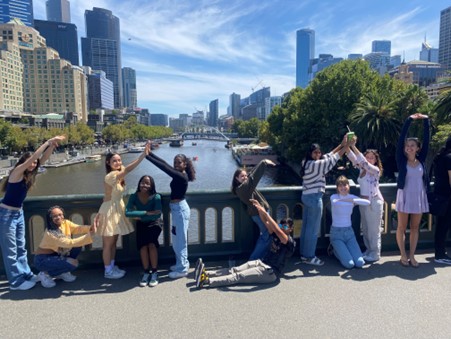
My home town – Melbourne – is number 5 on the list of best global cities for international students. It’s quite and achievement! At the same time, international students make our city even better.

The ranking was according to the QS Best Student Cities 2025, and is a testament to its vibrant cultural scene, exceptional academic institutions, and inclusive atmosphere.

University of Melbourne Deputy Vice-Chancellor (Global, Culture and Engagement) Michael Wesley has become a real champion of the vital role international students play in the life of our cities.

He noted, ‘Melbourne being ranked as the 5th best student city globally is a remarkable endorsement of our vibrant, inclusive, and culturally rich environment. It reflects the University of Melbourne’s commitment to providing world-class education that is deeply integrated with diverse global perspectives. This ranking affirms our commitment to fostering a diverse and dynamic community that prepares students to thrive in a globalised world’.

Ranked among the best

At the core of this thriving educational landscape is the University of Melbourne, which continues to set the benchmark for excellence and global engagement.

The University has a great appeal – it is the highest-ranked Australian university across three major global rankings. Currently, it is ranked number 13 in the world according to the Quacquarelli Symonds (QS) World University Rankings, 37 in the Times Higher Education World University Rankings, and 35 in the Academic Ranking of World Universities. The University’s efforts to tackle the world’s greatest environmental and social issues saw it jump 42 places to be ranked ninth best in the world in the 2023 QS Sustainability Rankings.

International student community

A significant factor contributing to Melbourne’s high ranking as a student city is its vibrant international student community. At the University of Melbourne, international students constitute 45% of the total student population, representing over 150 nationalities. The largest cohorts hail from China, Indonesia, India, and Malaysia, reflecting the University’s appeal to top-tier students from the Asia and Pacific region.

We all benefit from having international students!

These international students enrich the cultural fabric our campuses and enhance the educational experience for all students. Domestic students benefit from the diverse perspectives and global networks that their international peers bring, preparing all students for success in a global economy.

READ MORE:

https://about.unimelb.edu.au/news-resources/awards-and-achievements/announcements/melbourne-top-5-global-destination-for-studying-abroad/_recache

Learning a lot about networking within different countries

Andy Molinsky is a professor of organizational behaviour at Brandeis University’s International Business School. He regularly writes for the Harvard Business Review, and his work has been featured in the Economist, Fast Company, Fortune, the Financial Times, the Boston Globe, NPR, and the Voice of America. 

He recently did some simple research which put a spotlight on how networking varies across cultures.

– Kanya is an MBA student in the United States who grew up in Thailand. She works in the construction industry and is 26 years old.

– Sandeep is an IT professional from India with an MBA degree from the United States. He is 28 years old.

– Mohamed is a security professional from Egypt pursuing an MBA degree in the United States. He is 24 years old.

Here are their answers:

1. Is networking common in your culture?

Kanya (Thailand): “No – it’s not common at all in Thailand. I have never been to networking events in my country before, other than a specific career fair. We don’t have any organizations that set up networking events.”

Sandeep (India): “Yes, it’s somewhat common, but only in certain situations. Indian culture is opening up to the idea of socializing and partaking in networking activities. As there is an influence of the western culture and the emergence of multinational companies is becoming evident, more and more Indian students and employees are making themselves available for networking events.”

Mohamed (Egypt): “The Arab culture is one that is more personal. You typically do business with those you know personally or have at least met. This makes networking vital in the Arab world. Networking is done in both business and non-business settings much like the West.”

2. Where does networking happen in your culture?

Kanya (Thailand): “Only career fairs provide us with the chance to meet with employers.”

Sandeep (India): “It can happen in many different places – career fairs, conferences, and even at unexpected places like parties or other informal get-together. Social parties, charities, functions are hot spots for youngsters and experienced employees alike to mingle with representatives from companies. I saw it happening in my workplace!”

Mohamed (Egypt): “There are both formal and informal settings to network. I have personally found that connections made through informal networking are more beneficial than those made in a career fair. This could be at a social outing or the informal portion of a conference.”

3. In your culture, what matters most: your resume and skills, the way you present yourself during a networking conversation, or both?

Kanya (Thailand): “When we meet employers at a career fair, they are not usually interested in our resumes. They want to talk with us about our experiences.”

Sandeep (India): “A lot of companies pay special interest to the resume of an individual, encompassing all the skills and expertise he or she has in his or her previous assignments. But at the same time, a lot of companies also look at how an individual carries himself or herself. Confidence is a big positive sign for many employers who are looking forward to hiring someone who can meet expectations without breaking a sweat; a fast learner perhaps.”

Mohamed (Egypt): “Both are crucial, but I believe the way you present yourself is more important. The personal presentation isn’t just a foot in the door; it’s a first interview. Your resume and skills are the second round interviews.”

4. If you are talking with a potential employer at a networking situation in your culture, how appropriate is it to talk about yourself and your background?

Kanya (Thailand): “It is not wrong to talk about yourself at career fair because that is why you are there. But it’s different than in the United States. In the US, you promote yourself and talk about your positive qualities. In Thailand, we’re not used to that. We don’t promote ourselves like in the United States. Instead, we just share our experiences and provide additional details if the employer asks about it.”

Sandeep (India): “You can mention something about your background, even if the employer doesn’t ask, as long as you do not sound too conceited. In the contemporary work environment in India, employees are becoming smart and impromptu in their demeanor. They like to boast, if I can say, a bit about their past jobs, their skills sets. But some overconfident employees and students blow it!”

Mohamed (Egypt): “This depends on the context. Given the right employer, job, and situation you can talk about yourself. I think it is more common for those coworkers to discuss personal matters amongst one another than with your supervisor.”

INTO INDIA comment – Networking varies across cultures – everything about communicating and doing business varies across cultures. It pays to be ready!

https://www.andymolinsky.com/

Where Australia’s ‘An India Economic Strategy to 2035’ missed the point No. 1 – the threat to education is real

Australia finally has ‘An India Economic Strategy to 2035’ which is a good thing, with trade now declining to around A$14 billion.

A big part of that trade is education, with Indians big users of our universities and colleges.

The strategy mentions “visa employment conditions” as a potential threat – it should have been stronger. Changing visa conditions have had the intended consequence of employers now being uncertain and scared to offer employment to overseas graduates.

This is bad for Australia long term. Australian governments have one department discouraging Indian students (immigration) and the rest of the country hoping we can get more – time for the government to step in.

But even worse is that Indian graduates are not prepared for employment in Australia – and the report missed this key point. Their CV’s are not up to scratch, their English is difficult to understand, few have learnt presentation skills and their self descriptions often miss out their most attractive employment qualities. From our pilot study we know that these things can be quickly fixed, giving Indians a real chance of getting the jobs they want.

If this employment mismatch continues, we will have thousands of Indian graduates of Australian universities taking unskilled jobs – and word will get back to India – “don’t come to study in Australia because you will not be offered a job”. 

The report did call for our universities and businesses to work together to provide employment for students while they study – this is good. But the report made no mention of how unemployable these students are when sitting opposite corporate recruiters.

Missing this point was a big miss by the report. In addition to fixing the visa debacle, the government urgently needs to call the universities in, demanding a solution on employability skills.

Otherwise our trade will decline even further.