Indian budget signals some shifts in education and skills training

The Indian Budget this month signalled continued commitment to free (free-er) market economy and was interesting in terms of education, skill development and related sectors.

The New Education Policy (NEP) is at the centre of reforms, set to bring major changes in school and higher education.

YoungIndians 2

Research is being given a big thrust with the National Research Foundation. Also, approx. US$60 million has been allocated to world-class institutions, signalling the continued thrust on excellence in higher education.

PM Modi is personally committed to having high ranking universities in India and some future deregulation is expected to allow greater global involvement – but nothing on this in the budget.

The finance minister also highlighted the ambitious Study in India programme, which has the potential to make India the hub of learning (again).

The National Sports Education Board is a much-needed initiative to promote sports amongst children who want to pursue that as a career.

We do hope the much-awaited Higher Education Commission of India (HECI) takes shape this financial year – still waiting on that one.

Family businesses in India are the world’s most upbeat

Family businesses in India are on a growth trajectory, with 89 per cent of them expecting to grow in the next two years, according to a survey.

The global survey, ‘Family Business Survey 2019’ by PwC, was done among 2,953 family leaders across 53 countries, including 106 family business leaders, between April 20 and August 10, 2018.

The survey has revealed that 89 per cent of family businesses in India expect to grow in the next two years, with 44 per cent of them looking at growing aggressively and 45 per cent expecting steady growth.

“Regulatory changes are getting family businesses to bring in order and professionalise the business, and disruptive technology is pushing them to transform. These new market dynamics are cultivating a renewed sense of ambition in family businesses, making them resilient in the face of change,” PwC India Partner and Leader, Entrepreneurial and Private Business, Ganesh Raju K said.

In terms of expansion, a little more than half of the family businesses are open to internationalisation, while 40 per cent are looking at diversification, the survey said.

Nearly half of the family businesses in India are open to mergers and acquisitions both within India and outside thus reinforcing the belief that inorganic growth will facilitate synergies and achieve incremental revenue, it said.

A lot of Indian family business owners are looking at private equity or venture capital funding or are looking at listing their business on stock exchanges.

Further, the survey said, more and more companies looking at professionalising their business functions are distinguishing between ownership and management as they feel partnering with the right talent might help family businesses to adapt to the changes.

About 73 per cent of Indian family businesses have the next generation working in the business and 60 per cent plan to pass on the management or ownership to the next generation.

It also found that 92 per cent of family businesses in India allow family members to work in the business. When it comes to spouses or partners, three-fourth of family businesses allow them to own shares and two-third allow them to work in the business.

BUT – there is some evidence the next generation of young Indians will want to branch out and create their own startups rather than the traditional path of joining the family firm.YoungIndians 2

The next steps will be critically important for Adani in Australia

Now that the Adani mine in Queensland has passed what seems to be the final hurdle, while it will still be a focus of protests it is now important for Adani Group to create and build a long term image and relevance in Australia. Adani Group is widely misunderstood here.

Few if any Australians are aware of the diversified role of Adani in areas such as solar power (below).

adanisolar

There have been mistakes. While “overstating” projects might be good communication in many countries, it is a disaster in Australia which is the home of the “tall poppy syndrome” (want to chop you down) and cynicism. In Australia it is best to under-estimate a project and then deliver beyond expectations.

This initial approach hurt the project and much of the bravado might well have been the Queensland Government – but dealing effectively with local politics is another important task for the group.

Here are some challenges, opportunities and ideas for the future brand of Adani in Australia:

  1. Build up the media, political and community profiles of your local Australia team
  2. Create some leadership profile opportunities for Mr Adani
  3. Clarifying the Adani approach of “vertical integration” which is not well understood in Australia
  4. Accept that protests and negative media will continue but strive to at least get your proper share of media space
  5. Carefully select the media you will deal with – and provide media tours of Adani in India – with full transparency
  6. Support and become involved in coordinated media relations programs with Indian High Commission in Canberra
  7. Have Mr Adani seen as a “promoter of Australia” by leading an annual group of Indian business leaders to visit and explore opportunities in Australia
  8. Bring some scientific R&D work to Australia – for example with RMIT University as a collaborator – this has the advantage of giving Adani relevance outside of Queensland
  9. Create an alliance with Indian foundations which are high profile here – for example ASHA Foundation educates slum dwellers and is well known for having a slum young person graduate from Melbourne University. Provide scholarships for more to come here
  10. Create or support a meeting of leading Australian and Indian resources and environmental scientists in some annual dialogue
  11. Have a regular presence in Canberra
  12. Develop some “owned media” content that is highly professional, well written and not propaganda
  13. Facilitate Australian business and political missions to India, leveraging close contacts

Australia’s Cotton On enters India market

Cotton On, Australia’s largest fashion retailer, has made its entry into the Indian market through online shopping platform Myntra.

This is a smart move – low cost, quick results and great active market researh.

The brand plans to compete with the likes of H&M and Forever 21 in India, by opening its flagship store — either in Delhi or Mumbai — in the third or fourth quarter of 2020.

cotton3

AVS Global Network, a retailer of global fashion brands that focuses on retail through digital platforms, is responsible for launching Cotton On in the country.

AVS Global Network has managed to secure an exclusive contract with online retail platforms Flipkart, Myntra and Jabong to sell Cotton On products in India for the next year and a half.

Cotton On Group was established in 1991 and is present in 19 countries including New Zealand, South Africa and Singapore, with about 1,500 stores across the globe.

The Australian giant has eight brands in its kitty, namely — Cotton On, Cotton Kids, Cotton on Body, Factorie, Ruby, Typo, Supre and Lost. Each one of them caters to a different market segment.

Cotton On is testing the Indian waters by selling its products online before investing in stores.

I like this strategy for India, China and other South-East Asian countries – they are increasingly buying apparel online, compared to other Western markets.

Perhaps online is your starting point for India too?

Modi 2.0 – What will Modi do in 7 major policy areas?

Health

Telemedicine and diagnostic laboratories

More medical colleges

National immunisation programs

Modernisation

50 cities to have metros

Toilets for all Indians

State road network expansion

Inclusion

Banking access for all

Pension for small shop keepers

Poverty reduced to single digit

Economy

Grow to $5 trillion by 2025 and $10 trillion by 2032

Infrastructure spend

Credit scheme for MSME’s

Governance

Simultaneous elections

Time-bound delivery of public services

Upgrade governance standards

Education

Indian institutions to rate in top 500 in world

Medical and specialist doctors

Foreign Policy

Increase diaspora interaction

Multilateral cooperation on terrorism and corruption

Increase diplomatic corp

PLUS since this is PM Modi, expect the unexpected in this new 5 year term as Indian Prime Minister.

Australia’s PM Morrison should visit India to protect our education trade

Australian Prime Minister Scott Morrison needs to move fast to protect Australia’s education trade with India, now that the world’s biggest democracy has given Prime Minister Narendra Modi a second term in power.

Modi is a reformer – he can move fast and in surprising ways. We know he wants to transform education and there might be some shocks ahead for Australian universities.

Modi knows Indians mainly study abroad because their Indian universities are not up to standard. So he wants to change that.

The second Modi Government is aiming to boost India’s very low rankings among global universities. Freeing up his university sector will see closer ties with elite universities in England and America, and we could fall down the list if we do not act now.

Based on his track record so far, the Indian PM could make massive changes, deregulating up to one hundred of its best universities at any time soon.

Many in Delhi are critical of Australian universities which they claim have simply wanted a one-way transaction to make money out of Indian students. While some of our universities have created serious collaborations with India, in general this criticism is valid.

The next wave of education will see success for those who can create real collaboration, with two-way exchanges of students. Whether Australia can move fast on this is in doubt.

PM Modi is a politician who is not afraid of delivering surprises, as shown with his demonetisation move in his first term aimed at reducing corruption and driving the economy to digital rather than cash transactions. Surprises can transform into shocks if the leaders do not have a close personal connection – that’s why PM Morrison needs to act now to shore up our education trade.

Professor Bhargava of RMIT University shows how to respond to Industry 4.0

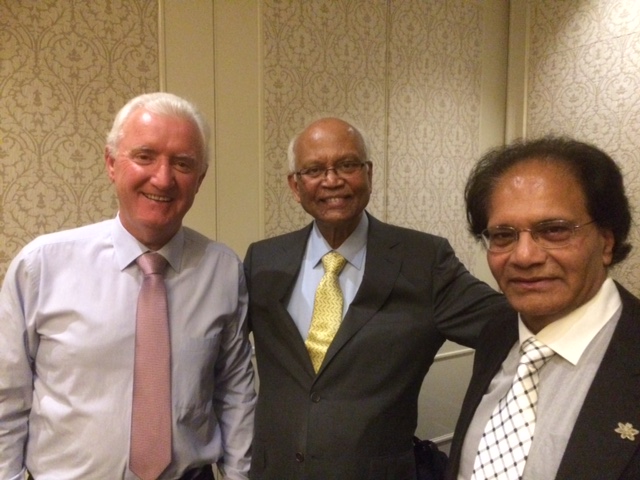
Featured pic – such an honour for me to be with two global innovators – India’s Dr Mashelkar and Australia’s Professor Bhargava (right)

Most students and many universities will not be ready for the fast-changing world of “Industrial Revolution 4.0” which has begun and will be in full swing by the time most graduate.

In Australia the RMIT University Distinguished Professor Suresh Bhargava, Associate Pro Vice-Chancellor (India), Director-Centre for Advanced Materials and Industrial Chemistry (CAMIC) College of Science, Engineering & Health is a pioneer of “The Science for Developing a 21st Century Scientist”.

This program will see students learning the art of global collaboration over a four-year program – one year each at RMIT University, with industry in Australia and India, involved in CSIRO international collaborations and with the Indian Academy of Scientific and Innovative Research.

Now, employers would be keen to talk to such a graduate!

Professor Bhargava says we should “Move towards collaborative innovation”.

Australia’s Chief Scientist, Dr Alan Finkel AO, is enthusiastic: “Very few of us have the opportunity to do something that is first in the world and worthwhile.”

Professor Bhargava has been my mentor on matters India and educational for many years.

I will be speaking at several Indian universities later this year on my own passion piece:

The 7 ways graduates can thrive in Industrial 4.0

  1. Show you can continue to learn

We know employers’ value this very highly – their focus is not on what you know through your degree – but is more on what you can learn in future. Prepare for this by being curious, reading and listening widely, entering discussion groups and being able to summarise what you have learned outside of university or since your degree.

  1. Demonstrate wisdom and common sense

For employers, further than what you know is how you think, and the value of wisdom and common sense. The best way to describe the difference between knowledge and wisdom is through the humble tomato – knowledge tells you a tomato is a fruit (not a vegetable) – but wisdom prevents you adding the tomato to a fruit salad. One fast track to wisdom is via mentors and guides, those who can share experience with students.

  1. Gain good collaboration and friendship skills

Industrial 4.0 will make collaboration easy and instant with anyone, anywhere and anytime – and the change will benefit those who have the skills to reach out, make friends, work across the globe and build collaboration. Future corporations and employers will be looking for people who can build collaboration.

  1. Gain cross-border understanding and skills

Already our lives in one country are intersecting with lives of other countries, and Industrial 4.0 will make the globe an even smaller place. Those who have travelled, who have acquired both knowledge and experience of other cultures will be in high demand, simply because almost every job will have global aspects.

  1. Become an outstanding communicator

Traditional “soft skills” training will not prepare students for the fast future – outstanding communication skills for Industrial 4.0 will include rapid pitching, ability to support points in a way which moves others, skills to relate directly and closely with those above and below you – any student sitting back quietly as a “newbie” will get left behind. Old notions of being silent in front of elders or superiors will not apply. Respectful and strong communication skills will rule.

  1. Be a team-based problem solver

More work will be team-based and some of those who succeed will actually present to future employers as a team. Problem solving as a team while at university should lead students to then approach employers as teams – a good standout in the race to gain attention.

  1. Build self-reliance and resilience

With the demise of “study hard, get the degree which entitles you to a job for life” model, students will need skills in self-reliance and resilience. As jobs come and go, individuals will need to be able to bounce back and start again, maybe many times in their careers. Where no jobs are forthcoming, graduates will need to create their own or join teams that provide solutions.


6 ways young Indians are taking a different approach to employment

As the fastest growing economy today, India is home to a fifth of the world’s youth. Half of its population of 1.3 billion is below the age of 25, and a quarter is below the age of 14.

The World Economic Forum and the Observer Research Foundation recently collaboratively conducted a survey of more than 5,000 youth in India.

  1. Indian youth are independent, optimistic and open to a changing labour market

The influence of family and peers on the career and educational choices of India’s youth is in decline. Young people are increasingly seeking productive employment opportunities and career paths that reflect their individual aspirations. Moreover, a third of the respondents report being interested in entrepreneurship, and 63% report being highly or moderately interested in supplementing their income with gig work.

  1. Indian youth need more guidance and career counselling

Many youth report facing multiple barriers to finding desirable and suitable job opportunities. Factors like information asymmetries on jobs and skills, and lack of guidance for setting realistic career goals and making professional choices, are holding back young Indians. 51% of respondents report that a lack of information about available job opportunities that match their skill sets is a significant barrier. Around 30% report a lack of access to any kind of counselling or mentoring opportunities. 44% of respondents view this as the most important factor in the demand-supply mismatch.

  1. Young Indians are interested in pursuing higher education and skills development

84% of respondents consider a post-graduate degree as a requirement for their ideal job, while 97% aspire to a degree in higher education. They are also keen on other forms of ongoing education, with 76% of youth reporting that they are very interested in participating in a skills development programme. Increased employment opportunities and higher wages are the main motivators for this goal.

  1. The private sector must do more to bridge the skills gap

The private sector needs to play a more active role in enhancing the capabilities and skills of India’s youth. India is faced with a paradox: there is significant youth unemployment, and yet the private sector bemoans a lack of adequately skilled and market-ready workers. Notwithstanding the government’s role in providing basic education and training, there is a significant need for greater private sector involvement. This will ensure that training initiatives are demand-driven and impart skills that match industry requirements.

  1. India’s socio-cultural norms add further complexity

34% of the surveyed youth report that discriminatory and personal biases related to their marital status, gender, age or family background are a major barrier when looking for a job. 82% of female respondents said their ideal employment would be full-time, disproving the stereotype that women prefer part-time jobs. Similarly, despite the persistent view that household work and unpaid work are suitable and desirable for women, only 1% of surveyed female youth report this as being a desirable option for them.

  1. Social Media and the internet can play a bigger role in effective job-hunting

81% of survey respondents rely on media and internet sources for obtaining information about employment opportunities. The prevalence of social media and internet use among India’s youth presents an opportunity to expand their awareness about education pathways, employment opportunities, skill needs, and available skill development programmes.