Just watch India’s TCS and Accenture dominate the future world of IT

Tata Consultancy Services Ltd (TCS) is set to surpass DXC Technology Co. to become the world’s third-largest software services provider in fiscal 2018-19 – behind IBM and Accenture.

TCS grew 9.6%, or added $1.82 billion in new business, to end with $20.91 billion in revenue in the year ended 31 March.

TCS’s strong performance over the two years has seen a change of guard at the top. In 2017, TCS entrusted Rajesh Gopinathan, who was then chief financial officer, to take over as chief executive and succeed N. Chandrasekaran, who was named the chairman of Tata Sons Ltd. Still, the company managed to retain all its senior executives and improved its growth and profitability, with the consensus view that this was one of the smoothest management transitions at an Indian corporate entity.

Experts predict the fight for world dominance will be between TCS and Accenture.

But when it comes to profitability, TCS is already way in front – TCS ended last year with a 25.6% operating margin, while Accenture and DXC had 14.8% and 14% profitability, respectively.

80,000 Indians to travel to UK for World Cup of Cricket

When India take on South Africa in its first world cup fixture at Southampton on June 5, there will be a sea of people dressed in blue to cheer the team. The one-and-a-half-month long cricket carnival kicks off from May end and the estimate is around 80,000 Indians may travel for the World Cup. 

India dominates world cricket – money, supporters, TV audience, etc.

kohli2

The demand is the highest for India-Pakistan match at Old Trafford in Manchester on June 16 and also for the final at Lords on July 14.

To put the 80,000 in perspective, in a typical year approximately 515,000 Indians visit UK.

New era for India-Australia as Ms Petula Thomas becomes Director of Indo-Australia Chamber of Commerce

Exciting news for the India-Australia relationship – Ms Petula Thomas has been appointed the new Director of the Indo-Australian Chamber of Commerce.

Petula worked with the British Deputy High Commission (BDHC), Australian Trade Commission (Austrade) and British Airways in Chennai over the past 15 years and brings a wealth of experience in strategic leadership, international relations, marketing and business development.

Petula is a passionate innovator and supporter of Women in Leadership, so I feel she will make a big positive difference in this role.

PetulaThomas

She is also a strong communicator.

We need strong and effective communication to enhance the India-Australia role and to make it easier for business of both countries to get together.

I hope the IACC can pioneer more exchange of people, more two-way missions, great education, more collaboration, improved cross-cultural understanding and positive steps to ensure that business in both countries know best what works in each country.

By the way – Petula has an amazing track record, winning four global and regional performance awards from the Foreign & Commonwealth Office in London, when she headed Consular Operations for South India, leading on Customer Engagement for the MENASA region (Middle East North Africa and South Asia) and Communications/Digital strategy for India.

Petula has worked with Austrade, Australian Government, where she received commendation from the Deputy CEO Austrade for successfully delivering on multi-city Industry events in India & Australia. During her career with British Airways Plc. she received a Regional CASAMEA award (Central Asia South Asia Middle East & Africa) for Revenue Development/Sales from British Airways Plc.

Petula has a First class Masters Degree in Science and recent qualifications in Project Management and Customer Relationship Management (including Sales, Marketing and E-commerce).

We wish her every success and happiness in the important new role.

6 things young Indians want in employment

As the fastest growing economy today, India is home to a fifth of the world’s youth. Half of its population of 1.3 billion is below the age of 25, and a quarter is below the age of 14.

The World Economic Forum and the Observer Research Foundation recently collaboratively conducted a survey of more than 5,000 youth in India.

  1. Indian youth are independent, optimistic and open to a changing labour market

The influence of family and peers on the career and educational choices of India’s youth is in decline. Young people are increasingly seeking productive employment opportunities and career paths that reflect their individual aspirations. Moreover, a third of the respondents report being interested in entrepreneurship, and 63% report being highly or moderately interested in supplementing their income with gig work.

  1. Indian youth need more guidance and career counselling

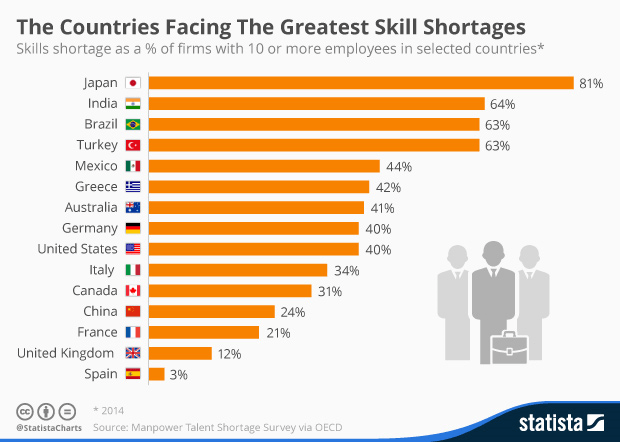
Many youth report facing multiple barriers to finding desirable and suitable job opportunities. Factors like information asymmetries on jobs and skills, and lack of guidance for setting realistic career goals and making professional choices, are holding back young Indians. 51% of respondents report that a lack of information about available job opportunities that match their skill sets is a significant barrier. Around 30% report a lack of access to any kind of counselling or mentoring opportunities. 44% of respondents view this as the most important factor in the demand-supply mismatch.
Youth

  1. Young Indians are interested in pursuing higher education and skills development

84% of respondents consider a post-graduate degree as a requirement for their ideal job, while 97% aspire to a degree in higher education. They are also keen on other forms of ongoing education, with 76% of youth reporting that they are very interested in participating in a skills development programme. Increased employment opportunities and higher wages are the main motivators for this goal.

  1. The private sector must do more to bridge the skills gap

The private sector needs to play a more active role in enhancing the capabilities and skills of India’s youth. India is faced with a paradox: there is significant youth unemployment, and yet the private sector bemoans a lack of adequately skilled and market-ready workers. Notwithstanding the government’s role in providing basic education and training, there is a significant need for greater private sector involvement. This will ensure that training initiatives are demand-driven and impart skills that match industry requirements.

YoungIndians 2

  1. India’s socio-cultural norms add further complexity

34% of the surveyed youth report that discriminatory and personal biases related to their marital status, gender, age or family background are a major barrier when looking for a job. 82% of female respondents said their ideal employment would be full-time, disproving the stereotype that women prefer part-time jobs. Similarly, despite the persistent view that household work and unpaid work are suitable and desirable for women, only 1% of surveyed female youth report this as being a desirable option for them.

  1. Social Media and the internet can play a bigger role in effective job-hunting

81% of survey respondents rely on media and internet sources for obtaining information about employment opportunities. The prevalence of social media and internet use among India’s youth presents an opportunity to expand their awareness about education pathways, employment opportunities, skill needs, and available skill development programmes.

 

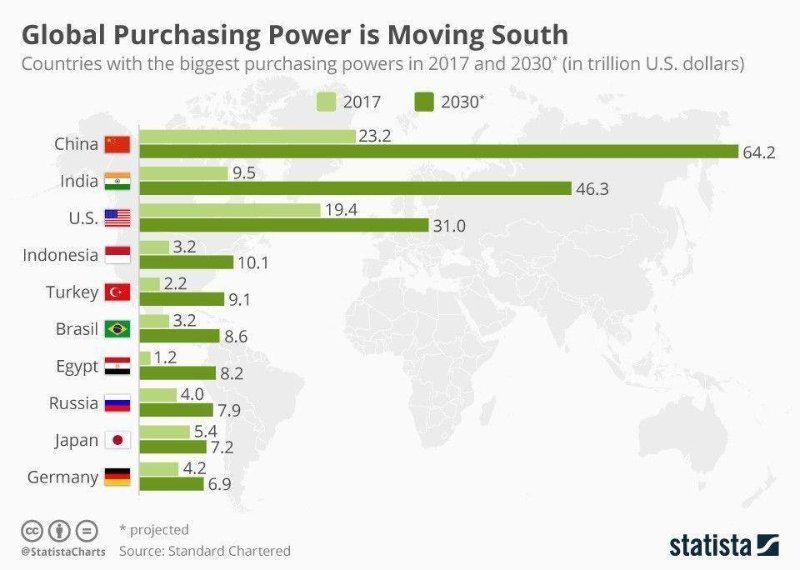
Global Purchasing Power is moving to Asia

The biggest nation on Earth, China, is expected to keep its top spot as the country with the largest purchasing power on Earth and is on track to almost triple its purchasing power by 2030, according to an analysis by the British Bank, Standard Chartered.

India will almost quadruple its purchasing power, moving to rank 2.

China will double the USA while India will beat USA by approx 50%.

asia map

In the case of Japan, the country is expected to lose 5 ranks and emerge as the country with the 9th highest purchasing power worldwide.

Developing economies like Indonesia, Turkey, Brazil and Egypt are set to move into ranks four to seven respectively, toppling the reign of countries like Japan and Germany, which are still growing their purchasing power but at a much slower rate. The U.S. is expected to only drop one rank to position 3 but is grappling with slower growth.

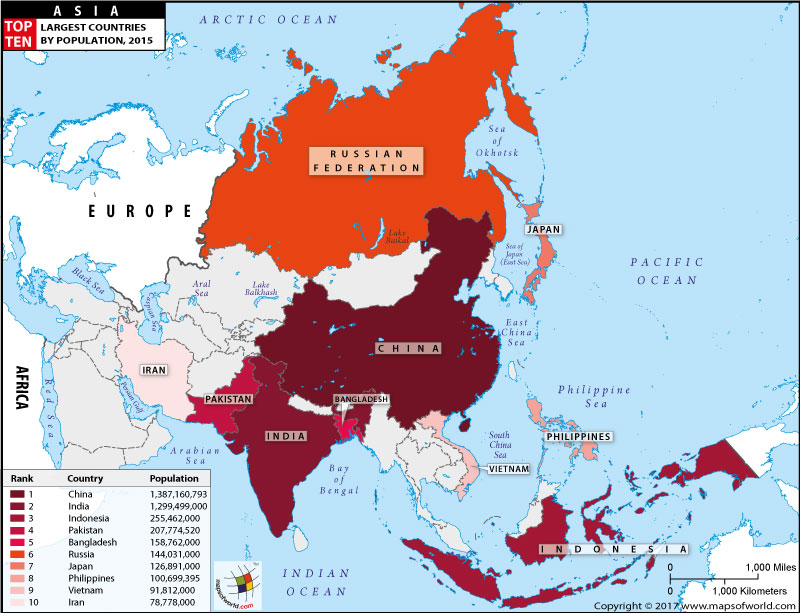
In summary – an amazing outcome for Asia – especially China, India and Indonesia.

asia map 2

How is your Asia engagement strategy going? Time to begin, change or reinvigorate? Get good advice so you avoid the mistakes of many before you.

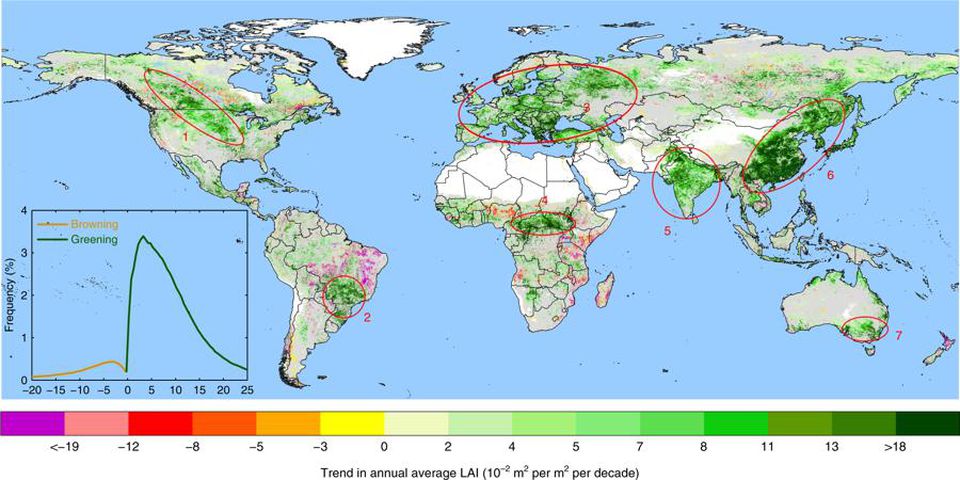
Let’s give credit where due – India and China are greening the planet!

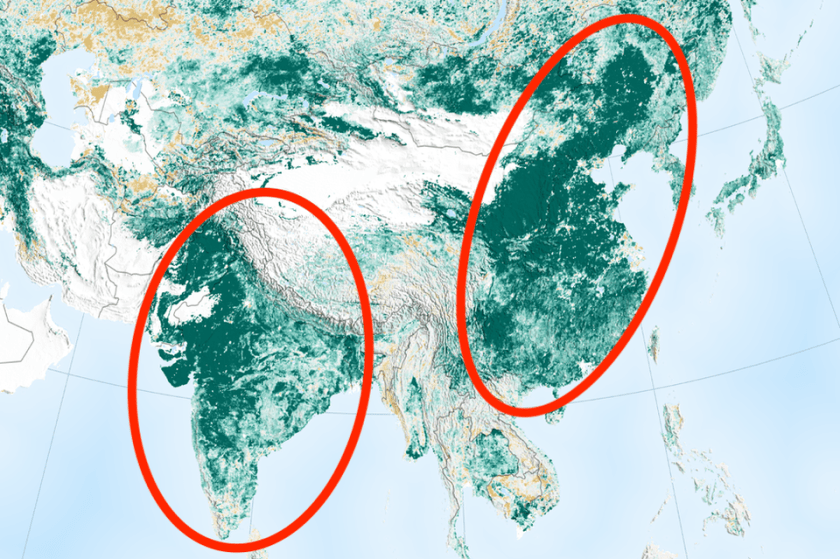
Congrats to India and China – these two are doing heaps to green the planet.

NASA discovered the good news – the world is a greener place today than it was 20 years ago. What prompted the change? Well, it appears China and India can take the majority of the credit.

The countries are responsible for the largest greening of the planet in the past two decades. The two most populous countries have implemented ambitious tree planting programs and scaled up their implementation and technology around agriculture.

India continues to break world records in tree planting, with 800,000 Indians planting 50 million trees in just 24 hours.

So – let’s give praise where it is due.

Green2

Megacities right on Australia’s doorstep – opportunities in Asia-Pacific

In 1900 only 15% of the globe’s population resided in cities. By 2008 over half of the world’s population lived in cities. The trend continues.

Megacities have 10 million or more people and the future growth is in Asia Pacific.

In 2017, Asia Pacific accounted for the largest number of megacities, with 19 of the 33 (58%). China and India are the regional and global leaders, with six and four megacities each in 2017, respectively. For India these are Mumbai, Delhi, Bangalore and Kolkata. Chennai will join them within a decade.

mumbaitrain

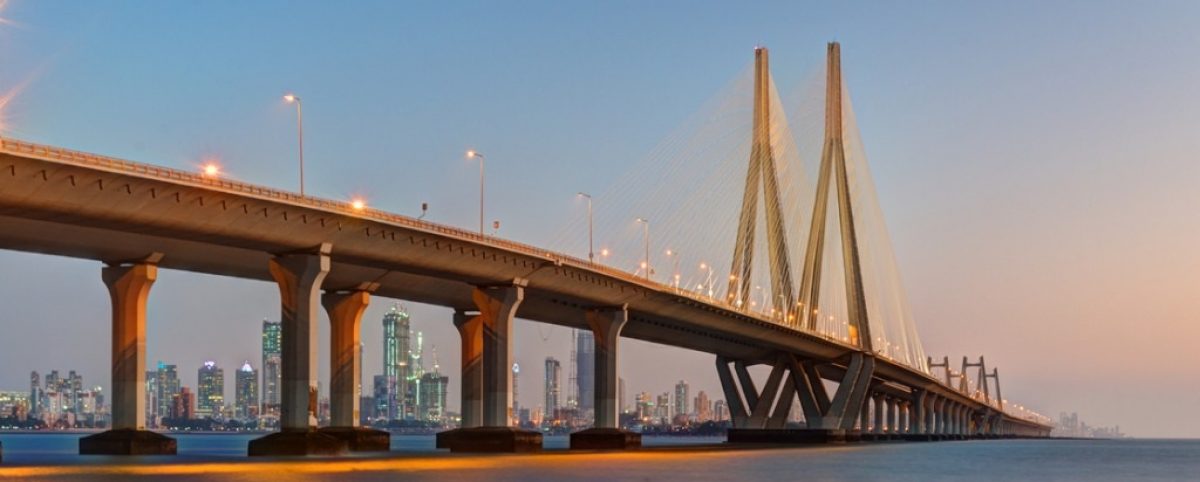
Pictured – Mumbai, one of India’s four Megacities

Jakarta, capital of Indonesia, (picture below) will replace Tokyo as the globe’s biggest city – 35.6 million by 2030.

jakarta2

Ageing is expected to have an impact on many key megacities in East Asia over 2017–2030. Growth in the share of over 65-year-olds will be particularly apparent in Seoul, and Chinese megacities such as Beijing and Shanghai.

The twin opportunities for Australia – become involved in the move towards “smart cities” and provide services for the ageing populations. It’s right on our doorstep.

The harmony of Kerala was so real

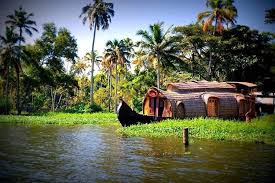
Experience Number Three – my series on India tourism. This one is in Kerala – Gods Own Country – we have been in the mountains, on the beach, we are in a floating hotel on the backwaters. Kerala is a long thin state on the south west side of the very bottom tip of India, so it is hot, tropical and amazingly friendly. One friend told me this is a legacy of always being a global trading centre and not a place of conflict. In the first evening on the backwaters – pull in for the night – the lovely sound (for Australian ears) of the top being popped off a bottle of beer – but there are some real spiritual sounds – the singing of Christian hymns comes from one side – the chant of the Hindus and the call to prayer of the Muslims – all at once – my friend says let’s get the leaders of the world here so they can see it is possible to be different but live in harmony. Ah, Kerala, well done!!

More tourism experiences in future blogs…

keralamt

When in India in a suit and tie, watch out for the Holi Festival!

Experience Number Two – my series on tourism experiences in India. This one was in Kolkata, lots of sweets, love the intellectual culture, last day of a business trip I have just one more business appointment and then on to the plane – but with an hour to spare I get my friend to take me to the museum home of the great Rabindranath Tagore – poet, thinker, philosopher – and we are on the second floor – I look out the window – the building is next to a university and has become surrounded by students – throwing pink purple blue and red powder over each other – Holi Festival has started – so we have to leave for the final appointment – walk through, so far so good, then two charming young students say “May we Sir?” with their powder – I am in India, I am here for the experience, so I say YES. Arriving at the appointment my host laughs and hugs me – and we remain strong friends.

More experiences of India in future blogs…

kolkata5

Yes Steve SIR!

In the last 10 years I have been to China once and India 7 times. Why? Both are exciting and the new thing. I choose India because it is more than a destination – it is an EXPERIENCE.

Experience Number One – is actually here in Australia, where I work as a volunteer helping Indian university students improve their employability skills. They are so polite. By contrast, Australia has a very informal culture where everyone is regarded as equal – old and young, rich and poor, powerful and not. First names are used everywhere – 10 year olds at my golf club often say “How was your game STEVE?” But Indians have a formal courtesy which is charming and it is the only time in Australia I am called “Sir”. I ask the students – can you adjust to our informal culture here and call me Steve? Their answer – yes we can Steve SIR.

More experiences of India in following blogs…Anna3