University students out of step with employers on what employers really want in new hires

A NEW survey has revealed the skills that employers value and how different they are to what university graduates think are important. The QS Global Employer Survey 2018 has highlighted the misconceptions students have about what skills employers want and the areas where there is a graduate skills gap.

For the report released last month, more than 11,000 employers were surveyed around the world and their answers were compared to responses from 16,000 prospective students.

aboriginal

A key finding is that students relatively overvalue the importance of creativity and leadership skills, and undervalue the importance of flexibility/adaptability and teamwork.

The development of soft skills, such as team-playing and resilience, had become almost as important as the technical skills and knowledge acquired during a degree. What are known as “enterprise skills” such as problem solving, communication, teamwork and digital literacy, were in demand.SwinJune

The skills employers ranked as the most important for graduates:

  1. Problem solving
  2. Teamwork
  3. Communication
  4. Adaptability
  5. Data analysis
  6. Resilience
  7. Organisation
  8. Technical skills
  9. Creativity
  10. Leadership
  11. Language
  12. Commercial awareness

The skills students thought were the most important:

  1. Creativity
  2. Organisation
  3. Problem solving
  4. Leadership
  5. Teamwork
  6. Communication
  7. Resilience
  8. Commercial awareness
  9. Adaptability
  10. Technical skills
  11. Language
  12. Data analysis

India Students

The biggest difference between the two answers was for creativity, which students placed as the most important skill but employers ranked ninth among their priorities.

This was followed by data analysis, which employers ranked highly as the fifth most important skill but students ranked 12th.

Students were also confused by leadership, which they ranked as fourth most important, but employers rated as 10th.

Employers also rated adaptability highly, in fourth place but students put this in ninth place.

The only skill to feature on the top three for both employers and students was problem solving.

The report suggests students around the world underestimate how much employers value flexibility/adaptability and analytical skills, as well as resilience. They wrongly assume creativity, leadership and organisational skills are more important.

Our Employability Skills Master Class helps students align with what employers want, and builds in the skills to thrive in the era of the Fourth Industrial Revolution.

cropped-steve22.jpg


My state of Victoria hits record export levels and is open for business

Forgive me for being parochial in this blog, but I just have to talk about my home city of Melbourne and our state of Victoria – so well known to tourists for the Great Ocean Road (pictured below).

greatoceanroad

Victoria’s exports have hit record levels and are still growing as the Victorian Government helps more Victorian companies break into global markets and create local jobs. Exports from Victoria grew 6.45 per cent to reach a record $51.6 billion in 2017-18.

Victoria’s services export performance has been particularly strong. Valued at $22.5 billion in 2017, it now represents more than 40 per cent of total Victorian exports.

This has been driven by sectors like international education, which has grown 98 per cent since 2012 to $9.8 billion, and tourism which is up 62 per cent to $4.8 billion over the same period.

melbourne

Medical technologies and pharmaceuticals, a key sector identified for support through the government’s $200 million Future Industries Fund, has seen substantial growth, with exports of pharmaceutical products surging 72 per cent in the past two years to $1.56 billion.

Victoria is Australia’s biggest exporter of food and fibre, another key sector the Victorian Government is supporting, with exports reaching a record $12.8 billion in 2016-17. Victoria now accounts for 79 per cent of Australia’s dairy exports, 52 per cent of animal fibre, 45 per cent of horticulture and 38 per cent of prepared foods exports.

Victoria’s export growth is even more impressive given it has come over a period when the state’s single biggest exporter, Toyota, ceased production, highlighting the diversity and strength of our export sector.

mcgmelb

The Victorian Government offers a range of services to help local businesses get export ready, prepare market strategies and understand regulatory requirements so they can start taking their products and services to the world.

Since December 2014, more than 4600 Victorian companies have participated in 130 government-supported inbound and outbound trade missions, resulting in more than $267 million of actual export sales.

The government has also grown Victoria’s network of international trade and investment offices (VGTIs) to 22, which is more than any other state, and put in place strategies to grow trade and investment with key markets including ChinaIndiaLatin America, and Southeast Asia.

So – looking for a dynamic, quality partner or location for business and education? Try Victoria!

Spur

Above pic – just one hour drive from Melbourne CBD is the beautiful wine and food area the Yarra Valley and one of the great forest drives, the Black Spur.

The Himalayas can show us a key difference between India and the west

Do Indians have a different world view and culture to the west? Of course, each country or region of the world has their own culture and differences exist – understanding and adapting to difference is one key to succeeding across cultures.

This simple statement about the Himalayas might help you see the difference.

If the Himalayas were located in the west, people would flock there for bungy jumping, extreme ski sessions, jumping out of planes and other extreme sports. For India, the Himalayas have been a location of contemplation, monasteries, thought and mindfulness.

alexander

I saw a similar point made using the example of Alexander the Great. The west admires Alexander as a person of action, conquest, growth and acquisition – while a hero in India could be a guru sitting in contemplation under a tree.himalayaMy point is simple – when we understand cultural differences we can then adapt our behavior and communication while remaining true to our own culture.



guru

Cultural generalisations can be helpful but remember they are just generalisations – there will be exceptions and culture is riddled with paradox. Many westerners are great contemplatives, while Indian history has many action heroes.

Finding the right words, the right you and making friends

Effective business leaders have the art of using the right words at the right time.

I like a combination of my grandmother and the Buddha for inspiration.

Grandma used to put it this way: “If you can’t say something nice, say nothing.” This is a wise caution against being too critical of others. She would have liked this quote from the Buddha: “If you know anything that’s hurtful and untrue, don’t say it. If you know anything that’s helpful and untrue, don’t say it. If you know anything that is hurtful and true, don’t say it. If you know anything that is helpful and true, find the right time.”

This becomes an effective restraint against communication mistakes, but how can we project ourselves and connect with others?

Brand

By changing the way you see yourself, and changing the way others see you, your personal brand and real leadership can develop and inspire others.

The first big change is to accept that in a modern world it is not enough to be very good at what you do – whether your skill is a profession, science, IT, engineering, health, a trade, finance or consulting. In addition to being the best at what you do, you have to have an impact on those you serve and this comes down to improving your communication and leadership. In that way, you create a positive personal brand.

You can improve communication by studying how business communicates, but also making big advances if we combine this with the wisdom of the ages, with the thoughts of great thinkers and spiritual leaders.

One of the barriers is that we make assumptions about people that often turn out wrong. If we assume a person is not interested in us, we become tongue tied or stay away – it is the assumption that is the barrier.

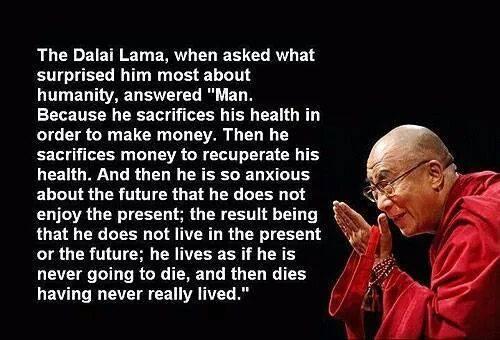
There is an alternative and I could find no better source than this quote from His Holiness the Dalai Lama: “Wherever I meet people, I always have the feeling that I am encountering another human being, just like myself. I find it is much easier to communicate with others on that level. If we emphasise specific characteristics, like I am Tibetan or I am Buddhist, then there are differences. But those things are secondary. If we can leave the differences aside, I think we can easily communicate, exchange ideas and share experiences.” This is a great soft skills lesson.HHDL quote

This western and eastern thought process was so beautifully developed by a western nun and great author in the Tibetan Buddhist tradition, Pema Chodron, who said: “When you open yourself to the continually changing, impermanent, dynamic nature of your own being and of reality, you increase your capacity to love and care about other people and your capacity to not be afraid. You’re able to keep your eyes open, your heart open, and your mind open. And you notice when you get caught up in prejudice, bias, and aggression. You develop an enthusiasm for no longer watering those negative seeds, from now until the day you die. And, you begin to think of your life as offering endless opportunities to start to do things differently.”

But this attitude needs to be combined with some of the communication lessons from corporate communication, showing how we can be more successful making new friends and lead by:

·      Listening to people

·      Speaking in ways they understand

·      Not being scared of being different

·      Creating something interesting to do

·      Making relationships fun

I know you can do it.

“The Pitch” – the next big thing for Indian students

What reality are students facing on graduation? Employers are impatient and demanding in job interviews, often starting with a blunt “Why should I hire you instead of all these other people?” and ending quickly if the answer is not convincing. This is particularly the case in India where almost half of the population is under 25.

On top of this, students who want to move into startups and new businesses will find financiers and advisors similarly impatient.

The reality for student graduates is they are entering a fast-moving world that demands to be convinced, right now. Can they do the convincing?

Repeated studies by employer groups suggest students are not at all convincing, not articulate, inexperienced in teamwork and show little leadership aptitude. How could they be, when most universities do not teach these skills?

Can we solve this problem? Can we create a generation of graduates who are job ready, who can hit the ground running?

The answer is “yes”, and the key to this is not so much the old fashioned soft skills training programs but it is found in the exciting world of “pitching”.

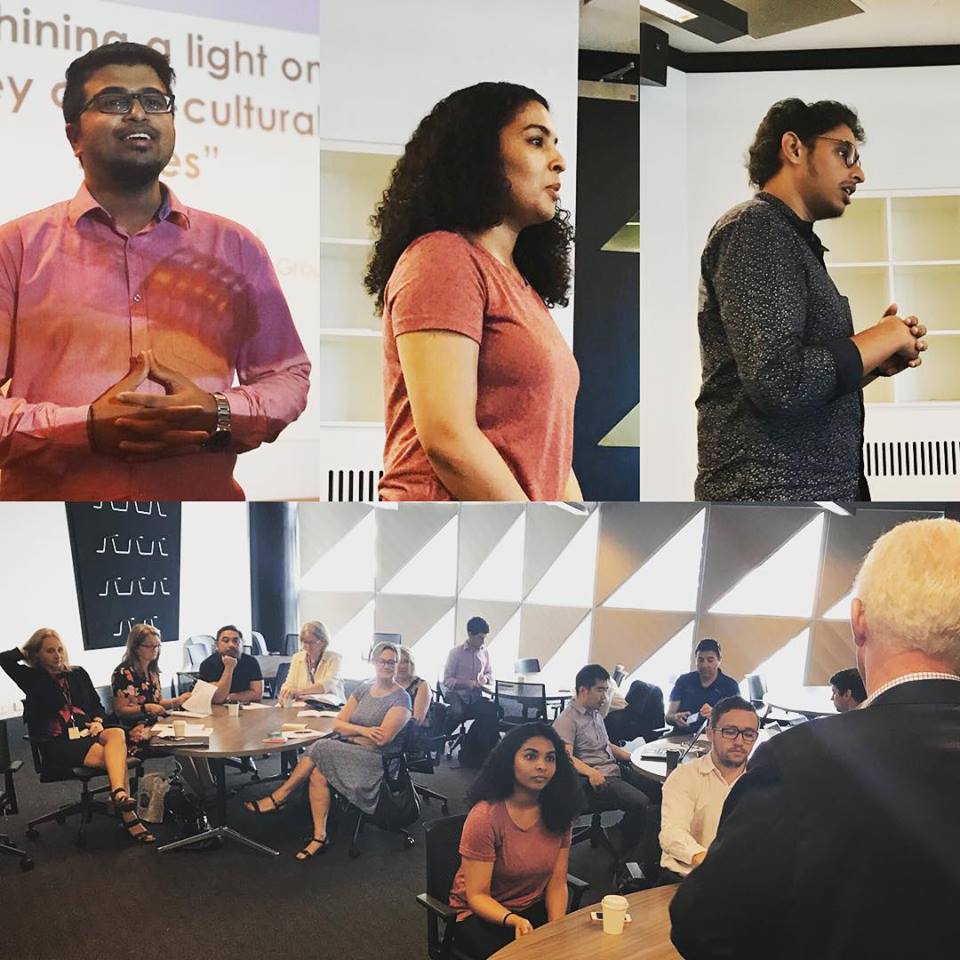
In the last quarter of 2017, several parties combined to conduct an Indian Student Employability Pilot Program in Melbourne. These included Australia India Business Council, ISANA International Education Association and my company EastWest Academy Pty Ltd.

The objective was to test whether a short intervention could add significant value to the students in terms of: Presentation skills (pitching); Interview techniques; Linked In profiles; CV’s.

The program included three group sessions plus interaction via WhatsApp, email and personal contact. To add real zest and motivation, the final session was an opportunity for the students to pitch to the board of ISANA International Education Association – a challenging but exciting prospect to convince influential leaders.

By focusing our intervention on a rapid program of developing a dynamic “pitch” for the forthcoming board meeting, the students had a clear goal, timeline and motivation.

Outcomes were exciting to experience. The pitches were competitive, with much improved clarity and pacing, slower speech and clear transmission of information. What was really exciting was the students quickly learned that any claim they make needs to be supported by proof – generally one additional sentence.

In addition, the presentation to the board was interactive and showed a good ability to handle tricky questions and effective use a two-part answer – if the question is about weakness, outline what that might be and then state what steps you have taken to improve. Or if about strengths, again, outline what that might be and then show proof of when you used that strength.

The key to this success was the excitement around “the pitch” – this is what the students wanted, they saw it could work for them and they put energy and skill into making high impact pitches. They are ready for the future.Never give up

Can India help solve the western disease of unhappiness?

It seems many in the west struggle to live with wealth – there is evidence of considerable dissatisfaction, unhappiness and medical conditions that impact a sense of well-being. If you doubt that there is mental confusion in the west, just reflect for a moment on the western phenomena of “road rage”, surely the product of unhappy minds.

Could some of the answers to this western dilemma be found in India?

Prayer2

From Sri Sri Ravi Shankar and many others, including Buddhist thinkers, we learn that our attitude to events and people around us is the most important factor in our mental well-being. The west largely seeks this well-being through events and others, not through self contemplation.

People in the west have extensive material wealth but little focus on the mind and the spirit. Largely as a result, they continue to seek lasting happiness from things outside of their own mind – happiness through a job, travel, possessions, plastic surgery, new partner, bigger house and so on. Buddhist teachers remind us all these things can be fine – so long as we have a stable sense of inner well-being. That is, lasting happiness comes from within.

namaste

The Buddha taught in India that looking for lasting happiness outside of our inner life results in attachment (where we want more and more and fear losing what we have) and in aversion (where we blame others for our unhappiness). You can see how “enough is never enough” would drive these minds.

Another western phenomena is “busyness” which is evidence of impatient minds and the drive for external sources of happiness.

India has long taught patience – living with adversity, accepting the flaws of others – whereas the west is so driven that patience is a word rarely used.

himalaya

If the Himalayas were located in the west, people would flock there for bungy jumping, extreme ski sessions, jumping out of planes and other extreme sports. For India, the Himalayas have been a location of contemplation, monasteries, thought and mindfulness.

It has long been said that the ultimate western hero was Alexander the Great who conquered more than anyone before him – while a hero in India could be a guru sitting in contemplation under a tree.

In this comparison, could we find one key to happiness in the wealthy west?

10 things that shape the mind of Australians

I am often asked by Indians what is it like to be an Aussie? Why are there so few people in Australia? It has made me reflect on what is it like to be an Australian, the country of my birth? Here are some thoughts:

An Island Home

Australia is the biggest island on earth. We often talk about the “tyranny of distance” as a factor in our history and personality – so far from anything, isolated. But isolation probably makes us feel vulnerable and as a result we have always sought big “friends” (Britain, and then USA).

Personal Space

road

It is a long way between anything in this land. You can drive for many hours without seeing another car or another person. Our feeling of space explains why Aussies visiting India or Europe soon long for the “peace and quiet” of home.

Stars

southerncross

Drive for an hour or two out of the light of our cities and the stars seem to go on forever and our beloved national symbol – the Southern Cross – is a comforting sign of being “home”. The Southern Cross is five stars – if joined by a line they would make the shape of the Christian cross. Seen from here, the Milky Way is ever present and so dense with stars it can look like a white haze. In Australia, the universe makes you feel small and vulnerable – one insight into the Australian world view.

A Fair Go and Tall Poppy Syndrome

fairgo

On this dry, isolated island home, we are all in this together. As a result, Aussies grow up believing in a fair go for all, in equality of opportunity, in support for those struggling to make it and in not standing out too much (the tall poppy syndrome). If you get too loud or too successful, we will cut you down (as in the flowers).

Direct and economical

cricketgo

From our western origins as convicts or free settlers in a harsh environment, our speech became direct and to the point. It’s too hot and dry for idle chatter. Australian cricketers are direct and can be aggressively so – which in truth is much the same for all of us. We admire those who face our directness and “can take it”.

The original inhabitants

aboriginal

The British who settled here decided there was no-one here before they came – “Terra Nullius” is a Latin expression meaning “nobody’s land”, and is a nasty principle sometimes used in international law to describe territory that may be acquired by a state’s occupation of it. I don’t like it and nor do most Australians and it was not overturned until 1992. Thanks Britain! Meantime, a lot of harm was done to indigenous peoples. But many indigenous are successfully living as teachers, nurses, doctors, skilled workers. But it is not our style to celebrate this (see “Tall Poppy”).

Urban fringe

mcgmelb

Most Australians live in cities that cling on or close to the coast. These cities are stunningly good – well laid out, everything works, they have sophistication and a quality of life envied around the world. We have culture, sports facilities and urban gardens.

“Dormitory” suburbs

suburbs

When work is over, Aussies rush to their homes, close the door and do not go out again until work tomorrow. The quality of our homes plus the amount of technology to play with is among the best in the world.

Multicultural

multicultThe Chinese came here in the 19th century gold rushes. After World War Two, it was the Greeks and Italians who came to drive manufacturing in our cities. Then the Vietnamese, Serbians, Croats, Fiji Indians, Africans, South Africans, New Zealanders and Pacific islanders. Now – China and India vie for our leading source of migrants. We live side by side, mostly in harmony. We travel together, celebrate each other’s festivals, eat food from all countries…but in the back of our mind is the fragile land – and a kind of primal fear that too many migrants could spoil it.

Worldly

Yet the paradox of all the above is that Australians are not insular, we are outward looking, mostly well informed about the world and we travel a huge amount. But it is always comforting to “come home”.

There is such a thing as “Indian Time”

Different cultures can perceive time in different ways. In the west we see time as sequential, a straight line, whereas India sees time as synchronic, they see the past, present and future as interrelated.

Why do we need to know this? Knowledge of the culture of others is not about making judgments of others – rather, it helps us adapt to differences.

In a nutshell, this western approach to time explains why we are always rushing about, completing one meeting and rushing on to the next, while your Indian host seems relaxed, not in a rush, dealing with many other things while meeting with you and so on.

The Indian view of time partly explains the seeming “chaos” of Indian conferences – people constantly leaving or entering the room, private meetings can distract your attention and of course mobiles will ring and will be answered. All of this can be confusing for westerners, yet for the Indians, this is just a normal situation.

In a business meeting, the Indian you are talking to might also be signing letters, taking messages from staff, handling calls and seemingly not paying attention – but in fact knows exactly what you are saying despite what westerners would see as interruptions.

It is important for the visitor to adapt to this difference – especially on business visits. For example, filling your day with meetings could mean you miss the real opportunity, such as towards the end of a long meeting, your Indian host might want to introduce you to a superior or a friend in another company – this is a sign of your acceptance, the meeting has gone well, and they are honoring you. Without understanding this difference, you rush off and miss the opportunity.

Where Australia’s ‘An India Economic Strategy to 2035’ missed the point No. 1 – the threat to education is real

Australia finally has ‘An India Economic Strategy to 2035’ which is a good thing, with trade now declining to around A$14 billion.

A big part of that trade is education, with Indians big users of our universities and colleges.

The strategy mentions “visa employment conditions” as a potential threat – it should have been stronger. Changing visa conditions have had the intended consequence of employers now being uncertain and scared to offer employment to overseas graduates.

This is bad for Australia long term. Australian governments have one department discouraging Indian students (immigration) and the rest of the country hoping we can get more – time for the government to step in.

But even worse is that Indian graduates are not prepared for employment in Australia – and the report missed this key point. Their CV’s are not up to scratch, their English is difficult to understand, few have learnt presentation skills and their self descriptions often miss out their most attractive employment qualities. From our pilot study we know that these things can be quickly fixed, giving Indians a real chance of getting the jobs they want.

If this employment mismatch continues, we will have thousands of Indian graduates of Australian universities taking unskilled jobs – and word will get back to India – “don’t come to study in Australia because you will not be offered a job”. 

The report did call for our universities and businesses to work together to provide employment for students while they study – this is good. But the report made no mention of how unemployable these students are when sitting opposite corporate recruiters.

Missing this point was a big miss by the report. In addition to fixing the visa debacle, the government urgently needs to call the universities in, demanding a solution on employability skills.

Otherwise our trade will decline even further.

Australia finally has a strategy to build relations with India – but detail and time will tell

At last! Australia has ‘An India Economic Strategy to 2035’ — let’s hope this will have an impact and lead to change.

The strategy document noted that current trade with India is around $15 billion – it should have lamented this as a pathetic failure of previous initiatives. In contrast, current trade with China is $200 billion.

The report talks about several priority areas but only time will tell if the detail and approaches are right.

It misses on not placing enough emphasis on cross-cultural understanding. This is Australia’s biggest failing and underpins our poor outcomes with India – we just cannot talk to each other in a way we both understand.

The report also misses some strategic points – while it talks about declining US power in the region it could acknowledge that India has never understood our close alliance with the US. Nor does India have Australia’s (US based) global focus that we have to boost democracy etc. India is far more accepting of the world as it is. To know this is to have better diplomatic (and trade) relations.

It is also light on detail about how to benefit from the reach and connections of the 700,000 or so Indians who have migrated to Australia. But further focus and research will no doubt come from the report.

I really like that the report noted the Indian opportunities for Australia “would not fall into its lap and that the government would require a sharper national focus on India, an unambiguous commitment by Australian business and a deeper understanding by both government and business of the magnitude of what is unfolding in an Indian market place which will only get more crowded”.

More to come…

http://dfat.gov.au/geo/india/ies/index.html