
Can renewable energy vastly improve incomes and jobs for Australia’s First Nations people?

Can renewable energy vastly improve incomes and jobs for Australia’s First Nations people?

It seems the two might be about to come together.

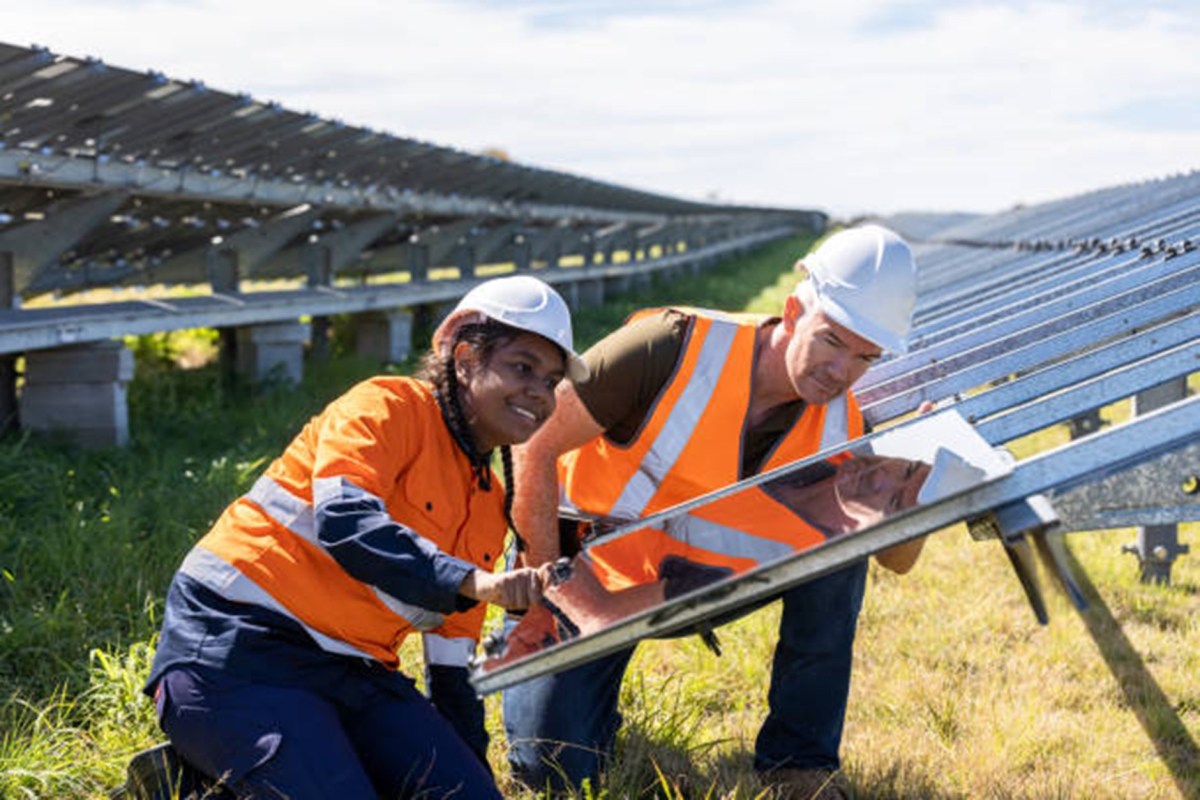
Australia’s plentiful solar and wind resources and proximity to Asia means it can become a renewable energy superpower. As the renewable energy rollout continues, Aboriginal and Torres Strait Islander people could benefit.

Renewables projects can provide income and jobs to Aboriginal landowners. Access to clean energy can also help First Nations people protect their culture and heritage, and remain on Country.

It seems Canada and the United States are already on this path.

The Australian government is developing a First Nations Clean Energy Strategy and has sought comment on a consultation paper. Submissions have closed, but If, like me, you feel strongly about the issue, have your say to Government and to MP’s.

This could be a gamechanger for Australia.

As an “energy superpower”, selling power to India and Asian neighbours, we make a difference for them, gain new export markets and create a big shift in how Australia is perceived in the region.

By speaking up, you can help our government do what is so obviously the right thing.

Two of the best quotes you will ever read about India

INTO INDIA is always finding new ways to promote India and build understanding of how to connect with this great country.

But, it has all been said before – and better than I could ever say it.

Two very famous westerners made powerful and personal statements about India, and I learnt from them both.

The great twentieth century western scientist, Albert Einstein, had this to say about India: “We owe a lot to Indians, who taught us how to count, without which no worthwhile scientific discovery could have been made.”

And the American great, Mark Twain, who gave the world so much in terms of easy-to-understand wisdom, said: “India is the cradle of the human race, the birthplace of human speech, the mother of history, grandmother of legend, and great grandmother of tradition. Our most valuable and most instructive materials in the history of man are treasured up in India only.”

What do you think?

The bridge that is transforming Mumbai

The last time I went from south Mumbai to have dinner with friends in Navi Mumbai, the trip took three and a half hours – making us 90 minutes later than the expected two hour trip.

Today you can do this trip in 20 minutes.

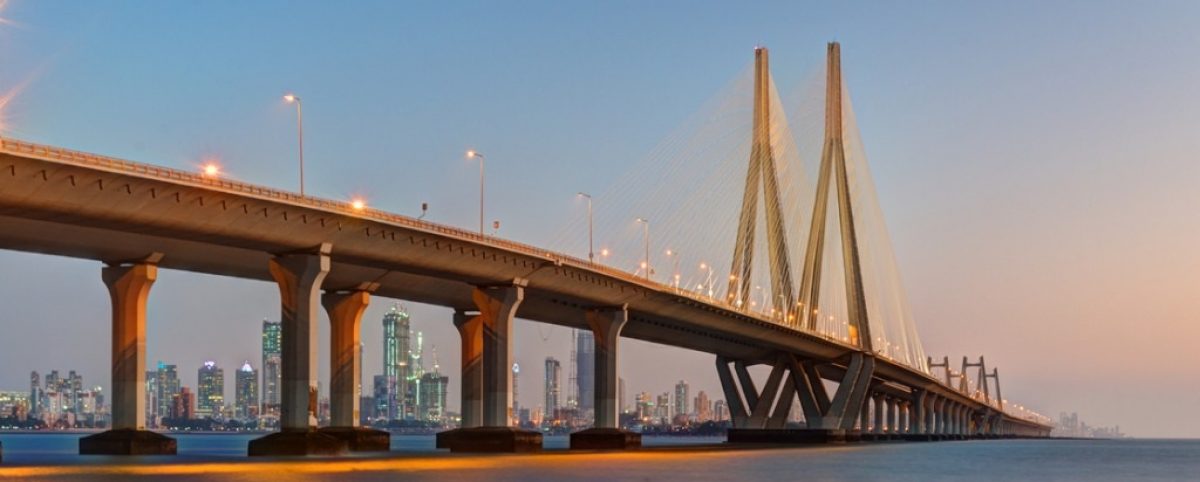
Prime Minister Narendra Modi inaugurated the Mumbai Trans Harbour Link (MTHL), the country’s longest sea bridge, on Friday. The sea bridge connects South Mumbai to Navi Mumbai and will reduce the current two-hour journey to just around 15-20 minutes.

While inaugurating the bridge, PM Modi (who loves to paint the big picture) said, “This is proof of our resolve that for India’s development, we can take on even the ocean and break the waves.”

The 21.8-kilometre-long bridge will enhance connectivity to both Mumbai International Airport and Navi Mumbai International Airport, reducing travel time from Mumbai to Pune, Goa, and South India. Additionally, it will improve connectivity between Mumbai Port and Jawaharlal Nehru Port.

Things are changing fast in India – perhaps this is your year to find out what this might mean for you?

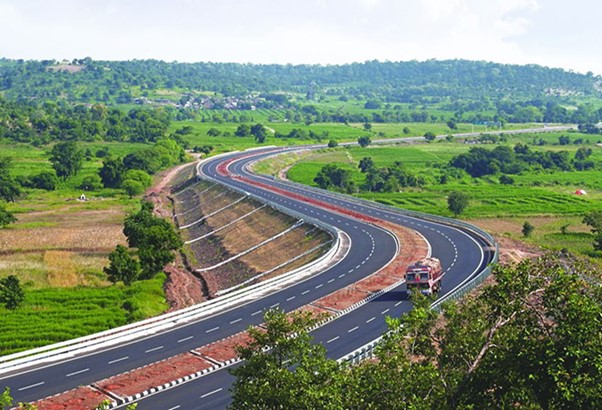
India’s “Look East” turning into railway and highway linkages

India first adopted “Look East” as a foreign policy in 1991 – but in true PM Narendra Modi form, he changed the name to “Act East” – and action there is. Two main projects show how change is coming.

As 2023 draws to a close, a decade-old Memorandum of Understanding (MoU) between India and Bangladesh, to set up the first Indo-Bangla international railway connectivity in India’s Northeast, has found fruition in the recently launched Akhaura-Agartala cross-border rail link.

Inaugurated digitally by Indian Prime Minister Narendra Modi and Bangladesh Prime Minister Sheikh Hasina, this railway connects, Agartala—the capital city of India’s Northeastern state, Tripura—with the Akhaura upazila in Bangladesh’s Bahmanbaria district. The connectivity through Bangladesh helps bypass the long, narrow, and congested Siliguri Corridor, also known as the ‘Chicken’s Neck’ which connects the Northeast to India’s mainland. In effect, this reduces the traveling distance from India’s Northeastern states such as Mizoram, and southern parts of Assam to Kolkata. For Tripura particularly, the distance to Kolkata by rail is reduced from 1,600 km to 500 km and the duration is reduced from 31 hours to 10 hours, approximately.

In another major “Act East” development, on the side-lines of the recently concluded 12th Mekong Ganga Cooperation (MGC) meeting in Bangkok on 16 July, Indian External Affairs Minister Dr. S. Jaishankar met with his Myanmar counterpart U Than Swe to discuss regional connectivity initiatives, with particular emphasis on expediting the India-Myanmar-Thailand Trilateral Highway (IMT-TH) project.

The IMT-TH project follows a proposed plan that starts from Bangkok and passes through cities like Sukhothai and Mae Sot in Thailand, and Yangon, Mandalay, Kalewa, and Tamu in Myanmar before reaching India. In India, it is likely to pass through Moreh, Kohima, Guwahati, Srirampur, Siliguri, and Kolkata, spanning over 2,800 km. The longest stretch of the highway will be in India, while the most minor road section will be in Thailand. Thailand’s Vice Minister of Foreign Affairs, Vijavat Isarabhakdi, stated in a recent interview that most of the project’s work in Thailand is over. The Indian counterpart also mentioned that around 70 percent of the work is complete. Upon being approached, Aung Naing Oo, Myanmar’s Trade Minister, revealed that most of the highway was constructed, spanning 1,512 km. The contractors will complete the remaining sections within three years.

“Act East” looks like building new connectivity between Southeast Asia and South Asia – and that strengthens the region.

How to Create an Effective Cross-Cultural Training Program

As Australia builds closer relations in Asia while India strides into the western world, it becomes more important than ever that employees have cross cultural knowledge.

My reading on cross cultural training programs is that the best focus on the assimilation of workers from a variety of cultures into a common corporate culture (sometimes called “cultural congruence”). The best also teach “cultural differentiation” – how to maintain your own culture while recognizing the value of others. That has been my mantra – stay true to your culture while adapting where you can.

This messaging has to start from the CEO and flow down, improving internal and external cross-cultural communications.

But beware – many existing programs are basically just etiquette training—such as whether you should bow or shake hands—and do not deal with the bigger issues.

Also beware of just training people in the basics such as Americans do this, Indian do that, Aussies do something else. Interesting and useful – but does not prepare your ream for behaving in cross culturally different situations. This takes many employees outside of their comfort zone.

Boeing: A Mixed Approach

At Boeing, the world’s largest aerospace company with 330,000 employees in 28 countries, leaders use a mix of approaches and tools—from online modules to afternoon seminars to one-on-one training—to help staff become more culturally aware. All employees are trained using GlobeSmart, an online resource developed by Portland-based Aperian Global. Workers and their families embarking on overseas assignments are given one-on-one sensitivity training and cultural orientation sessions.

The goal is to make sure employees are “not just landing in a country and getting introduced for the first time,” says Lisa-Marie Gustafson, SPHR, a talent manager for Boeing’s supplier management group.

Boeing also arranges “lunch and learn” cultural talks, employee rotation programs to allow overseas staff to work for nine to 18 months in the U.S., and diversity summits twice a year in U.S. locations.

Good training programs address subtle differences between people of different cultures. How is trust built differently in this culture? What is the most constructive way to provide criticism?

SAP: One Size Doesn’t Fit All

SAP is a software giant based in Walldorf, Germany, with locations in 130 countries. It has an elaborate diversity program, which includes cultural sensitivity training.  

Employees embarking on overseas business trips can access online cultural briefings. All SAP employees can take classroom-based training and receive interactive instruction. The company uses a mix of internal and external trainers and customizes its training depending on the location destination and employees’ needs.

Professor Andy Molinsky and “Global Dexterity”

I am a big fan and user of programs from Professor Andy Molinsky from Brandeis University – he claims the best training programs should also teach employees how to act in cultural situations that make them uncomfortable. That is, training would ideally teach employees “global dexterity”—which is also the title of Molinsky’s book.

In his programs, a student from Asia who may be culturally programmed to remain quiet unless she’s asked to speak, would practice speaking out at meetings without being prompted. Or an American who’s uncomfortable giving blunt feedback could practice that skill. Molinsky says the idea is for students to be put in realistic situations and to benefit from feedback and analysis in a supportive environment.

Making a start

Of course, for most corporations the first steps in building effective cross cultural training come from knowing your employees and assessing current attitudes.

You can choose to start with a simple program – creating a workplace committed to treating every employee, customer and client with respect. Of course, the program should define what that means—such as using no racial terms, jokes or language, even if such conduct is legally permissible in a particular country.

Tesla shows why India is the number one market right now and for many decades

The beauty of scale and economic dichotomy. 20% of Indians are growing their incomes and about to increase discretionary purchases – this 20% is a great market of 280 million people.

Mugunthan Siva, Co-Founder of India Avenue Investment Management gives some valuable insights into how this scale and dichotomy works.

The other 80% of the population of 1.4 billion is the “factory of India”, which allows companies like Tesla to manufacture more cheaply out of India. Plus of course the rural population with increasing productivity.

The real beauty of this – as employment and skilling in this segment increases, it will also start participating in more consumption.

A beautiful summary of why India today is the market of choice.

Read more detail here:

https://www.businesstoday.in/technology/news/story/tesla-to-set-up-factory-in-india-within-2-yrs-start-ev-imports-next-year-406499-2023-11-21

Searching for India – during the joyous explosions of Diwali

I did not know about the Diwali Festival – this is one of my first visits to New Delhi and I am staying in the beautiful old art deco Taj Ambassador Hotel, close by to the Khan Market and, these days, to a Delhi Metro station. The hotel is an oasis of calm.

It’s the end of a busy day and I retire early, drifting off and then sitting up startled by the massive explosion outside – it seems to be on the road in front of the hotel.

I put on some clothes and race down to reception and breathlessly ask: “did you hear that! What is it?” The reception staff are beaming, their joy is obvious. “Sir, happy Diwali – Indians let off firecrackers to celebrate.” I ask: “At this time of night?” She replies: “Sir, it could be at any time, day or night, we never know – but there will probably be more tonight.”

Since I cannot sleep, I check out this Diwali festival. It is beautiful – if a bit loud.

There is nothing in India more joyous than the annual Diwali “Festival of Lights” celebrating the triumph of good over evil, light over dark and knowledge over ignorance. Surely this optimistic and hopeful theme is relevant to our world today?

Families come together for meals and exchange of gifts such as sweets and dried fruits. Children look forward to Diwali in India in much the same way as they look forward to Christmas in the west – with great excitement and anticipation.

In towns and cities, public buildings are lit up and throughout India homes are surrounded by candles (diya), while people wear their smartest new clothes, and the atmosphere is one of hope. At the end of the day, the sky is lit up by firecrackers and sparklers.

People express their thanks for things like good health, wealth, knowledge and peace.

At heart, Diwali is an expression of goodwill to all people, and so its public face is not about the voice of one religion. One of the few festivals to be held across the whole of India and touching all 1.4 billion people, Diwali cuts across religions and is celebrated by Hindus, Jains, Sikhs and Buddhists.

Diwali is really a reminder of the beauty of this world and all things in it – what a great message of hope and optimism this is for all our children.

A final note on Diwali

Although my first encounter with Diwali – that explosion in Delhi – filled me with feat in this era of terrorism, yet with all that, Indians freely continue to celebrate as they always have. I admire that.

I was in Jaipur (the pink city) during one Diwali and vendors were selling firecrackers on the pavement – they were stacked about a metre high, and one vendor had about 10 metres of these giant explosives. Bigger than you would have seen when firecrackers were legal in the west. The vendor was happily sitting on top of the lethal pile, smoking a cigarette! Nobody but us noticed or cared. As I learn about India in my search, I am not suggesting selling firecrackers on the footpath, but maybe we can learn again to relax a little in the way Indians do.

As the influence of India grows and as the Indian diaspora in many countries also expands, I hope that the beautiful Diwali might become a truly global celebration of all that is good in us.

This is one of my first lessons as I continue my search for India.

5 reasons to join a trade mission to India

Many people report having “gone it alone” to India, had wonderful experiences, came home with bundles of signed MOU’s – and then nothing happened. Wrong people? Wrong profile? Missed the market?

There are 5 main reasons a trade mission will work better for you:

With pre-mission briefings, backgrounders and just exchanging experience with others on the mission, you will know better than to sign up with the first person who says “yes” (did you know in India it is rare to say “no”?)

On a mission the Indian audience notices you – you will be connected with the government and business community (did you know that government and business are incredibly closely integrated in India?)

You will be able to work positively with others, leverage skills and knowledge of the way the market works in India – including expertise of Austrade and State Government Business Offices (did you know India is a “collective” culture and you need the right point of entry?)

Each day of a trade mission is learning – you will learn first hand from others and exchange your ideas with them (did you know most products and services need some form of adaptation to succeed in India?)

You will gain some valuable insights into the culture and history of this proud nation, so rather than filling your day with endless meetings you will be able to spend some time exploring India (did you know what a huge impact you can have simply by showing interest in the history and culture of India?)

As they say – If you can make it in India, you are ready for anywhere.

Take a look at this forthcoming mission from some experts:

https://www.linkedin.com/feed/update/urn:li:activity:7123800940507267072

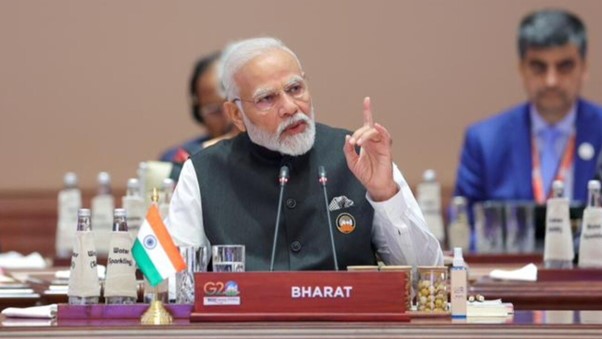
Women, the Global South and inclusive development clear winners of India leading the G20

In the sense that the G20 is mainly about global conversations and agendas, India succeeded in directing those conversations and setting out an agenda which will be picked up by the next G20 presidency country – Brazil.

India’s G20 presidency was focused on sustainable and inclusive growth, including women-led development initiatives.

India also shifted the G20 somewhat from a fundamental economic platform, to addressing the challenges of climate change, disasters, growing water and energy insecurity, democratic backsliding and gender inequality.

India was also successful in building consensus – something which has been a challenge over the years. It welcomed the African Union as the newest member and signalled the need for great inclusion of countries, including the Global South.

Drawing women-led development into the mainstream was a priority of India’s presidency, resulting in the G20 announcing the creation of a new Working Group on Empowerment of Women to support the G20 Women’s Ministerial that will start during Brazil’s term.

Indians embraced and celebrated the G20 – and India as president clearly made a positive difference.

Can kinder communication restore respect and civility?

Something has changed in how we communicate with each other. Like the pandemic, it has infected Australia and might have spread to India.

Just for ease, some commentators call this change “Trumpification” of our public conversations. Of course, it is not just Trump, it is also an outcome of spiteful and hateful social media. We have forgotten how to be respectful and kind.

It is too easy to blame America for our own problems, but we have seen over there that trading in hate and fear – combined with deliberate misinformation – creates divisions that might be hard to heal.

Social media has encouraged and built extremism, has destroyed much of our civility and is weakening respect, integrity, trust and social cohesion.

It is a stretch to blame Trump for all of this – much as he has deliberately practised anger and misinformation – and we must acknowledge that what we are seeing publicly now is what has laid dormant in our cultures probably for all time. Extremism and hatred are now empowered and public.

Long term, it will be difficult to turn around the negativity unleashed mainly by social media. It is hard to stop the toxic infection of how we treat each other. But it is worth having a go.

Mallika Bajaj and her company, Little Yellow Beetle, based in New Delhi, is helping clients create kinder content. It is one step in the right direction and might just restore respect, thoughtfulness and caring to our public discourse. I hope so.

https://www.littleyellowbeetle.com/

Here is an earlier discussion I had with Mallika Bajaj.