
What does the election of Donald Trump as the 47th President of the United States mean for India?
In the past Trump has taken steps to address the US trade deficit with India, like increasing steel and aluminium tariffs, removing GSP benefits, calling out India for high tariffs on motorcycles, dairy, technology items and also pushing for a much more stringent IPR regime.
INTO INDIA provides 9 reasons India is well placed for the next four years of President Trump:
- The Indian economy grows due to domestic demand – not trade
India’s biggest advantage in any global trade war is that it relies much less on trade than most countries – India is flat our trying to meet growing domestic demand, and with a young population this will likely continue.
But India’s largest trade partners are China and the USA – roughly equal. So, a trade feud between those two will have an impact in India.
2. India has the advantage of a trade surplus with the USA
Again, here India is better off than most as it has a trade surplus with the USA.
3. India is seen as an alternative supplier to China
Trump’s administration has talked about imposing tariffs of up to 60% on Chinese imports, potentially damaging China’s competitiveness in the US market. In this context, India stands to benefit as an alternate supplier for some of the products where China has dominated in the past, such as electronics, textiles, pharmaceuticals, and more.
The US imports huge volumes of merchandise from China, such as smartphones, mechanical appliances, toys, furniture, and plastics. India’s share in these sectors is currently low, but the imposition of high tariffs on China could make Indian exports more competitive. For instance, India’s share in the US smartphone market is only 3%, compared to China’s 27%.
Similarly, the pharmaceutical sector, where India already has a strong export presence, stands to benefit from ‘Trump tariffs’. India’s pharmaceutical exports to the US already account for a considerable share, and with China’s market share likely to shrink, India could see even more demand for its generics and other pharmaceutical products.
4. Indian renewables might benefit from Trump’s “climate scepticism”
Another area where India could see an uptick in exports is the renewable energy sector. Trump’s proposal to cut green energy subsidies in the US may create a gap that Indian green energy exporters could fill, particularly with photovoltaic cells used in solar panels.
5. India has a counter to the 10% tariff challenge
However, Trump’s proposed universal tariff of 10% on all imports to the US (as mentioned in his recent speeches) could trigger a global trade war, and India’s businesses may find themselves caught in the crossfire.
But – the economic benefits India stands to gain from trade diversion away from China could well outweigh the costs of universal tariffs.
6. Indian business optimistic and investing in the US
Conversely, Indian businesses are optimistic about the favourable business environment in the US under Trump 2.0. For instance, the Aditya Birla Group has expressed intentions to increase its US investments, citing the historically favourable relationship between Trump and India. Trump loves new investment.
7. India has a friendly investment ecosystem
Investments are also expected to flow into India. According to a report by The Economic Times, Apple Inc. could boost its iPhone production in India to over $30 billion annually within the next two years.
Here India’s timing is good – India has developed a strong, investment-friendly ecosystem, making it an appealing destination for global capital. The country’s growing market, skilled workforce, and regulatory improvements position it well to attract more investment, especially as businesses seek alternatives to China.
8. India has ordered large numbers of US aircraft
India has another bargaining tool – it makes large aircraft orders, generating jobs in the US, clearly demonstrate why India will be at the Washington DC negotiating tables.
9. The Trump and Modi friendship runs deep
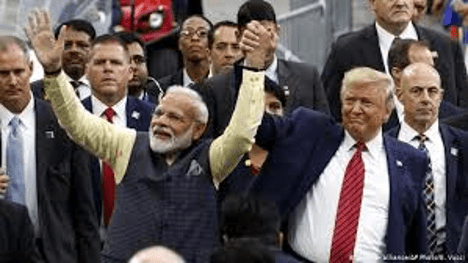
Both leaders are seen as outsiders in the establishment of their capitals – New Delhi and Washington DC. Both are anti traditional approaches to governing. Both are often described as alpha – strong – leaders. From my direct experience in India during the first term of Trump – he knows he has a huge fan club in the Indian PM and among Indian businesses.

 Into India